Handbook · Learning · 14 min read
How to learn: the science of remembering
Last reviewed:
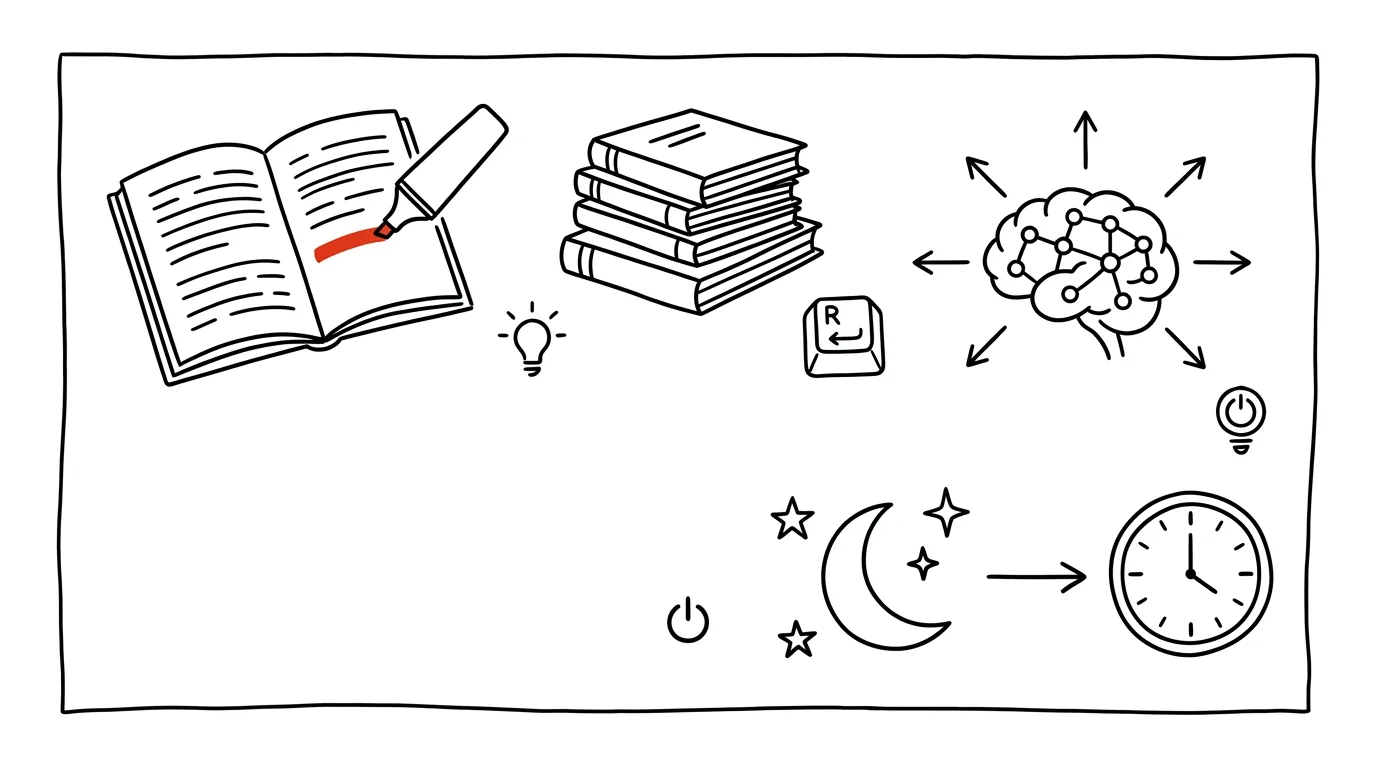
Highlighting and re-reading create the feeling that you know the material. But memory is actually built somewhere else — in retrieval, over time, and during sleep.
In this article
- The illusion of fluency: why highlighting deceives you
- Retrieval: the strongest tool that gets used the least
- Forgetting isn't a bug, it's part of the plan
- Interleaving, and difficulty that helps
- Sleep as the other half of learning
- Testing as learning, not just measurement
- Three myths that cost the most time
- Putting it all together
- Key takeaways
There's a scene almost everyone who has ever studied for an exam knows. You're sitting over your notes, reading the same chapter for the third time, the text feels familiar, the sentences slide by under your eyes, and you get a pleasant feeling that you already know this. Three days later, at the exam, they ask you about the first term in that chapter — and your head goes blank. It isn't bad luck, and it isn't nerves. It's that the whole time, you were measuring something different from what the exam was actually asking for.
Learning has an uncomfortable property: the feeling that we know something and the fact that we know it are far less connected than we'd expect. Most techniques that feel pleasant and smooth lead to fast forgetting. And most techniques that actually work feel clumsy, slow, and frustrating while you're using them. That gap is the core of this whole chapter.
Memory isn't built at the moment you take information in — it's built at the moment you pull it back out of your head. Reading, listening, and highlighting are input. Retrieval, explaining, and testing are what actually build memory. If you take away a single sentence from this whole chapter, make it this one — because practically everything else follows from it.
The illusion of fluency: why highlighting deceives you
Cognitive psychology has a name for that pleasant feeling on your third read-through: the illusion of fluency. When a text is familiar, it reads fast and smoothly, and the brain interprets that ease as proof of knowledge. But reading fluency only measures how well you recognize the text — not whether you can retrieve it when it isn't in front of you.
The difference between recognition and recall is fundamental. Recognizing the right answer among four options is a different task from producing it out of an empty head. Most exams, work situations, and everyday life demand the second one. When you study with a method that only trains recognition, you're preparing for a different event than the one you'll actually walk into.
Highlighting and underlining have a similar problem. Research on the effectiveness of study techniques repeatedly ranks highlighting among the methods with very low payoff — and the reason is understandable. Highlighting is a decision about importance, not processing of content. It takes a second, requires no understanding, and leaves a colored trace in the text that we then mistake for the work we did. Worse still, a highlighted line pulls attention toward an isolated sentence and away from the context it only actually makes sense in.
That doesn't mean you shouldn't read the text. It means reading is the start, not the end. Anyone who stops at reading and highlighting has bought the groceries and is calling it a cooked dinner. The practical test is simple: after finishing a chapter, close the book and try to summarize, out loud or in writing, what it was about. Whatever comes out is your actual knowledge. The rest is illusion.
Retrieval: the strongest tool that gets used the least
Active retrieval means trying to pull information out of memory with no prompt — closing the material and answering a question, retelling a chapter from memory, sketching a diagram out of your head. Of all the study techniques the psychology of learning has systematically studied, retrieval has long ranked among those with the strongest and most reliable effect. It works across ages, subjects, and types of material.
The mechanism is instructive. When you successfully pull up a memory, you don't just confirm it's there — the act of retrieving it strengthens it. The memory trace changes with the act of recall, and the path to it gets reinforced. That's why retrieval is learning, not merely checking. And that's why the order most people study in — learn everything first, test yourself afterward — is exactly backwards from how it should go. Testing belongs in the middle of preparation, not at its end.
Interestingly, even a failed attempt helps. When you can't recall the answer but genuinely try, and only then look at the correct solution, you remember it better than if you'd just read it straight away. A failed attempt at retrieval still prepares the ground — the brain marks out the slot the information belongs in. That leads to a piece of practical advice that runs against instinct: don't look at the material too soon. Sit in the discomfort a few seconds longer.
In practice, retrieval takes many forms, and it doesn't have to be flashcards. Closing the book after a chapter and writing down what you remember. Explaining the material to a classmate, or to an empty chair. Drawing a diagram from memory and only then comparing it to the original. Answering the questions you jotted in the margin while reading. All these variants share one thing: at the moment you answer, the solution isn't in front of you. The tip Close the notebook and retrieve walks through the practical steps.
One trap lies in wait for anyone who discovers AI as a study partner. Having material explained to you is comfortable, and the explanation tends to be excellent — but listening to a clear explanation is still input, not retrieval. The illusion of fluency forms even more easily here than with reading, because a good explanation smooths away every single snag. Use AI mainly to have it question you; the tip Explain it to me like... shows how.
Forgetting isn't a bug, it's part of the plan
Late in the nineteenth century, the German psychologist Hermann Ebbinghaus measured on himself how fast learned syllables faded away. The result is the forgetting curve: a steep drop shortly after learning, which gradually levels off. Later research refined the details, and the exact shape depends on the type of material and how well it was learned, but the basic shape holds. Most of what you learn today and never return to, you won't know a week from now.
The answer isn't to study longer. The answer is to return to the material after a gap. Spaced repetition — the spacing effect, in the research literature — is one of the best-documented phenomena in the psychology of learning: the same amount of time split across several sessions on different days produces significantly more retained material than the same time dumped in all at once. Five hours across five days beats five hours in one evening, and not by a little.
Why it works can be explained from the previous section. When you return to material after a gap, you've forgotten part of it — so retrieval is harder. It's exactly that harder act of retrieval that strengthens the memory trace the most. When you read the same page a fifth time in one evening, it's just as easy every time, because it's sitting in your short-term memory. Nothing is happening. The gap is a way of manufacturing difficulty.
That leads to a practical timing rule. The ideal moment to review is when you can still recall the material, but it takes real effort. The exact interval isn't set by counting, but by feel and feedback: whatever comes easily, push further out; whatever slips, bring closer. Spaced-repetition apps do exactly this logic for you — the tip Flashcards and repetition: Anki plus AI, fully used shows how to work with them. Without an app, a calendar is enough — see the tip Study five times, an hour at a time.
The most important consequence is organizational, not technical: spaced repetition can't be improvised at the last minute. It requires starting on the material earlier than strictly necessary. Anyone who opens their notes three days before the exam has no way left to use spacing, even if they know everything about it. In that sense, the single strongest study technique is planning.
Interleaving, and difficulty that helps
Why mix things up when studying in blocks feels clearer
Instinct says to master one thing properly, then move on to the next. Get through the whole chapter on quadratic equations, work through twenty problems of the same type, then move on. It's clear, you can feel progress, and the problems come faster toward the end of the block.
Interleaving does the exact opposite: it mixes problem types and topics together. Instead of twenty quadratic equations in a row, you solve a quadratic, then a logarithmic problem, then a word problem, then a quadratic again. Research on math problems, as well as on pattern recognition — identifying painting styles, or clinical symptoms — repeatedly shows that interleaved practice produces worse performance during practice and better performance on a later test.
The explanation is instructive. When you solve twenty identical problems in a row, from the second one on you don't need to think about what type it is — you know from context. So you're only training the procedure, not the decision of which procedure to use. But on an exam, or in practice, nobody announces that this particular problem is quadratic. Interleaving trains exactly the recognition that block practice skips, and it also forces memory to pull the procedure back out fresh each time, instead of letting it sit on the surface.
The cost is how it feels. Interleaved practice goes more slowly, you make more mistakes during it, and it feels like it isn't working. That feeling is the most common reason people abandon interleaving — not because it doesn't work, but because it doesn't feel good while they're doing it. Students who've tried both methods usually rate block practice as better themselves, even though they score higher on the test after interleaving.
Desirable difficulties: when learning should push back
The psychologists Robert and Elizabeth Bjork coined the term “desirable difficulties” for this group of phenomena. They're obstacles that worsen performance and how it feels during learning, but improve long-term retention and transfer. Retrieval, spacing, and interleaving all belong in this category. So does rephrasing material in your own words, generating an answer before you see one, or changing the environment you study in.
But the word “desirable” matters. Not every difficulty helps. When material is too hard, prior knowledge is missing, or the task is confusingly worded, the difficulty just burns capacity and adds nothing. The difference is whether the demand requires more processing of the content, or just more of a struggle with its form. Blurry handwriting, a chaotic presentation, and an unclear teacher are undesirable difficulties. A question with no hint is a desirable one.
That gives a practical self-assessment rule: if your studying feels completely smooth, you're probably not learning much. And conversely, if you keep discovering what you don't know, you're probably doing it right. Discomfort isn't proof of quality by itself, but fluency is a fairly reliable warning sign. The chapter The science of productivity goes into how the brain processes load and how that changes over time.
Sleep as the other half of learning
Learning doesn't end the moment you close the book. During sleep, especially in deep sleep and REM, consolidation takes place — fresh memory traces get replayed, shifted, and woven into existing networks. Research on sleep and memory confirms this process from many angles, and the consensus is strong enough that sleep should count as part of your study plan, not its competitor.
The most practical consequence: an all-nighter before an exam is a bad trade. You're swapping hours in which your brain would be storing the material for hours in which you're taking it in exhausted. On top of that, you damage your attention and your ability to recall the next day — exactly what you need for the exam. Faced with a choice between two extra hours of studying and two extra hours of sleep, sleep usually wins — especially if you've studied honestly beforehand.
Consolidation also suggests a timing recommendation. Material covered in the evening, right before sleep, has the advantage that there's no whole day full of other information sitting between learning and sleep. A brief review before falling asleep — a few minutes of retrieval, not an hour of new reading — is a cheap, effective investment. And right after waking up, it's worth trying to recall what you studied the day before; you'll find out what consolidation handled and what it didn't.
Alongside sleep, overall physical condition also plays a role, covered in more detail in the chapter The body and productivity. For learning specifically, two things are worth mentioning: exercise before and after studying improves cognitive performance, and neither hunger nor dehydration gets along with concentration. These aren't extra tricks — they're conditions without which every other technique operates at half strength.
Testing as learning, not just measurement
In both school and workplace practice, a test is treated as a measuring stick. Something gets learned, and then you measure how much of it stuck. But research on the so-called testing effect shows that a test is also one of the strongest learning interventions there is — the act of being tested itself changes what you remember, not just what it reveals about what you remember. A group that studied material and was then repeatedly tested on it remembers it noticeably better weeks later than a group that spent the same time re-reading instead of being tested.
This finding has surprisingly wide-reaching implications. It means practice tests aren't preparation for learning — they're learning itself. That a quiz doesn't have to be a punishment, it can be a tool. And that the best way to get something out of a lecture or a training session is to generate questions from it and answer them after a gap — not replay it again.
For a test to teach, it needs to meet a few conditions. First, feedback has to follow: without information about what was wrong, an error can lock in place. Second, it should require recall, not recognition — an open-ended question teaches more than a choice among four options. And third, the risk of failure has to be low. A test that decides a grade triggers stress, and stress makes retrieval worse. That's why the most useful tests are the ones you set for yourself, or ones with no stakes attached.
- 1EncounterA lecture, a chapter, a video. Input, not learning — the goal is understanding, not memorizing.
- 2QuestionsRight after the encounter, generate questions from the material. What could you be asked? What's the core here?
- 3RetrievalWith the material closed, answer them. Hold out a few seconds even when you don't know.
- 4CheckOnly now look. Mark what slipped, and fill in what was missing.
- 5GapLet it sit a day, three days, a week. Forgetting is part of the process, not a failure.
- 6ReturnCome back and retrieve again. What comes easily, push further out. What slipped, pull closer.
Three myths that cost the most time
Learning styles. The idea that everyone has their own channel — visual, auditory, kinesthetic — and learns best when instruction is matched to that channel is widespread among both teachers and students. But review studies repeatedly fail to find support for the key part of the claim: that matching the format to a declared style improves outcomes. People genuinely differ in preference — preference just doesn't produce better learning.
What works instead is choosing the format based on the nature of the material. Learn a map visually, pronunciation by listening, a lab procedure by hand. And combining channels usually helps everyone, not just the people who picked that particular channel. The harm caused by the myth isn't that drawing diagrams is bad for you — it's that people needlessly give up on methods they've labeled “not mine.”
Multitasking while studying. Studying with a show playing, hopping over to chat, or with your phone face up next to you isn't accompanied learning — it's interrupted learning. Attention doesn't split between tasks, it switches — and every switch costs time and a piece of context. The result is longer studying with a worse outcome. The impact is biggest with more complex material that requires holding several things in your head at once.
Music is a specific case where it matters whether it competes for the same channel. Instrumental music without strong dynamics usually interferes little; music with lyrics, while reading or writing, often does. Anyone unsure should try both and compare not the feeling, but the actual recall result the next day.
Blind faith in hours logged. The last myth is the quietest: the belief that what decides the outcome is time spent over a book. Hours in the chair are easy to count, so they get counted. But an hour of passive reading and an hour of spaced retrieval aren't the same quantity. If you keep a study log, write down what you did and what came out of it — not how many minutes you sat there. The chapter Studying productively offers a practical framework for planning your studying.
Putting it all together
Every principle in this chapter can be summed up in a single stance: treat your memory as something you test, not something you fill. In practice, that means flipping the time ratio. Most people spend the overwhelming majority of their study time on intake and only a fraction on checking. Try flipping that — go through the material properly once, and spend the rest of the time retrieving, solving, and explaining.
The second change is about the calendar. Spread your preparation across more days, even if each one gets less time than before. It isn't only about spaced repetition — shorter sessions sustain full attention better and leave room for sleep to do its part of the work.
The third change concerns how you judge your own progress. Stop asking whether the material feels familiar, and start asking what you can actually pull out of it with the notebook closed. It's a more uncomfortable measure, because it shows the gaps. But that's exactly why it's useful: a gap you know about three days in advance is a to-do item. A gap you discover during the exam is a problem.
The next chapter in this series covers what gets produced along the way while you learn — notes. You'll see the same principle at work: a note has no value at the moment you write it, only at the moment it gives something back.
Key takeaways
- Fluency deceives you. Familiar text reads easily, and we mistake that ease for knowledge. Recognizing isn't the same as recalling — and it's recall that gets tested.
- Retrieval is the strongest technique you have. Closing the material and answering from memory doesn't just check your memory — it strengthens it. Even a failed attempt helps.
- Forgetting belongs in the plan. Spreading the same time across more days beats cramming it into one sitting. The best time to review is when recalling the material takes real effort.
- What feels worse often works better. Interleaving problem types and desirable difficulties make studying feel worse and the outcome better. Smooth studying is a warning sign.
- Sleep is part of learning, not its competitor. Consolidation happens at night; hours stolen from sleep get subtracted from what you retain.
- A test isn't a measuring stick, it's a tool. Practice testing with feedback and no stakes teaches more than reading the same material again.
- Learning styles and multitasking are dead ends. Choose the format based on the nature of the material, not a declared preference — and do one thing at a time while you study.
Want to keep the momentum?
One tip from the handbook by email each week — in an order that makes sense.
The Top 30 tips e-book, free — it lands in your inbox right away.
Then 1 tip a week · no spam · unsubscribe in one click
Prefer a system to single tips? The free email course — seven days, seven emails, one skill a day.