Handbook · Learning · 12 min read
Notes that actually do something
Last reviewed:
A note doesn't pay off the moment you write it — it pays off the moment it gives something back. Three reasons to write things down, a two-phase model, and the line where a note no longer belongs.
In this article
- Three reasons to write things down, and why each leads somewhere different
- Capturing and processing are two different jobs
- Cornell and other structures: a tool, not a dogma
- Your own words mean it's processed
- Linking: when it helps, and when it's just play
- Review and cleanup: an archive that doesn't grow forever
- Where notes end and a task list begins
- Key takeaways
Try opening notes from a lecture, seminar, or meeting that are six months old. Most people find one of two things. Either a dense, precise transcript where you can't find anything, and while reading you can't figure out why you emphasized that particular sentence back then. Or a handful of isolated keywords that made sense at the time, because you were there — and today they look like a foreign language.
Both are the same mistake, seen from two sides. The notes were written with the moment of writing in mind, not the moment you'll actually need them. And because writing happens with a head full of context, while reading happens with an empty one, your estimate of what will be enough is systematically too optimistic.
A note has no value at the moment you write it — only at the moment it gives something back. That gives you the one usable measure of quality: not how tidy it looks, not how much material it covers, but whether it gets you back, after time has passed, to what you understood at the time. This chapter is about how to write notes that pass that test.
The chapters Capturing information and Your second brain cover the capture system and where all your inputs flow into. This chapter is about something different and narrower: the quality of an individual note, and how to turn it into a learning tool. The previous chapter in this series, How to learn, showed that memory is built by retrieval. A note is the material retrieval gets made out of — or doesn't.
Three reasons to write things down, and why each leads somewhere different
Most arguments about how to take notes happen because three different jobs get debated as if they were one. Before you settle on a format, ask which one you're actually dealing with.
Not forgetting. A deadline, a number, a name, an agreement gets mentioned. The goal is preserving a specific piece of data exactly, because you won't be able to reconstruct it. Here, fidelity matters more than understanding, and the best note is the shortest complete one: what, who, by when. Processing adds nothing — if anything, rephrasing it in your own words can blur the data.
Understanding. You're hearing an explanation that's new and complex. The goal isn't a transcript, it's processing — you're building a model in your head, and the note is its trace. Here, your own words, questions, sketches, and simplifications are exactly what should get produced, even at the cost of losing half the detail. Details can be looked up later; lost understanding can't.
Having on hand. A procedure you'll use repeatedly, a contact, a template, phrasing that worked. The goal is findability and usability a month from now, with no need to think about it. Here, what matters is the title, the location, and whether the note is written for a person who remembers nothing — because that person is you, a year from now.
When these three jobs get mixed into one entry, the result serves none of them. A deadline gets lost among reflections, understanding drowns in a list of facts, and none of it can be found later. The cheapest improvement you can make right now is to let these three things flow into different places: data into your calendar and task list, understanding into your study notes, reusable things into an archive.
The distinction also affects how much you should write down in the first place. For the first job, whatever you don't write down, you lose — so it pays to be thorough. For the second, it's the opposite — the more you write, the less you understand, because writing competes for the same attention as understanding does. And for the third, selection is what decides: an archive that everything falls into becomes unusable faster than you'd think. One and the same piece of advice can't apply to all three situations, which is why most generic advice about note-taking is half wrong.
Capturing and processing are two different jobs
The most common reason notes fail is trying to do both phases at once. During a lecture or a meeting, you have limited capacity: you have to listen, understand, judge importance, and write, and writing takes attention away from all the rest. Trying for a perfect real-time transcript ends up with you transcribing and not understanding — your hand keeps moving, your head has checked out.
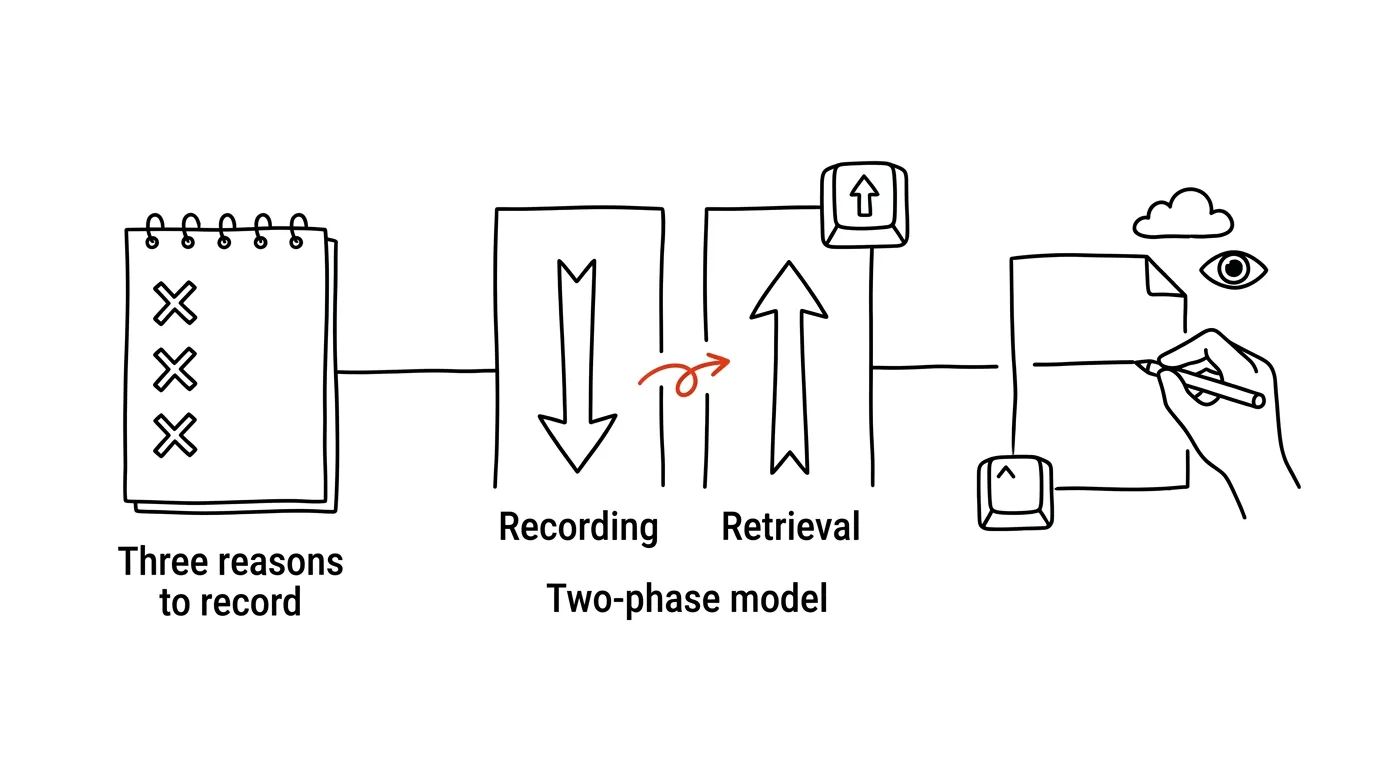
The two-phase model splits that conflict apart. In the first phase, you capture raw material: keywords, key terms, numbers, questions that occurred to you, and notes like “I don't understand this.” You don't try for form, completeness, or polish. In the second phase, with some distance and no time pressure, you process the material — rephrase it, fill it in, cut it down, add questions, and connect it to what you already know.
- 1Phase 1: captureDuring the talk. Keywords, terms, numbers, your own questions. No polish, no complete sentences. Attention belongs to listening.
- 2Flag the holesA question mark wherever something slipped past you. It's the most valuable mark in the whole entry — it shows where to come back to.
- 3Phase 2: processWithin twenty-four hours, ideally the same day. Rephrase in your own words, cut it down, fill in what's missing.
- 4Generate questionsOne to three questions per section that the note answers. This is what turns a note into study material.
- 5File itA title that makes sense a year from now. A place where you actually look for it. Links only where they truly connect.
The second phase tends to be faster than people expect — twenty minutes for a one-hour lecture is usually enough. And it has a side effect that pays for itself: processing brings you back to the material after a gap, which is exactly the spaced repetition from the previous chapter. Processing your notes isn't extra admin — it's the first review, in disguise.
There's an optimal gap. Right after the talk, your context is still fresh, and you'll fill in what's missing — but you won't find out what you forgot. With a gap of a day or two, processing is harder and therefore more effective, but you risk not being able to decode your own keywords anymore. A practical compromise: a short review the same day, and a longer processing session a few days later. Anyone who wants to speed up the second phase can find concrete steps in the tip Notes that study for you — with one important condition we'll get to below.
Cornell and other structures: a tool, not a dogma
The Cornell method splits the page into three fields: a wide column for notes, a narrow left column for keywords and questions, and a strip at the bottom for a summary. The trick isn't the layout — it's what it forces you to do. The left column is where you formulate questions, and those can be used for retrieval, because covering the right-hand side turns the note into a test. The bottom strip forces you to say what the whole thing was about, which is the fastest way to discover you don't actually know.
That's exactly why Cornell works: it has both phases and question generation built in. Anyone who divides the page and never writes anything in the left column has just gained narrower lines. The structure itself does nothing — it's the work it leads you to that does.
The same applies to other formats. Mind maps are great for material that's genuinely tree- or network-shaped, and clumsy for sequential procedures. Numbered outlines suit processes and hierarchies, and fall apart on topics where everything relates to everything else. Tables and comparison matrices are underrated for material where a handful of parameters repeat across many cases — history, classification, material properties. Sketches and diagrams win wherever spatial relationships or flow are involved.
One format worth mentioning rarely shows up in study guides, even though it's the most useful in practice: a note written as the answer to a question. Instead of the heading “Thermodynamics,” you write “Why does a gas cool when it expands” and the answer in your own words underneath. That shortens the entry, because the question defines what's relevant — and above all, it's already in a shape you can use for retrieval. Anyone who keeps notes this way for a whole semester ends up with ready-made test material at the end, with no need to build it separately.
It's more useful to have two or three methods and choose based on the nature of the material than to hunt for one correct one. And above all: choose deliberately. If you ask yourself, before you start writing, what shape this material has, you've already started processing it before you've written the first word. That's most of the benefit you can expect from structure.
Your own words mean it's processed
There's a simple test for whether a note was produced by processing or by copying: check whether it contains a sentence that was never actually said. If every phrase in it can be traced back to the source, your hand was working and your head wasn't. Your own words aren't a stylistic preference — they're proof the information passed through understanding.
Research on note-taking runs into this repeatedly, including in comparisons between taking notes on a laptop and on paper. Handwriting is slower, and so it forces you to select and summarize; typing tempts you into verbatim transcription, because you can actually keep up. The device itself isn't what makes the difference — it's whether the text was produced through selection and rephrasing. Someone who types briefly and in their own words has no disadvantage. Someone who copies a slide onto paper gains no advantage.
In practice, processing comes down to a handful of recurring moves. Cutting three sentences down to one. Replacing a technical term with your own explanation and keeping the original name alongside it in parentheses. Adding an example the talk didn't cover. Writing down what it connects to. And writing down what you don't understand — a question mark in a note is more honest and more useful than a seemingly complete entry with a hidden gap in it.
This is also where the line sits for working with AI. Having a lecture summary generated is fast, and the result tends to be better than your keywords — but a summary you didn't produce went through someone else's understanding, not yours. The useful application runs the other way: have AI generate questions from your note, look for what's missing in it, or push back on you as you explain the material. The general rule applies here too, that AI proposes and a human approves; for notes, it comes with an addition — the value is created precisely by that approving. And one more practical point: sensitive meeting minutes or personal data belong only in a paid account with contractual data protection, not in just any chat.
Linking: when it helps, and when it's just play
Tools like Obsidian, Logseq, or Notion let you link notes together and see what links to what. The idea is old and good: knowledge isn't a list, it's a network, and the value often sits in the connections, not the nodes. Anyone can handle the technical side in five minutes, as the tip Obsidian: links turn notes into a network shows.
But linking easily turns into a hobby in its own right. Hundreds of links pile up, the graph looks impressive, and none of it answers a single question. A simple criterion helps tell the difference: a good link forms when writing one note reminds you of another, and the connection explains something. A bad link forms when you systematically connect everything to everything, just because you can.
Linking makes the most sense where the same principles recur in different contexts, where you're building on one theme over the long run, or where you want to find contradictions and tension between sources. On the other hand, for material you only need for an exam, investing in a network of links is usually wasted — that's where questions and repetition pay off, not architecture.
The most practical form of linking is also the least flashy: a note that states, right at the start, what it belongs to and what came before it. One sentence of context replaces ten links. And when you keep your notes in an environment you can later query, the value of that context grows further — the tip A second brain that answers describes how to build and maintain an archive like that.
Review and cleanup: an archive that doesn't grow forever
Notes tend to pile up faster than their usefulness grows. Without regular maintenance you end up with an archive that has everything in it, but a search returns twenty results and you don't know which one is still valid. An out-of-date note is actually worse than none at all — it takes you back to something that's no longer true, and you believe it, because it's your own handwriting.
- DuringRaw capturekeywords, terms, question marks over whatever slipped past
- Same dayProcessingyour own words, filling in gaps, questions for later retrieval
- One weekFirst useyou answer your own questions with the entry covered — this is where the note actually pays off
- One monthReviewwhatever proved useful stays; whatever you never once opened is a candidate for deletion
- After the semesterDistillationtwenty pages shrink into one, with conclusions and a link to the source
A useful cleanup rule: you don't have to delete anything, but it has to be clear what's still current. An archive folder you move retired notes into, so they stop cluttering your search, is enough. And every so often, a distillation — pulling half a page of what you actually use out of long-form notes and letting the rest sit.
Review has a second function that's easy to forget. When you go back through what you wrote a month later, you see not just the material, but your own habits: where you were transcribing, where you never asked a single question, where you wrote down things you already knew at the time. Patterns like these are far easier to fix than it is to find the perfect system.
Where notes end and a task list begins
The last, but most common, source of chaos is mixing two different things: information and commitments. A line in meeting notes reads “send Peter the materials by Friday,” it sits there among the other notes, and on Friday nothing happens. Not because nobody looked at it, but because notes get read at random, while tasks get checked.
The line is simple, and worth following consistently: whatever requires action belongs in a task list; whatever just describes a fact belongs in notes. Meeting notes are a legitimate place for a commitment to be born, but not a place it's allowed to keep living. The last step of processing your notes is always exporting the commitments out — with an owner and a deadline. The chapter Getting Things Done goes into this principle in more detail, where separating material from actions is the foundation of the whole method.
The same holds for study notes, in a different form. The line “I don't understand this, look it up” is a task, not a note. Left inside the entry, it reliably turns into a surprise on exam day. Turned into an item on a list, it has a chance of getting resolved. The best students don't have cleaner notes than everyone else — they just pull their question marks out more consistently.
And one more interface worth mentioning: between notes and your calendar. Details like a submission deadline, an exam date, or the time of an office hours slot are easy to write into notes and hard to find there. If there's a place that will proactively remind you, that's where they belong.
Key takeaways
- A note pays off at the moment of retrieval, not at the moment of writing. The one usable measure of quality is whether it gets you back, after time has passed, to what you understood.
- First, get clear on why you're writing. Not forgetting, understanding, and having on hand are three different jobs — and each wants a different format and a different place.
- Split capturing from processing. Capture raw during the talk, process it with some distance. Processing doubles as your first review.
- Structure is a tool, not a dogma. Cornell works because of the questions and the summary, not because of how it splits the page. Choose the format based on the shape of the material.
- Your own words are proof of processing. If every phrase can be traced back to the source, your hand was working and your head wasn't. A question mark is worth more than apparent completeness.
- Link when the connection explains something. Systematically linking everything to everything is a hobby, not knowledge work.
- An archive needs maintenance and a boundary. An out-of-date note is worse than none, and whatever requires action belongs in a task list — not among your notes.
Want to keep the momentum?
One tip from the handbook by email each week — in an order that makes sense.
The Top 30 tips e-book, free — it lands in your inbox right away.
Then 1 tip a week · no spam · unsubscribe in one click
Prefer a system to single tips? The free email course — seven days, seven emails, one skill a day.