Handbook · At the company · 13 min read
Sync or async? A decision framework for workplace communication
Last reviewed:
When a meeting makes sense, when a document does, when a short message does, and when doing nothing is the right call. Plus the real cost of a meeting, writing as a workplace skill, and the trap of an endless thread that never actually decides anything.
In this article
Thursday morning, an invite shows up on the calendar: "Q3 Alignment," sixty minutes, nine attendees, no agenda. Nobody asks why. Everyone clicks "Accept," because declining an invite from a colleague looks uncooperative. Thursday at eleven, nine people join the call, the first ten minutes are spent waiting for whoever's supposed to share their screen, the next twenty recap what most attendees already read in an email, and in the last five minutes someone says, "Okay, let's pick this up again next week."
That meeting just spent nine person-hours. That's more than one person's full workday. But the real cost is higher — it split nine people's days in half, into two chunks where nothing demanding can get done. And the whole thing was decidable with one document containing a clear question and three options.
In the previous chapter of this series, we established that a team isn't the sum of its individuals. This one is about what either multiplies that sum or crushes it: choosing a communication channel isn't a matter of convenience or habit, but a managerial decision about how a company spends its most expensive resource — people's focused attention. Companies that make this decision consciously have roughly a third emptier calendars without slowing anything down. Companies that don't make it at all drown in meetings while complaining that nothing ever gets decided.
Four channels, not two
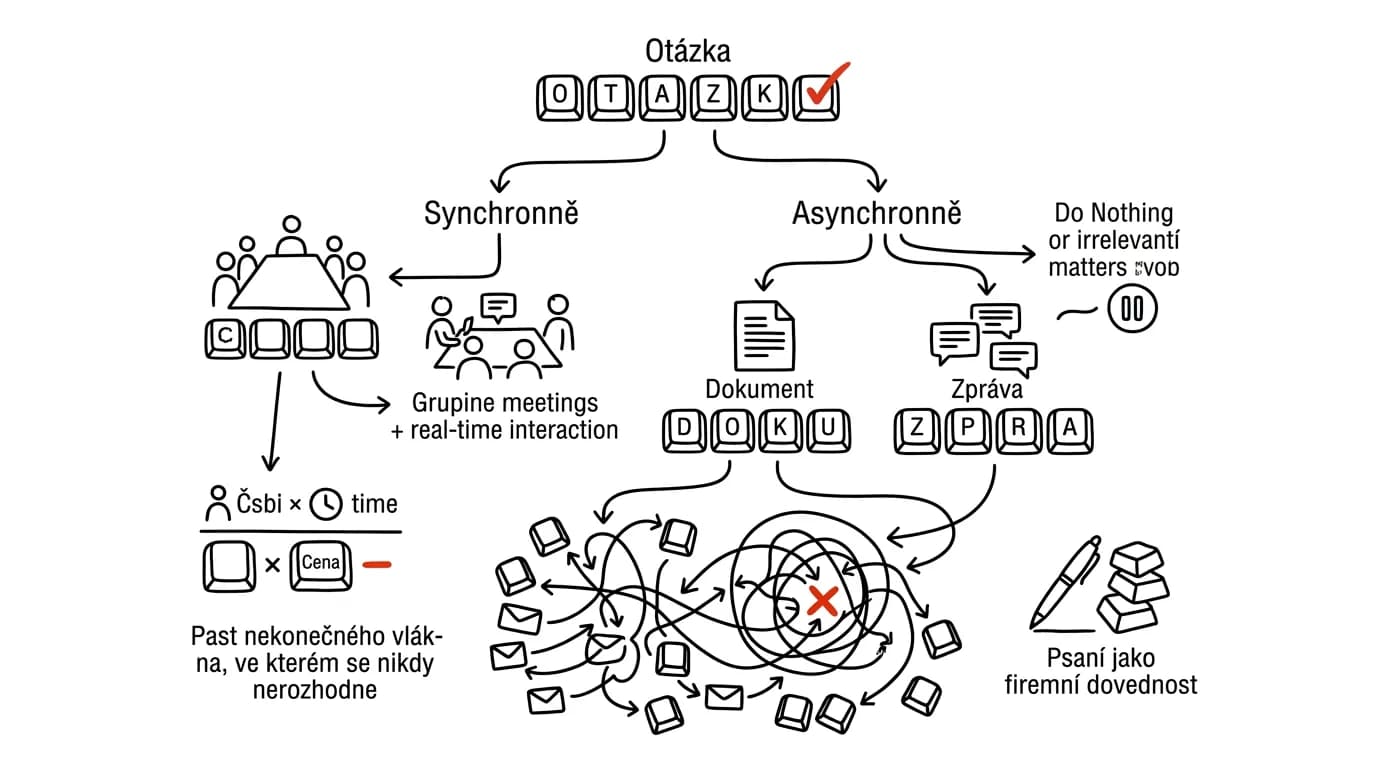
Splitting things into synchronous and asynchronous communication is useful, but too crude. In practice, a manager and a rank-and-file employee alike have four options to choose from, and the difference between them matters a great deal.
A meeting is the most expensive tool and the fastest one at once. You pay for it with everyone's attention at the same time, but you get something you can't get otherwise: a real-time reaction, tone of voice, the chance to ask a follow-up on the spot, and a shared decision everyone was present for.
A document is slower, but deeper. It's created once and read repeatedly. It forces the author to think a thought through to the end, and gives readers time for a considered reply — exactly what a call doesn't allow. A document also stays. A meeting evaporates the moment it ends.
A message — chat, a short email — is a coordination tool, not a content tool. It works for things like "here's the link," "I'm on my way," "can you approve this." The moment a message runs past five sentences or contains three questions at once, it's a badly written document.
And then there's a fourth option, the one companies forget most often: nothing. A significant share of workplace communication addresses information nobody actually needs in order to work. Statuses nobody reads. Alignment that's really a check-up. A CC to five people "just in case." Choosing not to communicate is a legitimate option, and in overloaded companies often the most useful one.
Kvadrant „Důležité, neurgentní“ je místo, kde vzniká skutečný pokrok — plánujte si pro něj čas dřív, než ho urgence sežerou.
The point isn't to stop talking at work. It's to talk where talking has irreplaceable value — and to keep everything else from crowding out room for exactly those conversations.
When a meeting has irreplaceable value
There are four situations where trying to replace a meeting with a document is a false economy. It looks like efficiency, but really it just postpones the problem.
A decision with an unclear brief. When you yourself don't know what question you're actually solving, it can't be written down. The written form requires the author to already understand the structure of the problem. If three people show up with three different ideas of what the task even is, that shared understanding has to be negotiated out loud first. The difference from an ordinary meeting is that this one takes twenty minutes, has three attendees, and its output isn't a decision, but a brief — which then gets resolved in writing.
Conflict. Two people who don't understand each other will understand each other even less in writing. Text has no tone, no pause, no way to immediately say "wait, that's not what I meant." A thread where tension is escalating is the surest route from a work disagreement to a personal dispute. A simple rule applies: the moment you feel irritation in a thread, stop typing and set up fifteen minutes on a call.
A sensitive topic. Feedback, a role change, poor results, layoffs, anything that touches a person personally. Here, synchronous form isn't about efficiency, it's about decency. A chat message carrying information that changes someone's working life is an organizational failure regardless of how well it's written. The chapter on leading people covers this in more depth, but the principle is simple: the more personal the impact, the more personal the channel.
Creative work. Brainstorming, concept exploration, working with possibilities. Ideas bounce off each other in people's heads, and the speed of that exchange has its own value. Asynchronous brainstorming exists and works, but more as preparation — everyone writes down their own ideas beforehand, so the shared conversation doesn't just chase whatever gets said out loud first.
In every other case, a test applies that's worth more than any methodology: try writing it first. If writing it reveals the thing is clear, you just saved a meeting. If three open questions come up, you have a ready-made agenda and the meeting will be half as long. Either way, you win.
What a meeting actually costs
The cost of a meeting is almost never calculated in companies, because it never shows up on an invoice. Yet it's the simplest calculation in workplace economics: length times number of attendees. A one-hour meeting with eight people costs eight person-hours — and if it repeats weekly, that's roughly two work-months a year. In those two months, you could get a real chunk of a project done.
That calculation, though, is only the smaller part of the bill. The bigger one is called calendar fragmentation. Demanding work needs unbroken blocks. An hour split into three twenty-minute pieces doesn't have a third of the value of three twenty-minute pieces — it has a value close to zero, because you never manage to get into focus. And here's the treacherous part: one meeting in the middle of the morning doesn't cost an hour, it costs the whole morning. The remaining two hours dissolve into "I'm not really starting yet, I have a call soon" and "I'm still recovering from that."
A model example: someone working nine to five with an hour for lunch has seven hours. Zero meetings means two to three unbroken blocks where real work can happen. One meeting at eleven and one at three means four chunks of an hour and a half each, none of which is enough for a complex task. It's not about the number of hours in meetings, but about how they're distributed.
That leads to a practical consequence that costs nothing and changes the most: cluster your meetings. Meeting-free mornings for the whole team, meetings in the afternoon. Or two "meeting days" a week and three protected ones. Same number of meetings, dramatically different outcome. The same goal is served by scheduling meetings for 25 or 50 minutes instead of 30 or 60 — a breath of space forms between calls and people stop showing up five minutes late everywhere.
Meetings can also be tackled systematically with AI: the meeting that won't eat your day walks through the whole chain, from auditing recurring meetings in your calendar through building an agenda around decisions to checking commitments before the next meeting. The strongest point in the whole system is the simplest one: no agenda, no meeting.
Writing as a workplace skill
In companies that operate asynchronously, writing is as much a professional skill as working with a spreadsheet. Not beautiful writing — writing that, once read, tells a person exactly what to do. The difference between a company where documents get read and one where documents get ignored isn't the tool. It's whether people know how to write a text that has a head, a tail, and an obvious purpose.
A document meant to replace a meeting needs six things. A question or a decision right in the first paragraph, not buried at the end. Context at a level sufficient for someone who doesn't already see into the topic. Options, including the one you're not recommending, with the reason why. The author's recommendation — a document with no opinion is just a pile of information, and nobody decides anything from it. A concrete ask of the reader: what you need from whom, whether it's agreement, comments, or just acknowledgment. And a deadline for when a response is expected, with a note on what happens if none comes. The single most useful sentence in all of workplace communication is: "If nobody objects by Friday, we're going with option B."
Writing has one more effect that's hard to explain until you've experienced it: it's a tool for thinking, not just a record of it. When you can't put a thought into writing, that usually doesn't mean you can't write. It means you haven't actually thought it through. An hour spent writing a proposal often reveals that a decision rests on an assumption nobody ever checked. That assumption would have slipped by in a meeting, because nobody stops to dwell on a subordinate clause in conversation.
The first draft of a document, incidentally, is exactly what AI is good at helping with today. A dictated stream of thoughts can be shaped into structure, a long email thread into a summary, notes into a proposal. But the rule that runs through this whole site still applies: AI proposes, the human approves. Responsibility for a document's content always belongs to its human owner — the person whose name is at the top.
Status updates are their own chapter. A status meeting is the most common type of meeting with no reason to exist: information flows in one direction, nobody decides anything, and eight people listen to seven reports that don't concern them. A written status instead of a status meeting is about the simplest asynchronous change there is — three questions, a form, Friday. The freed-up hour can go to what a meeting is good for and text isn't.
Response speed is a cultural setting, not a personal trait
The most common reason asynchronous communication "doesn't work" in a company isn't the tool or laziness. It's the unspoken expectation that a reply should arrive immediately. When people don't know how long a reply can take, they behave rationally: they watch chat constantly so they're not the slow one. That turns an asynchronous tool into a synchronous trap that shatters the day even more reliably than meetings do.
The fix is boring and effective: write down what response time applies to which channel, and have leadership be the first to honor it. As long as the boss replies to chat within two minutes, no policy will help.
The numbers aren't sacred — every company sets them to fit its own operations. What's sacred is that they exist and that people know them. When it's clear chat can wait until the afternoon, closing it for three hours is legitimate. Without that rule, a closed chat is a transgression.
The same equation has a flip side: whoever is available has a right to be unavailable too. Fixed windows work well as a solution — blocks in the calendar for communication and blocks for focused work, visible to the whole team. The managerial version is called office hours: a fixed time each week when a person can be reached without booking ahead, and the rest of the week is protected. The principle is the same in both cases: availability is a service the company offers at a predictable time, not a permanent state of readiness.
Time zones and flexible schedules
Once a team has someone in a different time zone, working part time, or with kids to pick up from daycare, asynchronous mode stops being a choice and becomes an operational necessity. It's not a complication — it's a quality test that always reveals whether a company really knows what it's doing.
Three things work. A defined overlap window: two to three hours a day when everyone's available. Calls get scheduled inside this window, everything else runs outside it. Rotating the inconvenience: when a recurring meeting falls at a time that wrecks someone's evening, that gets rotated, so it's not always the same person paying for it. And recording plus minutes as the standard: whoever couldn't be at the meeting shouldn't be left out of what happened because of it. Automatic transcripts and structured meeting minutes with action items take just a few minutes today and are the cheapest way to make attending a meeting optional instead of mandatory.
The key principle is: in a distributed team, asynchronous is the default and synchronous is the exception that needs justifying. The exact opposite of the office, where the default is that you can just walk over to someone.
That doesn't mean giving up on relationships, though. Teams that never see each other fall apart into parallel-working individuals. Social contact just needs its own protected space — a regular in-person get-together, a virtual coffee with no agenda, 1:1 with a living document. The mistake isn't people meeting. The mistake is when they meet for information they could have just read.
The asynchronous trap: a thread that never actually decides anything
Asynchronous mode has its own pathology, and it's just as expensive as an overstuffed calendar. It looks like this: a document has forty comments, a thread has twenty messages, everyone's said their piece, nobody's said "here's what we'll do." A week later the topic fades, and a month later it reopens from scratch. The company feels like it's communicating intensely, and meanwhile nothing gets decided.
The symptoms are easy to spot. A thread with no owner. A discussion with no deadline. A question five people answer and none of them has the authority to decide. A document rewritten twice, with nobody sure which version is current. And the most common variant: a decision got made, but it's nowhere written down, so three weeks later nobody knows whether it still stands.
Four rules that cost nothing help against this:
- Every thread and every document has an owner. One person who carries the topic through to a decision — not a group, not a role, a specific name.
- Every open question has a deadline. "Comments by Thursday noon, then I decide." Without a deadline, a discussion never closes, it just tires people out.
- The two-round rule. If something doesn't get resolved in two rounds of written exchange, it's not a topic for writing. Set up a twenty-minute call and write the result back into the thread.
- A decision gets recorded separately from the discussion. At the top of the document, in a separate log, in one well-known place. Discussion is material, a decision is the product.
That last rule also bridges to the next chapter of this series, on company knowledge. A decision that's nowhere recorded behaves exactly like a decision that never got made — and six months from now the company will make it again, usually differently. Anyone who wants to see the difference between a record that's useful and one nobody ever opens will find it in the complete guide to introducing AI at a company, where the meeting-and-decision system is described start to finish.
The rest of the team-collaboration principles — tools, retrospectives, workflow — stay in the chapter on team productivity. The written side of things has its own chapter in professional email communication; most of the advice on email structure applies to an internal document too.
Key takeaways
- Don't choose between "synchronous and asynchronous," choose between four options: a meeting, a document, a message, nothing. The most overlooked and often most useful one is "nothing."
- A meeting has irreplaceable value in four situations: an unclear brief, conflict, a sensitive topic, creative work. In every other case, try writing it first — either way you come out ahead, with either a saved meeting or a ready-made agenda.
- A meeting's cost isn't just length times number of people. The bigger part of the bill is calendar fragmentation — so cluster your meetings and protect unbroken blocks.
- A document that replaces a meeting has a question in the first paragraph, options, the author's recommendation, a concrete ask of the reader, and a deadline. Writing isn't recording a thought, it's a tool for thinking it through.
- Response time is a cultural setting, not a personal trait. Write down what's expected on which channel — and have leadership be the first to honor it.
- Asynchronous mode has its own trap: a thread with no owner, no deadline, and no recorded decision. An owner, a deadline, the two-round rule, and recording decisions separately from discussion close it off.
Want to keep the momentum?
One tip from the handbook by email each week — in an order that makes sense.
The Top 30 tips e-book, free — it lands in your inbox right away.
Then 1 tip a week · no spam · unsubscribe in one click
Prefer a system to single tips? The free email course — seven days, seven emails, one skill a day.