Handbook · Methods · 13 min read
Creative techniques: mind mapping, Bullet Journal, sketchnoting and Zettelkasten
Last reviewed:
Four techniques that work the way the brain actually works — associatively and visually. No talent required.
In this article
In an era of endless information and unrelenting digital noise, the art of thinking well is becoming a critical skill. Creative techniques aren't the preserve of artists or geniuses — they're practical tools for anyone who wants to understand themselves, their own thinking, and the world around them a little better.
Our brains are extraordinarily complex systems that process thousands of inputs a day. The problem is that the modern world floods us faster than we're evolutionarily equipped to handle. We lose the ability to really think, create and connect ideas. That's exactly why creative techniques are more than a method — they're lifelines in a sea of information.
Say “creative technique” and most people picture an artist at an easel. The truth is more interesting: these are sophisticated methods of processing information that work precisely the way the brain does — associatively, non-linearly, and with unexpected connections.
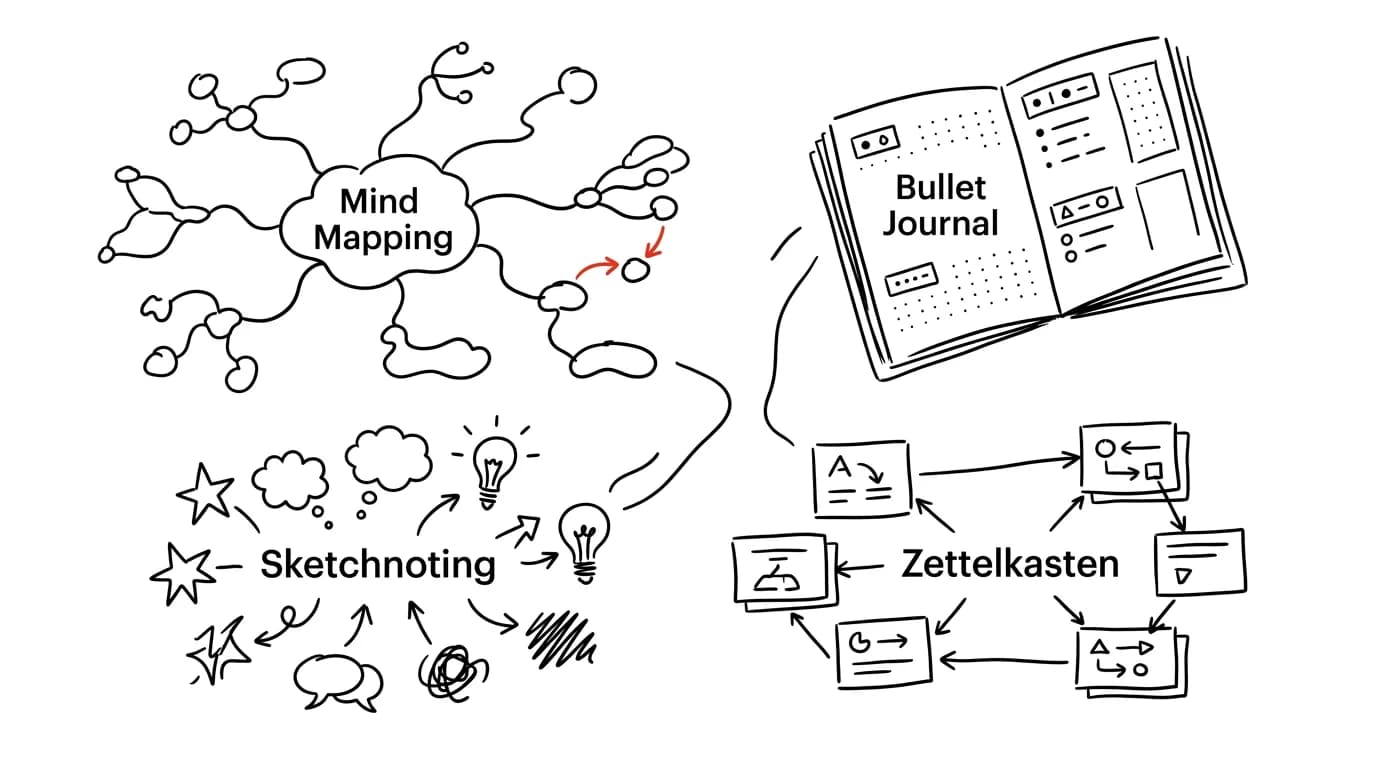
- 1Mind mappingProjects and decisions — you see the whole and the connections.
- 2Bullet JournalTasks, deadlines and life in one place.
- 3SketchnotingNotes from meetings and talks that you actually remember.
- 4ZettelkastenBuilding connected knowledge over the long term.
What problems these techniques solve
They aren't abstract exercises. They target three situations everyone knows:
- Information overload. “I have so many ideas but no way to sort them.” “By the end of a meeting I remember half of what was said.” “My notes are in ten different places.”
- Procrastination on big projects. “I don't know where to start.” “The project is so complex it paralyzes me.” “I can't get my thoughts in order.”
- Forgetting important things. “I always remember late in the evening.” “I have a great idea and lose it within the hour.” “I can't keep track of my tasks.”
The psychological benefits matter just as much as the content itself. Systematizing your thinking lowers stress, reduces the feeling of being swamped, and increases your ability to focus on what matters. Once you know you have a reliable system for catching and organizing ideas, your mind is freed up for actual creativity.
Mind mapping: thoughts as a web
Instead of linear notes, you draw a map of your thinking that resembles a web, where any element can connect to any other. The topic sits in the middle, branches radiate out.
Petra had dreamed for years about a trip to Italy, and every time it stayed at the level of idle talk. This time she pulled out a big blank sheet of paper and colored markers, and wrote “Italy trip” in the middle.
- Travel (blue branch) — flights via Skyscanner, a rental car for flexibility around Tuscany, local trips by train or bus.
- Accommodation (red) — Airbnb versus traditional hotels, Tuscany as the ideal region with countryside villas, a budget of $650.
- Itinerary (green) — Florence, Siena, small villages, wine trails, tasting the local food, photo stops in the landscape.
- Budget (purple) — flights roughly $350, accommodation $650, daily spending $65, about $1,700 in total.
For the first time her dream had a concrete shape. Mind mapping broke a seemingly insurmountable project into manageable pieces.
Why it works: you see all the connections at once, you can add new ideas easily, and nothing important gets left out.
The same map works for career decisions. In the middle, “Career change”; around it, four branches: where I am now (what I enjoy, what bothers me), options (tech sector, my own business, retraining), requirements (financial, time) and action steps. A decision that's been suffocating you for months turns into one clear page.
Bullet Journal: a living document of your life
Unlike a standard planner, the Bullet Journal offers a dynamic system that respects how naturally changeable life is. It isn't just a task list, it's a living document of your existence.
Kristen and Jacob, parents of two small children, lived in permanent chaos. Work obligations, childcare, the household — they felt like they were always in motion and never getting anywhere. They had notes on the fridge, in their phones and in a planner, and something still kept slipping through.
The monthly overview became their new family compass:
- Health — the children's checkups, vaccinations, dentist, physical therapy.
- Family milestones — Grandma Helen's birthday, their wedding anniversary, planned celebrations, the kids' birthdays.
- Finances — rent, mortgage payments, regular expenses, savings for the children.
- Kids' activities — parent-teacher meetings, sports clubs, trips and school camps.
The daily log is then a mosaic of everyday life with two simple marks: a dot for a task, a cross for anything unfinished that carries forward. Monday: call the preschool about Adam being sick, pick up medicine, rewrite Jacob's presentation, a cross next to the unpaid club fees for Ellie. Tuesday: morning workout, doctor's appointment, groceries, call Grandma.
Within a few months their life changed: less stress, better communication, a sense of control and a shared plan. They discovered that the Bullet Journal isn't just an organizational tool — it's a way of writing the family story together.
Why it works: everything is in one place, the system is flexible (you can add, remove, change), and a single glance is enough to grasp the priorities. No lengthy debates about who was supposed to do what.
Key lessons: start simple, be consistent, don't be afraid to experiment, and enjoy the process. A rigid template from the internet won't help you if it doesn't match your life.
It works just as well for a student with a job: a semester overview (exam dates, work shifts, project deadlines) plus a weekly layout — Monday lectures and an evening shift, Tuesday self-study and project work, Wednesday library and office hours.
Sketchnoting: notes you actually remember
Dominic was a classic analyst. Precise, systematic, and by his own account completely uncreative. He recorded every lecture the same way — line after line, text after text. His notes were perfectly legible and told him nothing.
At an international conference on artificial intelligence he happened into a workshop on visual note-taking. The instructor explained how to combine text, simple drawings and color highlights so the brain could process information more naturally. And then she said the line that broke it open: “This isn't about art. It's about communication.”
Dominic tried it at the very next talk. In the middle of the page he wrote “The AI revolution,” around it simple icons (mobile technology, key innovations, global impact), arrows between ideas, and the most important points highlighted in color. The talk gradually took on a visual shape:
- AI in practice — machine learning algorithms, predictive models, process automation.
- The future of work — human-machine collaboration, new professional roles, ethical challenges.
- New technology — neural networks, quantum computers, ethical AI design.
He discovered something surprising: when he was drawing, he experienced the talk completely differently. He grasped the connections better, the information stuck more easily, and listening turned into an adventure. The brain processes visual information far faster than plain text — sketchnoting activates visual memory, helps build mental maps, and engages more senses at once.
Within a few months he was sketchnoting everywhere: in meetings, while reading technical material, in his personal planning and in notes from podcasts. And he wasn't just reproducing the material anymore — he actually understood it.
What a sketchnote looks like in practice
Lecture notes (project management). Title and date at the top. Below it, three blocks: participants and stakeholders (client, team, users), project phases numbered one to five (initiation, planning, execution, monitoring, closing) and risks (time, budget, scope). At the bottom, a box for “key points” — clear goals, communication, documentation.
The process has three phases. Before the talk, prepare the title, a basic structure and space for the main themes. During the talk, capture key points, add quick icons and sketch in the connections. After the talk, fill in what's missing, highlight what matters and add color accents. That third phase is the most underrated and the most rewarding — it takes five minutes and it's what makes the note last for years.
A record of a team meeting. Title and date at the top, participants and their roles below (Jane — design, Peter — development, Mary — marketing). Draw the progress of each area as simple bars: design 70%, development 90%, marketing 40%. Then blockers (missing API documentation, missing assets) and next steps numbered one, two, three.
Project planning (an online store launch). The goal and its deadline at the top, then four phases: analysis (competitors, target audience, products), preparation (design, development, content), marketing (social media, SEO, paid ads) and launch (soft launch, full launch, monitoring).
A book summary. Title and author at the top, then the main idea in a single sentence, the key principles as a numbered list with an icon beside each, and at the bottom a box of quotes worth remembering. For James Clear's Atomic Habits, that's the main idea “small changes lead to big results,” the four laws of behavior change (make it obvious, attractive, easy and satisfying) and the line about not rising to the level of your goals but falling to the level of your systems.
Tips by situation
- Quick notes — simple icons, a basic structure, minimal color, keywords.
- Detailed records — more levels of hierarchy, more detailed drawings, color coding, cross-references.
- Notes meant to be presented — legible from a distance, bold headings, clear structure, strong colors.
Adapt every example to yourself. Start with the simpler version and add complexity as you gain experience.
Zettelkasten: a second brain for the long run
The method devised by the German sociologist Niklas Luhmann may be the most sophisticated personal knowledge management system there is. The principle is simple but revolutionary: every note is a self-contained unit that can be linked to any other. What emerges is a network of knowledge that keeps growing and changing.
Teresa was a promising freelance copywriter who devoured dozens of marketing studies, blogs and webinars every day. Her desk was buried under scraps of paper, sticky notes and half-finished documents. One evening, desperately hunting for a note about email marketing from a workshop three months earlier, she realized she needed a system.
In Obsidian she built a database where every note lives a life of its own. The one on email marketing looks like this:
- Main idea — an effective subject line raises open rates by as much as 30%.
- Tags — marketing, copywriting, sales, email marketing.
- References — a 2023 marketing study, the “Email Copy That Sells” workshop, academic work on B2B communication.
- Linked notes — the psychology of selling (behavioral economics, the role of emotion in purchase decisions, trigger theory), A/B testing (experiment methodology, statistical evaluation, case studies) and copywriting techniques (principles of persuasive writing, structuring a message, working with language and emotion).
When she later prepared a client presentation, she didn't have to search for anything — everything relevant was linked and instantly at hand. Her note system stopped being a dead archive and became a living ecosystem of knowledge.
Why Zettelkasten works: you build a knowledge base in which every note is a piece of a mosaic. You discover unexpected connections between topics and start thinking across disciplines. And searching takes seconds, because the information isn't merely stored, it's connected.
It works outside marketing too. A teacher can keep a note on “active learning” tagged pedagogy, motivation, methods, with an observation from practice (students remember 90% of what they teach others) and links to group work, project-based learning and peer teaching.
Fitting the techniques into your day
- MorningMorning pages + the plan in your Bullet Journalfree stream of thought, a quick mind map of the day's priorities, review of yesterday's notes
- DayEvery situation has its techniquemeetings → sketchnoting · ideas → Zettelkasten · tasks and deadlines → Bullet Journal · projects → mind map
- EveningReflection (5 minutes)review the day's notes, capture new ideas, prepare for tomorrow
The first week and the first month
The point isn't to use every technique at once. Start with the one that solves your biggest problem.
The first week: on Monday, try mind mapping your daily tasks. Tuesday and Wednesday, add a basic Bullet Journal. Thursday and Friday, experiment with sketchnoting. Over the weekend, assess what worked.
The first month: week one, one technique; week two, add a second; week three, combine them; week four, evaluate and adjust.
“I have no talent for this”
The most common worry — and a mistaken one. Creative techniques are skills you train like a muscle. Start simple: buy yourself a nice notebook and try a mind map for planning a vacation or your professional development. It doesn't matter what the first attempts look like. Every one of them is valuable, because it's teaching you.
In a digital age where technology floods us with information, creative techniques are more than productivity tools. They're tools for personal growth — a way to stay humanly creative in the middle of algorithms and data, and a bridge between information and genuine understanding.
Your brain is the most remarkable computer in the world. Creative techniques are the key to its full potential. Don't be afraid to use it.
Related tips
Voice capture: write down an idea even when you can't type
In the car, on a walk, with your hands full of groceries: “Hey Siri, add…” and the thought is in the system.
Dictation: you talk, your Mac types
Double-tapping the keyboard shortcut starts dictation wherever the cursor is blinking. It handles other languages surprisingly well.
Dictate messages on the go
The microphone on your keyboard writes what you say — reliably. A reply on the move doesn't have to wait for the keyboard.
In-depth guide · 18 min
Notion vs. Obsidian vs. Built-In Notes Apps: What to Pick
A fair comparison of three camps across eight criteria — from capture speed to price. With a comparison table, a pick for your situation, and an exit plan.
Want to keep the momentum?
One tip from the handbook by email each week — in an order that makes sense.
The Top 30 tips e-book, free — it lands in your inbox right away.
Then 1 tip a week · no spam · unsubscribe in one click
Prefer a system to single tips? The free email course — seven days, seven emails, one skill a day.