Handbook · Tools · 14 min read
Five levels of working with AI: from chat to agent
Last reviewed:
The difference between people whose AI saves them minutes and people whose AI saves them hours isn't the model they picked or a magic prompt. It's the level at which they're using AI — and how much setup and trust they're willing to put into it.
In this article
- A ladder, not a ranking
- Level 1: chat, where you carry everything by hand
- Level 2: persistent context, the end of repeating yourself
- Level 3: connected to data, where you stop being the messenger
- Level 4: routines, where it starts running without you
- Level 5: agent, where you hand over a goal
- Why most people get stuck at level one
- When to move up, and when to stay
- What to take away
Two people in the same office, the same tool, the same subscription. The first says AI saves him maybe ten minutes a day and that the whole thing is pretty overhyped. The second walks up to her computer in the morning and finds her inbox already sorted, four draft replies ready to go, and a one-page summary of what moved across her projects yesterday and who still hasn't answered. She doesn't have a better model. She has a different level.
The overview chapter AI and automation sketched this ladder and showed the concrete routines that can be built on its upper rungs. This chapter is its detailed map: what each level can actually do, what it costs you, when it's worth climbing higher — and, something said far less often, when it's right to stay exactly where you are.
The key idea: moving up a level isn't about learning a better prompt. It's a trade. You pay with setup, with access to your data, and with a slice of trust, and in return you buy time and reliability. Every level has a price, and that price has to make sense for your specific work. Whoever doesn't see this as a trade either stays stuck at level one forever, or jumps straight to level five and gets spooked by the first bad output.
A ladder, not a ranking
First, one clarification that decides whether the rest of this chapter is any use. The levels aren't a grading scale. Nobody is a better person for running an agent, or a worse one for opening AI in a browser twice a week. A level is the answer to the question how deeply is AI woven into your workflow — and the right answer differs depending on how much repetitive work your profession involves, how sensitive the data you handle is, and how expensive a mistake would be.
A lawyer working with unredacted case files may have a perfectly good reason to stay at level two. A project manager who retypes the same thing into three systems every day loses hours a week by staying at level one. Both are legitimate choices — as long as they're a choice, not just inertia.
Second clarification: you don't just skip levels. Each higher one rests on the habits of the one below it. A routine you build before you can reliably brief AI on work will produce useless output daily — just more of it, and without your oversight. That's why it pays to climb the ladder honestly, starting from the bottom.
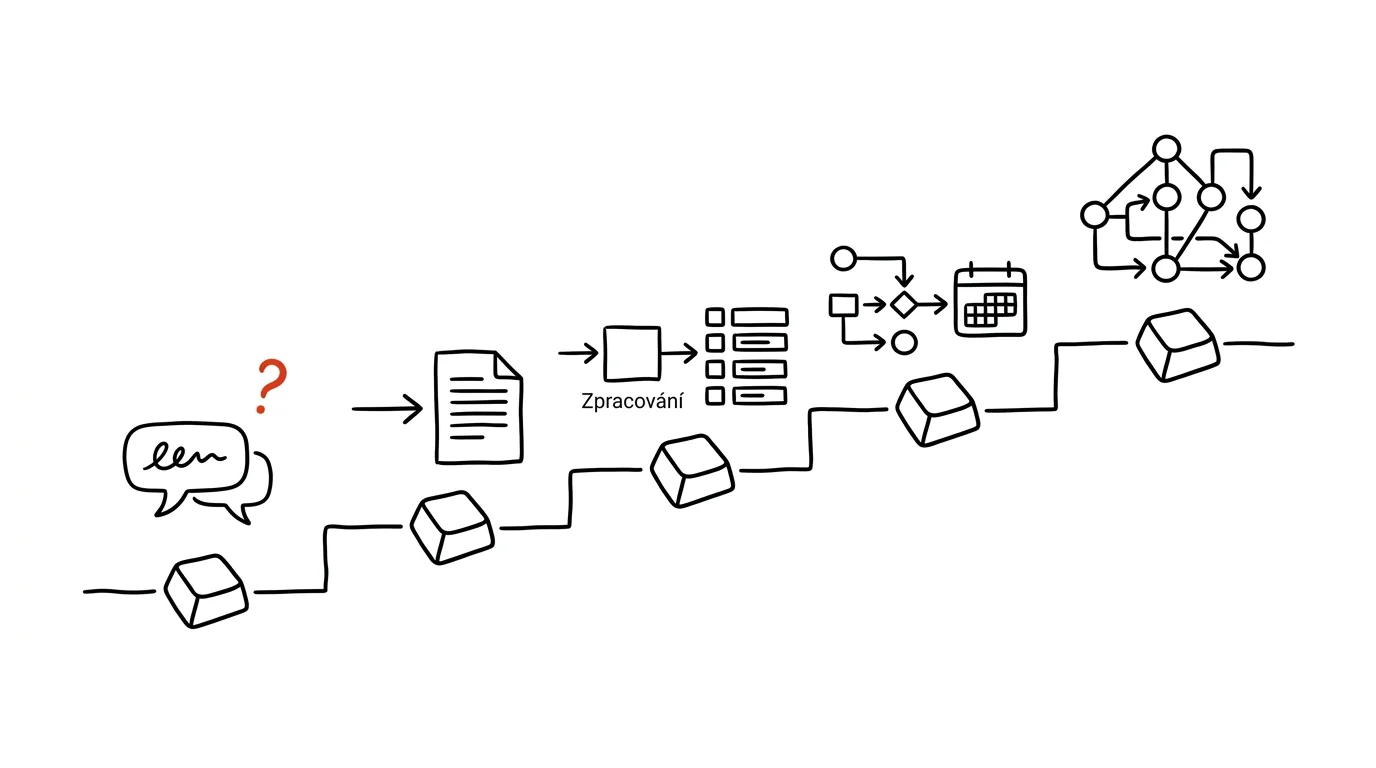
- 1ChatAI knows nothing about you. You supply context by hand in every conversation.
- 2Persistent contextAI knows who you are, what you're working on, and how you want output formatted. You don't have to repeat it.
- 3Connected to dataAI reads your email, calendar, and documents on its own. You stop copy-pasting.
- 4RoutinesIt runs without you, on a schedule. You approve finished drafts.
- 5AgentAI breaks a multi-step task into pieces and works through it on its own. You set the goal and check the result.
Level 1: chat, where you carry everything by hand
You open a window, type something, copy something back. This is the entry point, and it's worth not underrating it: even at this level, AI can rewrite a clunky email, explain a foreign contract in plain language, break a text down into its arguments, or draft an outline for a presentation. For plenty of professions, that alone is a noticeable time saver. Anyone who hasn't started yet will find the first step laid out in the tip Your first conversation with AI.
What it costs. Almost nothing. No setup, no data access, no new risk except one: whatever you paste into the window, you've now put there. That's exactly why the worst mistake on this whole ladder happens so often at this level — pasting a sensitive document into a free personal account. The chapter AI, ethically and safely covers this in more detail.
Where it grinds. Chat suffers from permanent amnesia. Every conversation starts with you explaining who you are, who you're writing for, and what the output should look like. Either you skip that explanation — and get generic filler you have to rewrite entirely — or you dutifully repeat it and burn more time on it than you save. This is exactly the experience that makes people say “AI writes like an insurance brochure.” It doesn't. It just doesn't know anything about you, because you didn't want to type it out again for the third time.
Level 2: persistent context, the end of repeating yourself
The second level fixes the amnesia. Tools offer it under different names — custom instructions, projects, spaces, knowledge bases — but the principle is one: whatever you'd otherwise type at the start of every conversation, you write once, and the tool remembers it. Who you are, what your company does, who you're writing for, what tone you use, what to avoid, what a finished output should look like. On top of that come standing reference materials: a price list, terminology, two or three sample answers that worked well.
The payoff is disproportionately larger than that small investment suggests. First-draft quality jumps, because the model no longer has to guess, and — more importantly — it becomes predictable, and predictability is what separates a toy from a tool. The tips Role, context, task, format and Projects and context cover the practical setup.
What it costs. Ten to thirty minutes, once, plus the habit of topping up the context occasionally. The risk barely increases — it's still true that only what you can live with being stored in that account belongs in the context.
When to move on. When you notice the main work is no longer writing the request, but gathering the material for it: copying in an email, digging up a date in the calendar, hunting for the latest version of a document. That's the signal for level three.
Level 3: connected to data, where you stop being the messenger
At the third level, AI stops waiting for you to bring it something. It gets direct access to your inbox, calendar, document storage, notes, or company system — usually through connectors called MCP, which the tip MCP connectors describes as USB-C for AI. The difference in day-to-day work is fundamental: instead of “here's the text of the email, write a reply,” you ask “what does everyone need from me today, and what should I do about it,” and the answer gets built on top of real data.
This is where a qualitative jump first shows up, not just a time saving. AI sees connections that aren't visible in a single copy-pasted email: that this client has already written a third time, that the promised deadline collides with a business trip, that the document mentioned in the email thread has a newer version.
What it costs. First, setting up and managing permissions. Second — and this is the substantial item — deciding everywhere AI can see. This is where the principle of least privilege starts to apply: access only where it's useful, a folder rather than the whole drive, read-only rather than write access wherever possible. Access tends to accumulate, so go through what's connected once a quarter and disconnect what you're not using.
It's worth noticing that this is also where the type of mistake changes for the first time. At lower levels, a mistake comes from ignorance — AI has no idea, so it guesses. At level three, a mistake comes from imprecise reading: the model has the data available, but pulls out the wrong date, misses a newer version of an attachment, or confuses two clients with the same name. It's more insidious, because output like that looks well-founded. That's why, from level three up, it's worth asking AI to cite where a claim came from — which email, which meeting, which version of a document. Checking then takes seconds instead of minutes.
When not to go further. When you're working with data that, under internal policy, can't leave a defined environment, or when you don't have an account with contractual data protection. Then the right move is sorting out the account and company policy first, not connecting connectors and hoping for the best.
Level 4: routines, where it starts running without you
A routine is work described once that then runs on its own — on a schedule, or triggered by an event. At seven in the morning it goes through email and drafts replies. Friday afternoon it puts together a week's summary. After every meeting it pulls action items out of the notes. The tip Routines in Claude shows the practical shape of this.
This is where the nature of your work changes, not just its speed. At levels one through three, you're the initiator: nothing happens until you remember to start it. At level four, you become the approver — you arrive to finished drafts and decide what to do with them. Anyone who doesn't accept this in advance is in for a disappointment: they expect a routine to “help,” and instead it produces a queue of things to review. Yes — that's exactly what it does. And it's a good trade, because reviewing takes seconds and writing from scratch takes minutes.
What it costs. Setup, and above all patience. The first two weeks, the routine won't work properly, because you haven't yet had the chance to explain the exceptions that live in your head but not in the instructions. The chapter Routines and agents covers this in detail.
Level 5: agent, where you hand over a goal
At the fifth level you don't hand over a step, you hand over a goal. The agent breaks the work into sub-steps on its own, uses whatever tools it has available, makes ongoing decisions based on what it finds, and returns a finished result — say, research on ten suppliers with a comparison table, an invoice folder gone through with discrepancies pulled out, or briefing materials for a meeting assembled from email, calendar and old notes.
It's the most powerful level and also the least predictable one. The model makes more decisions without you, so more decisions can go wrong — and a mistake at step three carries through into the whole result. That's why this rule matters double here: an agent may prepare, not finalize. Reading, sorting, searching, drafting, proposing — yes. Sending, paying, deleting, making promises on the company's behalf — no. This isn't distrust of the technology; it's that irreversible actions require a human signature.
When an agent is worth it. For work that's large in scope, mechanical, and well-describable — where you can see the output and tell whether it's wrong. Research, comparisons, consistency checks, prep materials. It's not worth it, on the other hand, where you can't judge the output yourself — then all you're getting is a faster route to something you have to trust blindly.
A good test before handing something to an agent is this question: could you describe this work to an intern who started last week? Not do it — describe it. Where to look, what counts as a finished result, what to do when something's unclear, and what not to decide on their own. If you can describe it, an agent probably can handle it. If you can't, the problem isn't the model; the work still only exists in your head, and you need to get it out first.
Why most people get stuck at level one
Getting stuck at chat isn't laziness, and it's rarely fear of technology. Almost always it's one of four things, and it's worth naming them, because each has a different fix.
First: nobody showed them there's anything further. The public image of AI is a window with a cursor blinking in it. Anyone who's never seen a working routine has no reason to suspect that email can be sorted overnight. The fix is seeing one concrete example, not reading another model comparison.
Second: the first experience was lukewarm. Someone types in a task with no context, gets a generic answer, decides it's not that great, and never tries again. But the mistake wasn't the model's — it's that AI was never given anything to work from. That's exactly why level two matters so much: without it, every level above it looks like marketing.
Third: worry about data. Completely legitimate, but the fix isn't staying put — it's an account with contractual data protection, a clear rule about what never gets uploaded anywhere, and a sensible scope of permissions.
Fourth, and most common: setup never fits into today. Half an hour on context and a routine is half an hour you don't have today — and won't have tomorrow either. And yet it's the single investment on this whole ladder that pays out every single day. The same trick that works for any other habit change helps here: don't do the whole thing, do one thing. Describe your role. One routine. The rest can wait.
When to move up, and when to stay
There's a simple signal that works better than any guide: move up a level when you catch yourself doing by hand, repeatedly, what the level above would set up once. Repeatedly typing the same context into chat — time for level two. Repeatedly copying emails and hunting through the calendar — level three. Repeatedly remembering, yourself, to kick off the same conversation — level four. Repeatedly feeding the model five steps in a row that it could work out on its own — level five.
The opposite signals matter just as much, because moving down is a legitimate choice too. Stay where you are when the cost of a mistake is high and you don't have the capacity to check output. Stay when your accounts and company data policy aren't sorted out. Stay when you need to keep a skill you'd otherwise be automating away — the chapter on ethics covers what's worth keeping for yourself, so you don't forget how to do it. And stay when a higher level would just be automating work you shouldn't be doing at all: automated nonsense is still nonsense, just more regular.
One quiet consequence is worth mentioning. The higher you stand on the ladder, the bigger the share of your work that consists of judging someone else's output — and the more your own expertise in the subject matters. A higher level doesn't replace domain knowledge; it puts a premium on it. Someone who can't tell a good draft contract from a bad one gets no benefit from an agent, just a faster route to a problem. That's why verification belongs at every level, not just the last one — the tip AI makes things up with total confidence shows how.
And one more thing people tend to underrate: you don't have to climb the whole ladder for everything at once. It's completely fine to run email at level four, because it's mechanical and well-defined, while writing client proposals at level two, because they matter and you want to be there from the first sentence. What decides it is the type of work, not a personal score.
Anyone who wants to climb this ladder across a whole company, not just for themselves, will find the process, the order of steps, and a sample policy in the tip AI at your company. Students facing the same question in an academic context will find An honest workflow for your thesis with AI useful. And a skill that's useful at every level without exception gets its own chapter: Prompting as a skill.
What to take away
- The levels aren't a grading scale — they're an answer to how deeply AI is woven into your workflow. The right level differs by type of work and cost of a mistake.
- Every move up is a trade: you pay with setup, data access and a slice of trust, and buy time and predictability. When that trade doesn't make sense, don't make it.
- Level two is the cheapest and highest-return move. Persistent context turns generic answers into usable ones and costs a few dozen minutes, once, for good.
- Getting stuck at chat has four typical causes: nobody showed you more, a lukewarm first experience, worry about data, and a missing half hour for setup. Each has a different fix.
- The signal to move up is simple: you're doing by hand, repeatedly, what the level above would set up once.
- Regardless of level, one checkpoint never goes away — the human. AI proposes, you approve; irreversible actions don't belong to the machine, not even at level five.
Want to keep the momentum?
One tip from the handbook by email each week — in an order that makes sense.
The Top 30 tips e-book, free — it lands in your inbox right away.
Then 1 tip a week · no spam · unsubscribe in one click
Prefer a system to single tips? The free email course — seven days, seven emails, one skill a day.