Tips & tricks · AI · Everywhere · ~3 hours of negotiation prep · 17 min read · in-depth guide, doing it ~1 h
Prepping for a negotiation in twenty minutes: research, arguments, BATNA, and rehearsal
Last reviewed:
Facts verified against the tools:
Change history for this guide →
In this article
- A typical scenario
- Phase 1: research on the other side that holds up to scrutiny
- Phase 2: your position, your walk-away point, and your backup plan
- Phase 3: the arguments and objections that are coming
- Phase 4: three scenarios for how it goes
- Phase 5: rehearsing the hardest part
- Phase 6: the one-page brief
- Phase 7: the follow-up that decides the outcome
- Common mistakes
- The best tools
- What you get out of it
- Pro tip
Most negotiations aren't decided at the table — they're decided before it. Someone who's looked up what the other side is actually dealing with, who's thought through where their own walk-away point is, and who's said the answer to the toughest objection out loud at least once, is playing a different game than someone rehearsing their opening line in the car. The difference isn't negotiating talent. It's preparation that most people skip — not because they don't want to do it, but because honest prep traditionally takes two to three hours, and nobody has that.
With AI, the same prep fits into twenty minutes, because it splits cleanly into what a machine is good at and what only you can do. The machine can quickly look up and organize what's publicly known about the other side, generate more objections than you'd think of on your own, lay options side by side, and play the other party so your toughest line doesn't get its premiere at the table. You set the goal, the walk-away point, and what you're willing to trade away — and you verify what the model hands you, because models will invent facts about companies and people just as confidently as they state everything else.
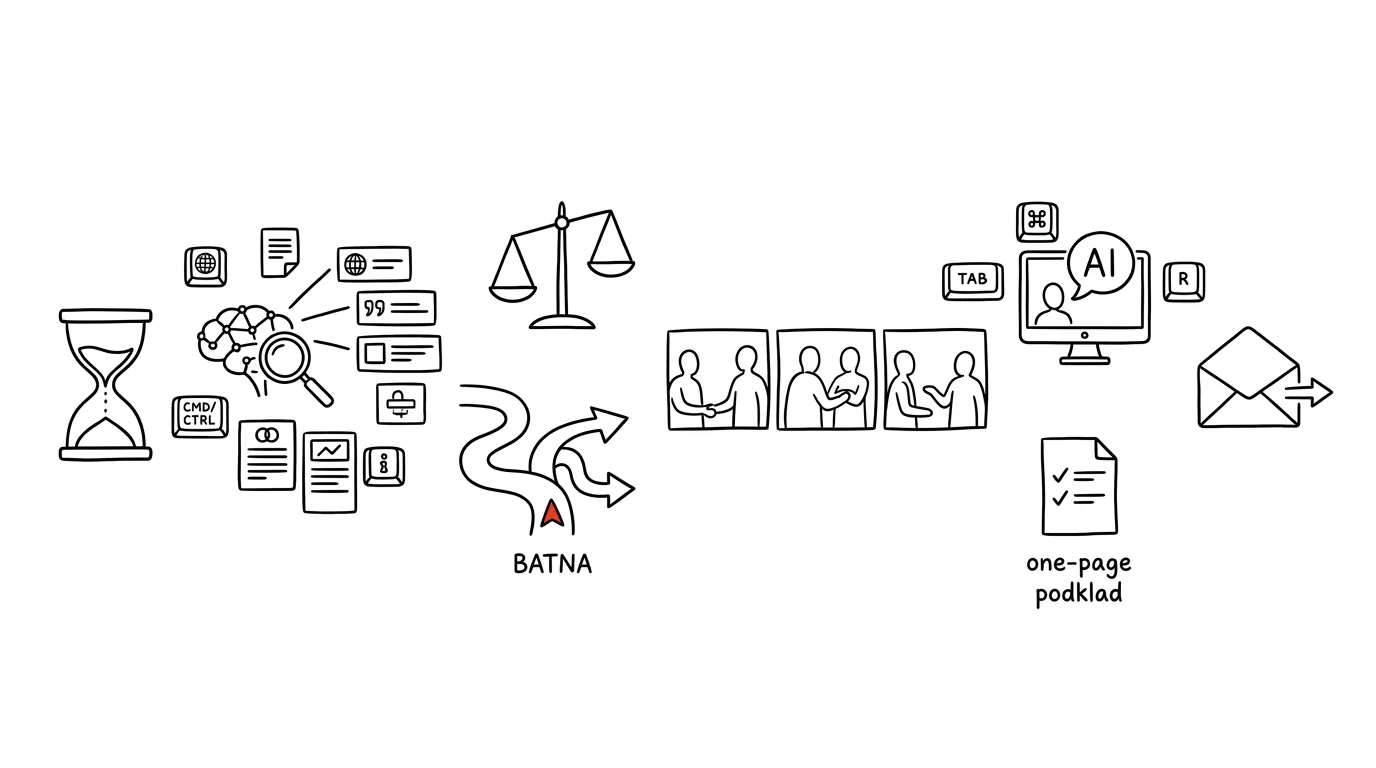
This guide walks through seven phases in the order you'd actually do them: researching the other side, your own position and backup plan, arguments and objections, likely scenarios, a live rehearsal, a one-page brief, and the follow-up after the meeting. The twenty minutes break down roughly like this: two minutes to kick off the research and let it run, five minutes clarifying your own position, five minutes building arguments against objections, three minutes running through scenarios, five minutes rehearsing the hardest part, and a final minute printing the one-page brief. If you have more time, it's the rehearsal that gets longer — not the research.
A typical scenario
Martin runs a small four-person studio, and on Friday he's meeting to renew a year-long contract with his biggest client — roughly forty percent of his revenue. He wants to raise the price, because the scope of work has grown over two years and the budget hasn't. He knows two people will be at the table: his usual marketing contact, who he gets along with well, and a new procurement person he's never met.
Without prep, it would go the way it always does: he'd show up with a number, hear “budgets are frozen this year,” back down to the old price, and spend a week kicking himself that it could have gone better. Instead, he sits down Thursday evening for twenty minutes. The research shows him the client launched a new product in May and has a fresh change in leadership on record at the business registry — he checks both against the original source. The procurement person's public profile shows previous experience at a retail chain known for pushing hard on unit prices; that's a clue, not a diagnosis. While clarifying his own position, he writes down for the first time what he'll do if this doesn't work out: he has two smaller jobs in the pipeline that together would cover half the shortfall, which means his walk-away point is real, not bluffed.
Then he has twelve objections generated. He already has a ready answer for nine; three catch him off guard — those are exactly the ones he practices out loud in a rehearsal where AI plays a procurement person pushing hard on price with no give. He loses the first round. He wins the second, because he stops defending the hours he put in and starts talking about what he made the client last year. He walks into the meeting with a one-page brief: goal, walk-away point, three arguments, three answers to objections, and the questions he wants to ask. He settles on eight percent instead of the twelve he asked for, but more importantly, the scope of work gets defined in writing. That afternoon, he sends a summary email that took three minutes to write from his own notes — and that he read in full before hitting send.
Phase 1: research on the other side that holds up to scrutiny
The goal of this phase isn't to know everything about the client. It's to find three to five things that will change how you run the conversation: what the other side is currently dealing with, what pressure they're under, who's actually deciding, and what's changed for them in the last six months. Everything else is trivia you won't use at the table.
Kick off the research first, because in deep-research mode it runs on its own for several minutes while you move on to phase 2. That's the main reason the whole prep fits into twenty minutes.
The company: what's going on and what's pressuring them
The prompt needs to be specific about what you'll actually do with the information. A generic “tell me about company X” just returns the marketing copy from their website — which you already know.
I'm preparing for a business negotiation with [company name, tax
ID], industry [industry], size [estimated headcount]. We're
discussing [subject of the negotiation, e.g. renewing an annual
campaign management contract].

Research public sources and return:
1. What the company actually does and where its main revenue
   comes from — in your own words, not a rewrite of their
   website copy.
2. What's changed for them in the last 12 months: new products,
   expansion, layoffs, leadership changes, acquisitions,
   investment.
3. Publicly available signals about financial health (financial
   statements, registry filings, press releases) and what year
   they're from.
4. Who their main competitors are and where the competition has
   pulled ahead of them in the last year.
5. Three things they're probably most focused on right now — and
   for each, note what you're basing that on.

Cite a source and date for every claim. Where you're not sure,
write “unverified” instead of guessing. Don't speculate about
internal matters that aren't public.
You'll get back a usable overview — point 5 especially, since it tells you how to frame your own offer. Two safeguards: open the original source (registry, annual report, press release) for every figure you plan to say out loud at the table, and skip citing numbers that are out of date rather than risk it. Models will confidently state revenue for a year that hasn't even been published yet, or mix up two companies with similar names. More on this in the tip on fact-checking with AI; how to prompt deep research is covered in deep research.
People at the table: roles, not psychological profiles
Knowing who you're talking to is legitimate prep. Building a profile of a specific person from scraps found online is something else — and it's pointless, because it won't actually help you in the negotiation. The only thing that matters is what role that person plays in the decision and what people in that role typically care about.
Two people will represent the other side at the negotiation:
- [role 1, e.g. marketing manager, my existing contact, we've
  worked together for two years]
- [role 2, e.g. procurement, someone I've never negotiated with,
  whose public profile shows prior experience at a retail chain]

Don't build a psychological profile of the specific individuals.
Instead:
1. For each role, describe what its typical goal is in a
   negotiation like this, and how success is usually measured
   in that role.
2. Where the interests of these two roles typically diverge —
   and how I can use that without pitting them against each
   other.
3. Which of them is likely to decide on price and which on
   scope.
4. Three questions I should verify at the start to find out
   whether this read is right.
5. What in my offer appeals to each of them differently — one
   sentence per role that I could actually say to them.

Keep it short, in bullet points.
Point 4 is there on purpose: research gives you a hypothesis, and only a question at the table can confirm it. And a rule that holds both legally and out of basic decency: don't put real names or personal details of specific people into the prompt — a role is enough. If you genuinely need to work with specific data about individuals or non-public business terms, do it only in a paid or business account with contractual data protection, never in a free chat.
The history of your working relationship
The most valuable material often has nothing to do with the internet — it's sitting in your inbox and your invoices. When AI has access to your mailbox through a connector, you can pull a factual overview out of it that nobody remembers off the top of their head.
Go through our correspondence with [company] over the last 24
months and prepare a factual overview ahead of the negotiation:

1. A timeline of the relationship: what we delivered and when,
   by milestone.
2. Scope changes we agreed on during that time — when, who
   raised it, and whether it was reflected in the price.
3. Points where conflict or dissatisfaction came up, and how
   they were resolved.
4. Promises we made and promises they made — with a date and a
   quote from the actual email.
5. What's still hanging, unresolved.

Work only from the correspondence, don't infer anything. For
every item, give a date and the subject line so I can look it
up myself.
This gives you material that boosts your credibility at the table more than any web research could — the sentence “in March we agreed to add reporting, and the price didn't change at the time” is unassailable because it's documented. But check the quotes: if the model cites a sentence you can't find in the actual email, don't use it. And don't bring the raw emails into the negotiation — the facts pulled from them are enough.
Phase 2: your position, your walk-away point, and your backup plan
This is the most important phase of the whole prep, and the only one you can't delegate. Most negotiations go badly not because the other side is smarter, but because you showed up without an answer to “what do I do if we don't reach a deal.” Whoever doesn't have that answer always backs down.
Goal, walk-away point, and the space between
You need three numbers, or three statements: what a great outcome looks like for you, what an acceptable outcome looks like, and the point below which you won't go. That last one has to be real, not rhetorical. If you tell yourself “I won't go below ten percent” but you'd actually take five, you lose the moment the other side senses it.
I'm negotiating [subject]. My starting position is [request].
Situation: [3-5 sentences of context — how long the relationship
has run, what share of my income it represents, what's changed].

Help me clarify my position. Ask me one question at a time, not
all at once, and don't move on until I've answered:
1. What's actually important to me in this negotiation — and
   what just looks important because it's the thing that comes
   up first?
2. What's my ceiling, my realistic goal, and the point below
   which I won't go?
3. Besides price, what else is valuable to me (payment terms,
   scope, contract length, exclusivity, references, deadlines)?
4. Which of those am I willing to trade away for something else?

Once I've answered everything, summarize my position in ten
lines and flag any places where I'm contradicting myself or
where my walk-away point looks made up.
Asking one question at a time is deliberate — if the prompt asks everything at once, you'll rush through it. The last paragraph tends to be uncomfortable, which is exactly why it's useful: it usually reveals that your “walk-away point” was a wish, not a decision.
Backup plan: what I'll do if we don't reach a deal
BATNA stands for Best Alternative To a Negotiated Agreement — plainly put, whatever you'll do if the negotiation ends without a deal. It's not a threat you say out loud. It's information that gives you calm at the table, because you know you have somewhere to fall back to. And it works the other way too: it's worth estimating the other side's alternative. A client who'd struggle to replace you pushes differently than one with three offers sitting in a drawer.
My goal in the negotiation: [goal]. Subject: [subject].
If the negotiation ends without a deal, I lose [what, exactly].

Break down my alternative to a deal:
1. List all my realistic options if we don't reach an agreement —
   including the uncomfortable ones. For each, estimate how long
   it would take to get moving and what it would cost me.
2. Which one is best, and how strong is it really (on a scale:
   locked in / in progress / just an idea in my head)?
3. What could I do this week to make it one notch stronger?
4. Estimate the same for the other side: how easily could they
   replace me, what would it cost them, and how long would it
   take?
5. From that, work out which of us has the stronger position,
   and tell me what I should watch for at the table to confirm
   it.

For point 4, clearly separate what's documented from what's
your guess.
Point 3 is the cheapest investment in the whole prep: one phone call the day before the negotiation that turns “I have an idea” into “I have something in progress” will change the tone of the whole conversation more than any argumentation technique. Treat the estimate of the other side's strength as a hypothesis — the model doesn't know their budget or their backlog.
Phase 3: the arguments and objections that are coming
An argument you've never said out loud isn't an argument. The goal of this phase is to have three or four reasons framed in the other side's language, plus a ready answer to the objections you hear every time.
Arguments in their currency, not yours
The most common mistake is arguing from your own effort. “I spent a hundred hours on this” is information about you; the other side cares about what they get out of it. Converting one into the other is exactly what a model is good at.
I want to win [request] at the negotiation. Here are my reasons,
as they're in my head right now:
[list 5-8 bullets in your own words, unordered is fine]

The other side is [role and what they care about — from the
research].

Do three things:
1. Rewrite each of my reasons so it's framed around what the
   other side gets out of it, not what it cost me.
2. Rank them by strength, and for the three strongest, note what
   I can back them up with (a number, documentation, an example
   from our work together). Where I don't have backup, say so.
3. Cut any reasons that sound like a complaint or an entitlement
   — and explain, for each one, why it would hurt me at the
   table.

Write the phrasing the way I could actually say it out loud:
short sentences, no five-line run-ons.
Point 3 tends to be surprisingly painful — it usually cuts two or three reasons you'd been building your case on. Check that the model hasn't slipped in numbers you never gave it; if you spot a specific percentage or amount in the rewrite that you never stated anywhere, cut it.
Twelve objections and an answer to each
This is where AI earns its keep the most: it generates more objections than you'd think of, and among them will be the one you'd otherwise hear for the first time at the table.
At the negotiation I'll be pushing for [request] with these
arguments:
[insert the three strongest arguments from the previous step]

The other side: [role, what they care about, what pressure
they're under — from the research].

List 12 objections they might raise. Rank them from most to
least likely, and for each one give:
- the exact wording, the way they'd realistically say it
  (one or two sentences)
- what's actually behind it (a concern, a mandate, a tactic)
- my answer in two or three sentences I could say out loud
- what to avoid in that answer so it doesn't come across as
  defensive

At least three of the twelve should be uncomfortable enough to
actually catch me off guard — not polite little questions.
Include one objection you think I don't have a good answer to,
and say so.
You'll get back a list you can pull the three toughest items from for rehearsal. That last instruction is the key — without it, models generate objections they can then conveniently knock down themselves. Rewrite the answers in your own words: phrasing you'd never actually say out loud rings false at the table, and people notice.
Questions you want to ask
Prepping for a negotiation isn't just about answering. A good question early on can save you half an hour of negotiating over something that never mattered.
Subject of the negotiation: [subject]. My goal: [goal].
What I know about the other side: [3-5 sentences from the
research].

Suggest 8 questions for me to ask — ones where the answer would
actually change how I run the rest of the negotiation. For each
one, note:
- why I'm asking (what I'll learn)
- when to ask it (at the start / after their offer / at the end)
- what it means if they answer evasively

Drop any questions I could answer myself or that ask about
things I already know. No questions that look like a trap or a
test.
Write three of those questions into your one-page brief. The most useful one is almost always the one that probes mandate — whether the person across the table can actually decide, or is just relaying.
Phase 4: three scenarios for how it goes
Being prepared isn't knowing one answer. It's being able to handle three different ways the meeting could go — accommodating, tough, and stalling. That last one is the sneakiest: nobody says no, it just “needs to be discussed further,” and three weeks later the old terms are still in effect.
Negotiation: [subject]. My goal: [goal], walk-away point:
[walk-away point].
My alternative if we don't reach a deal: [BATNA in one sentence].

Lay out three scenarios for how this could go:
A) Accommodating — they agree quickly, but with a condition
B) Tough — they refuse and push for the original terms
C) Stalling — they refuse nothing, but push the decision off

For each scenario:
1. How I'll know I'm in it (the first line that signals it)
2. Three decision points where what I should do changes
3. Exactly what I'll say at each of those points
4. Where the trap is in this scenario — what to watch out for
5. How to close it out if I can't reach my goal: what I walk
   away with instead of a deal (a written note, a deadline, a
   partial concession)

For scenario C specifically, tell me how to force a concrete
decision deadline without coming across as impatient.
You'll get back a decision tree you don't have to memorize in full — it's enough to remember the first line of each scenario. Point 5 is what sets a prepared person apart: even from a meeting that didn't pan out, you can walk away with a deadline and a written note instead of just a bad feeling.
Phase 5: rehearsing the hardest part
Up to this point, the prep has all been on paper. Here it turns into something that will actually come out of your mouth on Friday. Have AI play the other side and act out the three toughest objections from phase 3 — not the whole negotiation, you don't have the time or the need for that. The full rehearsal method, with difficulty variants, is in the tip on rehearsing a difficult conversation; here's the condensed version tailored to a negotiation.
Play [role — e.g. a procurement person at a large company] that
I'm negotiating [subject] with. Context: [3-4 sentences from the
research, no names].

Rules of the exercise:
- Stay in character until I say “break character.”
- Play it tough. Don't back down until you get a substantive
  reason.
- Open with [the hardest objection from phase 3].
- Talk the way people actually talk at the table: short, cut me
  off, push back with questions.
- Don't give me advice or comment on what I'm doing. Just play
  the role.

I'll open the topic. Respond one line at a time and wait for my
reaction.
Run it twice: once with the tough variant, once with the accommodating one that pushes for a delay instead. The key is to say actual sentences, not write “then I'd explain my reasons” — the exercise only has value if you say the words out loud. If your negotiation will be in person or on the phone, use voice mode.
The more valuable half comes after each round:
Break character.

Evaluate my argumentation in this conversation:
1. Where I was defensive or apologized for my own request
   (quote the specific lines)
2. Where I backed down without getting anything in return
3. Which of my arguments was strongest, and why I should lead
   with it earlier
4. What I had prepared that I never used
5. Three lines I should say differently next time — show my
   original wording next to an improved version

Evaluate the argumentation, not the outcome. Be specific, no
generic advice like “be more confident.”
You'll get back an analysis you wouldn't get from a colleague — with quotes of your own lines. The most common finding is always the same: three-quarters of your sentences talk about your own effort, and not one about what the other side gets. Don't adopt the improved phrasing word for word, though; rewrite it in your own language, or you won't actually say it at the table.
Phase 6: the one-page brief
Everything you've produced in those twenty minutes is worthless if you're carrying it around in six separate chats on your phone. The brief has to be one sheet you can glance at under the table, written so your eyes can find the right line in two seconds.
From everything in our prep, make a brief that fits ONE page,
that I'll bring to the negotiation. Format:

GOAL: one sentence
WALK-AWAY POINT: one sentence (the line I won't go below)
IF WE DON'T REACH A DEAL: one sentence

THREE ARGUMENTS: each as one sentence, the way I'd say it aloud
THREE QUESTIONS I'LL ASK: each as one sentence
THREE OBJECTIONS AND ANSWERS: objection | my answer (max 2
sentences)
FACTS I CAN CITE: max 5 lines, source for each
HOW I'LL CLOSE: what I walk away with even without a deal

Rules: no paragraphs, just lines. Nothing I can't read in two
seconds. Nothing I wouldn't say in my own words anyway. It has
to fit on one page even printed at size 12.
You'll get something you can actually use at the table. Before printing, read it line by line and cut: anything you already remember doesn't need to be on paper. And go through the facts section carefully — only what you've checked against the original source belongs there, because citing a number at the table that turns out to be made up is worse than citing nothing at all.
Phase 7: the follow-up that decides the outcome
A negotiation doesn't end with a handshake — it ends with whichever version of the agreement becomes the one that counts. Whoever sends the summary first sets the interpretation — and if someone asks a month later what you agreed to, that's the email that gets opened.
Write up your notes within half an hour of the meeting, while you still remember the exact wording. Feel free to dictate them on your way out of the parking lot; a model can turn a dictation into usable notes in a few seconds.
Here's my raw notes from the negotiation, dictated on the way
back, so it's disorganized and has half-finished sentences:

[insert dictation]

Turn this into structured notes for me (not for sending):
1. What we agreed on — only what was actually said
2. What's still open and who's supposed to resolve it
3. Any deadlines that came up, with dates
4. What the other side said about their priorities and
   constraints (useful for next time)
5. Where, based on these notes, I backed down, and what I got
   in return
6. What's unclear to me from the meeting and needs to be
   verified

Don't infer anything that isn't in the notes. Where the record
is ambiguous, write “unclear” and exactly what I need to fill in
from memory.
You'll get back an overview where point 6 usually surfaces one or two things that later become the basis of a dispute. Only from these notes do you draft the email — and that one is written for the person on the other side.
From these notes, write a summary email to the other side.

[insert notes]

Requirements:
- first paragraph: a one-sentence thank-you, straight into a
  summary of what we agreed on
- bullet points with specific items and deadlines
- clearly separate what's agreed from what's still awaiting
  confirmation
- close with one sentence asking for confirmation or additions
- no new terms that weren't raised at the table
- my tone: [businesslike / warm], maximum 200 words

Where you're not sure whether something was agreed or just
mentioned, put it in a note at the end for me instead of writing
it into the email.
Read the whole email before you send it — this is exactly the situation where AI proposes, the person approves applies. A sentence about an agreement that never happened is worse than no follow-up at all: the other side either corrects it (and you lose trust) or misses it, and the dispute just gets postponed. A human always sends it, even if your mail is connected through a connector.
The last step takes a minute and pays off long-term: save the notes, the one-page brief, and the list of objections into a folder or a persistent project. Before your next negotiation with the same client, you're starting from a ready-made history instead of from zero. To keep track of deadlines that come out of the meeting, the follow-up tracker is a good fit.
Common mistakes
- Citing research facts at the table without verifying them. Models will invent revenue figures, dates, and leadership changes with complete confidence. One disproven number tears down trust in everything else you said — and the other side knows their own company better than you do.
- Preparing arguments without ever testing them out loud. Text on paper looks strong and falls apart in your mouth. You only find out the difference between “I could explain that” and actually explaining it once you have to turn it into spoken sentences.
- Showing up without an answer to what you'll do if you don't reach a deal. Without a backup plan, a walk-away point isn't a limit, it's a wish — and the other side usually senses that before you do.
- Dumping names, salaries, and business terms into a free chat. Sensitive things belong only in a paid or business account with contractual data protection; replace names with roles and round off numbers — the prep works just as well.
- Having the follow-up email written and sending it unread. The model will smoothly add a sentence about something that was never agreed, and you've just put a deal you never made in writing.
- Spending two hours prepping for a negotiation where the stakes are low. The scope of your prep should match the stakes. A three-line note is plenty for a half-hour call about a minor change — not this entire process.
The best tools
- Claude with deep research — you set it running once and it works on its own for several minutes; it returns a report with links you open and verify.
- Projects (persistent context) — one project per client: negotiation history, agreed terms, communication style. You don't start the next round by explaining what's going on.
- A mail and calendar connector — pulls a timeline of the relationship and documented quotes of promises out of your correspondence; it's allowed to read, not send.
- An AI app's voice mode — for rehearsing a negotiation you'll conduct out loud: you speak, react in real time, and hear how your arguments actually sound.
- Public registries and annual reports — where you verify everything you're about to state as fact at the table. AI research is a starting point, not proof.
What you get out of it
- Time: honest prep that traditionally eats two to three hours fits into twenty minutes. Not because you do less, but because the research runs while you think.
- Money: in a price negotiation, preparedness matters more than eloquence. On a larger deal, the gap between caving to the old terms and settling a few percent higher is worth an order of magnitude more than the entire prep costs.
- Calm: you've already heard the hardest line once and already answered it once. That's the entire difference between nerves and calm at the table.
- Better agreements: a one-page brief and a follow-up within half an hour mean you settle on what you actually wanted, and it stays on record exactly the way it was agreed.
Pro tip
Try flipping the prep around: have AI write the one-page brief for the other side. The prompt reads “you're the procurement person at that company, prepare your brief for the negotiation with me — what's your goal, where's your walk-away point, what are your arguments, and what weaknesses do you see in the other party.” You'll see your own position from the outside, and you'll usually find one hole you'd otherwise have discovered at the table. Follow it up with a round where the model critiques your own offer — the method is in the tip have AI look for holes in your proposal.
And a final rule that overrides everything else: it's the position that's prepared, not a script. Someone who memorizes phrasing and recites it at the table comes across worse than someone speaking in their own words who knows where their line is. The point of prep is to clarify that line for you — not to write a script you'll cling to when the conversation veers somewhere else.
Want to go deeper? The handbook has a whole chapter on it — AI and automation.
Similar tips
Proofreading That Doesn't Rewrite You: Fix Only the Errors
AI loves to improve your style, even when nobody asked it to. Tell it to fix only spelling and punctuation and list the changes — your voice stays yours.
Mail Merge in Czech: Let AI Get the Vocative Case Right
In Czech, “Dear Mr. Novák” is wrong — it has to be “Dear Mr. Nováku,” the vocative case. AI adds a properly-declined salutation column to your contact table, for hundreds of names at once.
Ten Questions Your Audience Will Ask After Your Presentation
Before you present, have AI generate the audience's questions — curious, skeptical, and the one from your boss about money. You'll find out which ones you can't answer while there's still time.
Common questions
Can I quote facts from AI research directly at the table?
No — open the original source (registry, annual report, press release) for every figure you plan to say out loud. Models will confidently state revenue for a year that hasn't been published yet, or mix up two companies with similar names. One debunked number sinks trust in everything else you've said.
What is BATNA and why do I need one?
Best Alternative To a Negotiated Agreement — whatever you'll do if the negotiation ends without a deal. It's not a threat you say out loud, but information that gives you calm at the table. Without a backup plan, a walk-away point isn't a boundary, it's a wish — and the other side senses it before you do.
Can I have a profile made of the people I'm negotiating with?
Don't build psychological profiles of specific individuals — it's pointless and inappropriate. What's useful is the role: what a procurement person versus a marketing manager typically aims for, and where their interests diverge. Keep names and personal data out of the prompt — roles are enough; sensitive business terms belong only in a paid account with contractual data protection.
Why rehearse when I have my arguments on paper?
An argument you've never said out loud isn't an argument — text looks strong on paper and falls apart in your mouth. Have AI play the other side, run the three toughest objections out loud, then ask for a debrief with quotes of your own sentences. The most common finding: three-quarters of your sentences talk about your effort and none about what the other side gains.
Why should I send the summary first?
Because whoever sends the summary sets the interpretation of the deal — when someone asks a month later what was agreed, that email gets opened. Write your notes within half an hour of the meeting and read the email in full before sending: a sentence about an agreement that was never made is worse than no follow-up at all.
Is twenty minutes of prep worth it for small meetings too?
Not always — the scale of the prep should match the stakes. For a half-hour call about a minor change, three lines are enough, not this whole process. For a price negotiation on a larger deal, though, the difference between backing down and settling a few percent higher is orders of magnitude more than the prep costs.
Was this helpful?
Liked this tip?
I send one like it every week by email. Two minutes to read, hours saved.
The Top 30 tips e-book, free — it lands in your inbox right away.
Then 1 tip a week · no spam · unsubscribe in one click
Prefer a system to single tips? The free email course — seven days, seven emails, one skill a day.