Tips & tricks · AI · Everywhere · ~20 h a month · 16 min read · in-depth guide, doing it ~1 h
The content factory: thirty outputs from one pillar
Last reviewed:
In this article
- A typical scenario
- Phase 1: the pillar — one thing a month, done properly
- Phase 2: a brand voice you don't have to re-explain every time
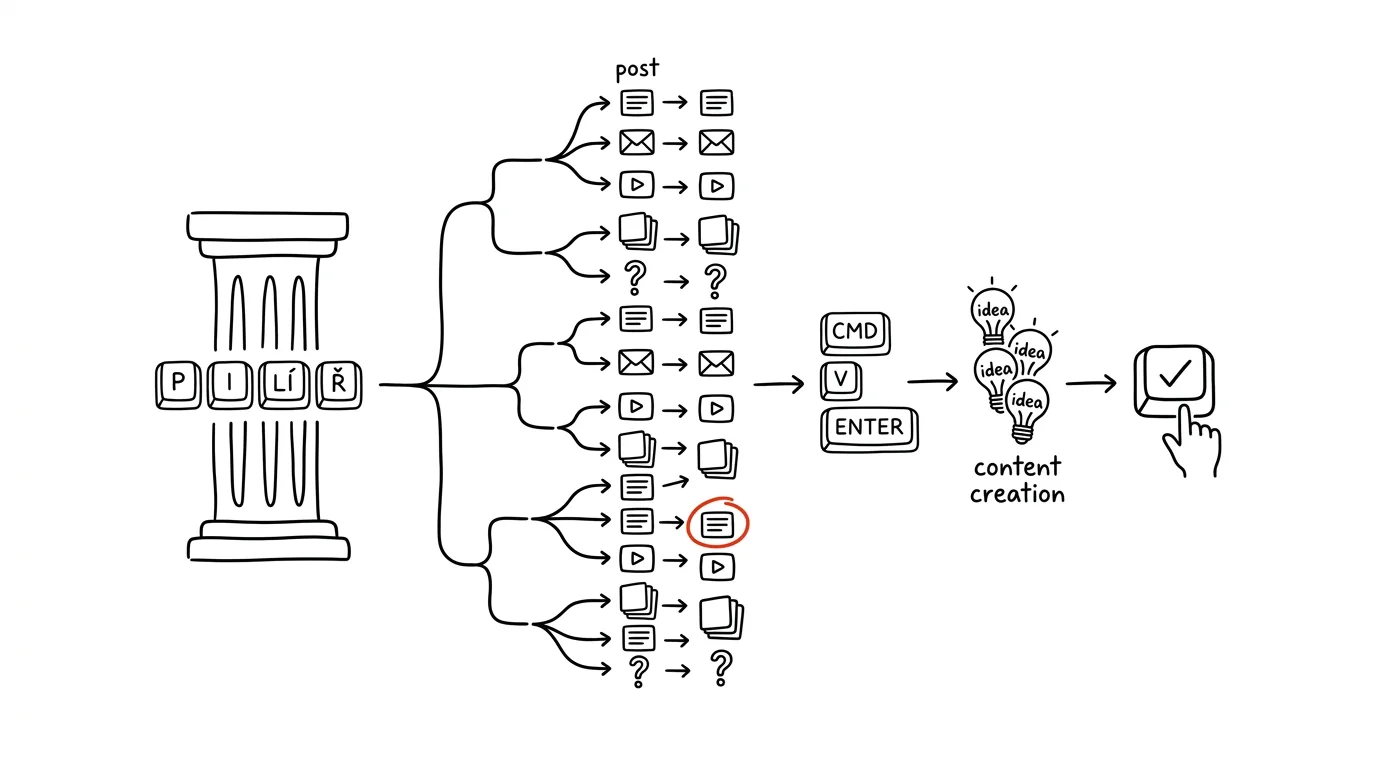
- Phase 3: deriving thirty outputs from one pillar
- Phase 4: a calendar and batch production in one sitting
- Phase 5: an approval workflow — AI produces, a human publishes
- Phase 6: recycling evergreen content and measuring what works
- Common mistakes
- The best tools
- What you get out of it
- Pro tip
Most companies and freelancers do content backward. Every week, either a meeting happens or a blank document opens, and everyone tries to figure out what to write about. Out comes a post that has nothing to do with last week's, a newsletter thrown together in a hurry on Friday, and a video that got made because “video's what people watch these days.” The work adds up; the trail doesn't — because thirty unrelated fragments never add up to a picture of what you actually understand.
The content factory flips that: you do one thing thoroughly once a month, and derive everything else from it. The pillar is one solid article, guide, or video — three to six hours of work carrying your thinking, your numbers, your experience. From it come dozens of outputs: posts for every network in that network's own language, a newsletter, a short video script, a carousel, an FAQ for your website. Not because the text gets copy-pasted — because one good idea can carry ten different treatments, while ten shallow ideas can't carry a single one.
In this model, AI is a production line, not an author. It can't invent the pillar, because it doesn't have your experience with customers or your numbers. But it can handle what wears you down about content: breaking a long piece into standalone ideas, dressing them up for a specific platform's format, producing fifteen headline variants, and holding the tone you've agreed on while it does. The guide runs in six phases, each with copy-ready prompts. One rule sits over all of it and must never slip, not even in the worst week: AI produces, a human publishes.
A typical scenario
Jana runs marketing at a ten-person company that sells accounting software to small business owners. Her old week looked like this: Monday, an hour spent hunting for a topic; Tuesday, writing a LinkedIn post and a second one for Facebook; Wednesday, trying to come up with something for Instagram; Thursday, writing a newsletter from scratch; Friday, realizing the blog hasn't had anything new in a month. Twelve to fifteen hours a week altogether, and a nagging feeling of always being behind.
After switching to the pillar model, the month looks different. In the first week, she spends a day and a half on a single piece: a big guide called “How a business owner knows they've outgrown spreadsheet invoicing” — with real numbers from their own data, three customer stories, and a checklist. On day two, she breaks it into twenty-eight standalone ideas, and from those, in one afternoon, produces eleven LinkedIn posts, eight shorter Facebook posts, two carousels, a script for a three-minute video, four FAQ questions, and two newsletters. Every piece passes through her hands — she edits each one, checks factual claims against the source, and schedules it.
For the rest of the month she just publishes, replies to comments, and collects reactions — and those reactions become the topic for next month's pillar. Time spent on content drops from fifty hours a month to under thirty, output volume goes up, and for the first time it all adds up to one story: a company that understands exactly when a small business owner needs to stop tracking things in a spreadsheet.
Phase 1: the pillar — one thing a month, done properly
The pillar is the deepest thing you'll produce all month. It needs to meet three conditions: it contains something you can't find elsewhere (your numbers, your experience, your process), it's big enough to carry derivatives (typically 1,500+ words, or ten minutes of video), and it answers a question people are actually asking you.
Where to get topics
You don't invent the best topics — you collect them. Sources that work: questions from sales calls, support tickets, comments, things you find yourself explaining to clients over and over, and objections that kill deals. This prompt turns a pile like that into a ranked list.
I'm [role] at a company that does [what, for whom].
Here's a raw pile of what people ask us — questions from
support, sales calls, and comments:

[paste the list, unedited is fine, 20-50 items]

Pick 8 candidates for pillar content (one solid article or
video that a month of smaller outputs will build on).

For each candidate, write:
1. The topic phrased as a question the reader would ask
   themselves
2. Exactly who this helps and in what situation
3. Why this topic deserves depth, not just one post
4. What we need to have on hand for it not to be generic —
   what data, story, or process of ours belongs in it
5. How many smaller outputs this could yield, and of what kind
6. How long this will stay relevant (months / years / goes
   stale fast)

Rank by how many people it helps, multiplied by how long it
lasts. Don't add topics that aren't implied by my list.
It comes back with a ranking where the top two topics usually surprise you — they tend to be things you consider obvious because you explain them every week. Use point 6 for planning: put evergreen topics early in the year so they work longer for you.
Brief the pillar before you start writing
A pillar written without a brief sprawls sideways and ends up as an overview of everything. Ten minutes on an outline saves two hours of rewriting.
I'm writing pillar content on: [topic, phrased as a question].
Target reader: [who, what's bothering them, what they already
know and don't know].
What I have available: [own data, case studies, a process,
interviews — list them].
Length: [e.g. 2,000 words]. Format: [article / video].

Propose an outline:
- 6-9 sections in an order that makes sense to the reader
  (from their situation to a solution, not from our company
  to our product)
- for each section, 3 bullets of what it should cover
- for each section, flag whether it should carry our data, a
  story, or a general explanation
- 3 spots where the piece is most likely to slide into
  promoting our product, and what to write there instead
- what's missing from my material to pull the outline off

Don't write the text, just the outline.
The last two points are what matters here. A pillar that slides into a sales pitch halfway through has no derivatives — good posts don't come out of an ad. And the list of missing material tells you whether to start writing today or call two customers first.
Write the pillar itself yourself. It's the one part of the whole process actually worth sitting down and thinking through — and it's also the material the entire rest of the month will live off of. Text a model generates from nothing produces derivatives that are also made of nothing.
Phase 2: a brand voice you don't have to re-explain every time
The most common complaint about AI-written content is “you can tell.” Usually fair — a model without instructions writes in the average voice of the internet: enthusiastic, generic, three synonyms where one word would do. The fix isn't writing a paragraph each time about how you like short sentences. It's fixing the voice once, in a permanent place.
Distilling a style guide from what you've already written
The best description of your voice doesn't come from thinking about it — it comes from analyzing text that already worked.
Here are 5 of our texts that I think are a good example of
how we want to sound:

[paste texts — a post, part of an article, an email to a
customer, anything]

And 2 texts that sound wrong:

[paste]

Build a style guide for our brand from this. I want concrete
rules, not adjectives:
1. Formal or casual address, and how we speak to the reader
2. Sentence and paragraph length — measure it on the samples
   and give actual numbers
3. Words and phrases we use (pull them from the texts)
4. Words and phrases we never use (pull them from the bad
   examples)
5. How we open and close a piece (the pattern from the samples)
6. How we talk about competitors, price, and our own product
7. Humor: how much, and what kind
8. What we keep for clarity's sake, given our field (technical
   terms — which ones we explain, which we don't)

Back up every rule with a quote from the samples. Where the
samples don't support a clear rule, say it can't be determined.
It comes back with a guide that, unlike most “brand voice” documents, has actual content — because it's derived from real text, not from wishes. Go through it and fill in what the model couldn't have seen (banned topics, legal restrictions, how the product name is written).
Save it to a Project, not a message
The guide belongs in persistent context — in Claude, that's a Project, where instructions, source material, and every conversation on one topic live together. Put the voice and the rules in the project instructions; upload the pillars, product description, a price list with the numbers stripped out, a list of typical customers, and samples of good writing as files. Every conversation inside then starts with knowledge of the brand, and you stop typing “write concisely, in [language], no fluff” into every message. The step-by-step process is in the tip a project with persistent context.
Two projects usually beat one: a brand project (voice, product, customers) and a current-pillar project (the piece itself, notes, derivatives). If you write for multiple clients, give each client its own project — otherwise the voices blur together.
Phase 3: deriving thirty outputs from one pillar
This is the heart of the whole factory. The process has two steps, and the second doesn't work without the first: first the pillar gets broken into standalone ideas, only then do outputs get built from them. Tell a model to “make ten posts from this article” directly, and you get the same summary ten times over, reshuffled.
Step 1: breaking it into atoms
Here's our pillar piece: [paste the text or video transcript].

Break it into standalone ideas — ones that make sense even
pulled out of context and can carry their own post.

Aim for 25-35 items. For each one:
- the core idea in one sentence (a claim, not a headline)
- type: opinion / how-to / a number or fact / story /
  common mistake / definition / list / objection-and-answer
- who it lands hardest with
- how strongly it stands on its own (1-5)
- where in the text it comes from (quote or paragraph)

Rules:
- don't add anything that isn't in the text
- don't repeat the same idea in different words; if it
  repeats in the text, merge it into one item
- copy numbers and facts verbatim, don't round them
It comes back with a stockpile you'll draw from all month. Check two things: whether the model merged two distinct claims into one (happens with long texts), and whether the numbers match the original. Save the stockpile to a file — it's the most valuable output of this whole phase, and you'll come back to it months from now.
Step 2: outputs by platform, not one text everywhere
Copy-pasting the same text to every network is the fastest way to work everywhere and land nowhere. Every platform gets read differently: on LinkedIn, people read the first line and decide from it; on Instagram, the image and rhythm win; in a newsletter, people have patience for three paragraphs; in a short video, you have three seconds.
Here's the idea stockpile from our pillar:
[paste the stockpile or selected items]

Produce 8 LinkedIn posts. Each built on ONE idea from the
stockpile (cite the item number), no summarizing the whole
article.

Format for each post:
- first line: a claim or situation that makes the reader click
  through. No “Ever notice this?” questions, no emoji
- 4-8 short paragraphs, blank line between them
- a concrete example or number in at least one paragraph
- ending: one sentence that states the takeaway — not a
  “comment below with your thoughts” call to action
- 120-200 words

Match the tone in the project instructions. Don't use emoji
as bullets. No hashtags.

Posts must not repeat each other — every one has to work on
its own, even if a reader saw all eight.
The last paragraph is what makes the difference. Without it, the model draws all eight posts from the three strongest ideas and leaves the rest of the stockpile untouched.
Pick 5 ideas from the stockpile that work visually, and turn
each into a carousel outline (8 slides).

For each slide:
- text on the slide: 12 words max, readable on a phone
- a note on what should be visible in the image (no stock
  photo descriptions — something specific from our world)

Carousel structure: slide 1 the problem, slides 2-6 content
one step or point at a time, slide 7 a recap, slide 8 what
the reader should do next.

Under each carousel, write a caption of 3-5 sentences that
makes sense even without swiping through the slides.
The carousel is where the most gets wasted: eight slides retelling the same idea eight times. The “one step or point at a time” requirement heads that off. Read the slide text out loud after it's generated — anything you can't say in one breath won't get read on a phone either.
Write a newsletter from our pillar [topic].
Subscribers: [who they are, why they signed up, how often we
write to them].

Structure:
- subject line: 5 variants, each a different angle (a number,
  a question, a specific situation, a contradiction, a direct
  promise). 50 characters max.
- first paragraph: the reader's specific situation, not a
  greeting and not “these days...”
- body: 3 ideas from the pillar, each with a short explanation
  and one example
- one thing the reader should do today, in under 10 minutes
- a link to the full pillar with one sentence on what more
  they'll find there

Length: 400-600 words. Tone per the project.
No “hope this finds you well,” no superlatives.
The newsletter is the one channel you actually own — which is why it gets the best of the pillar, not a teaser link. Pick the subject line yourself; five variants are material, not a decision.
Write a short video script (60-90 seconds) for idea
[item number from the stockpile].
Speaker: [who], filmed [on a phone / on camera], setting
[description].

Format:
- first 5 seconds: the exact words to say so the viewer
  doesn't scroll past. No greeting, no self-introduction.
- write out the body sentence by sentence, exactly as it
  should be spoken — spoken language, not written (short
  sentences, no three-line compound clauses)
- for each part, a note on what's visible on screen
- ending: one sentence
- 3 on-screen title variants at the end (8 words max)

130-180 spoken words total. Read it back to yourself and cut
anything that's awkward to say out loud.
Test scripts by reading them out loud with a stopwatch. The model reliably undershoots the time — written text has a different density than spoken text.
Pull everything from the stockpile tagged “common mistake” or
“objection-and-answer” and turn it into a website FAQ.

For each question:
- phrase the question in the customer's words (the way they'd
  actually ask it, not what we'd call it)
- an answer of 60-120 words, the first sentence answers
  directly
- where the answer is “it depends,” say exactly on what
- a link to the part of the pillar where it's covered in depth

Order by the question we get asked most.
Don't write marketing answers — where our product is a bad
fit, say so.
That last line sounds counterintuitive and works: an FAQ that admits who the product isn't for sells better than one that claims to fit everyone.
How much actually comes out of one pillar
A solid pillar typically yields fifteen to twenty posts across two networks, two or three carousels, two newsletters, two to three video scripts, and four to six FAQ items. At a reasonable pace, that's three to six weeks of content. You don't have to publish all of it — a stockpile you draw from beats a calendar you have to keep refilling.
Phase 4: a calendar and batch production in one sitting
Two things save more time than every prompt combined: knowing ahead of time what goes out when, and producing in batches instead of piece by piece. Switching between modes — think it up, write it, edit it, schedule it, and back to square one — costs more than the work itself.
A month's calendar
Here's my stockpile of outputs from the [topic] pillar:
[paste the list of finished and planned pieces — posts,
carousels, newsletter, video, FAQ]

Schedule them for [month]. Conditions:
- LinkedIn [3]x a week, Facebook [2]x a week, newsletter
  [1]x every 14 days, video [1]x a month
- we publish [Mon-Fri], our best times are [state if known]
- don't run strong pieces back to back, spread them out
- newsletter only after at least two posts on the topic have
  gone out
- I'm on vacation week [number], nothing that needs my
  reaction that week

Output as a table: date, channel, piece name, idea from the
stockpile, status (done / needs writing), what it still needs
(image, chart, client sign-off).

At the end, tell me where the month has a gap and what from
the stockpile to fill it with.
Move the table into whatever tool you actually schedule with (calendar, Notion, a post scheduler). The “what it still needs” column is what keeps Thursday's post from stalling on a missing image.
One sitting, a whole month
Batch production means: one three-to-four-hour block where you produce a month's worth of content. The precondition is that you already have a finished pillar, an idea stockpile, and a calendar — phases 1 through 4. After that, it's just rhythm.
The sitting that works: first, all first drafts at once, following the calendar (the model runs, you don't review yet), then a break, then one editing pass top to bottom, then a fact check on everything with a number or a name, and finally scheduling. Never switch between writing and reviewing piece by piece — “producing” mode and “judging” mode wreck each other.
We're batching. Here's the calendar for the next four weeks
and the idea stockpile:

[paste the calendar]
[paste the stockpile]

Produce first drafts of ALL pieces on the calendar at once,
in date order. For each one, note: date, channel, idea number
from the stockpile.

Stick to the formats we agreed on in the project. Don't stop
to comment or ask questions along the way — produce everything,
and put any open questions in a list at the end.

For any piece that uses a number, a name, or a claim about a
third party, add a line at the end: SOURCE: [where in the
pillar it's from]. Where you have no source, write
SOURCE: MISSING.
The SOURCE lines are a working aid for phase 5 — they tell you what needs verifying without having to go hunt for it. Delete them before publishing.
When not to batch
Batch production doesn't work for reactive content — commenting on a current event, responding to a customer situation, a thank-you note. That gets written in the moment, by hand. A ratio that works well: eighty percent factory content, twenty percent live. Run a hundred percent from the batch and after two months you sound like a press release.
Phase 5: an approval workflow — AI produces, a human publishes
This is the line that doesn't move. A model can write anything; only a human can hit send, publish, and reply in the brand's name. That's not caution — it's experience: a mistake in published content doesn't get fixed by deleting it, because someone's already seen it and taken a screenshot.
Three checks before publishing
Run three checks on every piece before it goes out, in this order — from the most expensive mistake to the cheapest.
Facts. Numbers, names, dates, claims about competitors, legal and tax information. Models make things up confidently, and the worst mistakes are the ones that sound credible.
Tone and commitments. Did we promise something we can't deliver? Does it sound like someone else? Are we talking about competitors in a way we wouldn't say out loud?
Formal details. Links work, image captions match the images, the client's name is spelled correctly.
Here's a finished piece of content, ready to publish:
[paste the text]

The source it came from (our pillar):
[paste the relevant part, or the whole pillar]

Check it and list findings — don't rewrite ANYTHING:
1. Factual claims, numbers, and names — for each one, note
   whether it's backed up in the source or whether it was
   added in the text. List anything added separately and
   flag it clearly.
2. Claims that were hedged in the source (“may,” “tends to”)
   and got stronger in the text (“always,” “proven”).
3. Promises to the customer that don't belong there.
4. Mentions of competitors or third parties.
5. Departures from the tone in the project instructions.
6. Sentences I wouldn't be able to defend if someone
   questioned them in the comments.

Cite the relevant spot for every finding.
Point 2 is why this prompt earns its keep. Overstating claims is the most common way an honest pillar turns into an exaggerated post — and on a normal read, nobody notices. Checking factual claims against the primary source is then a job for a human; the process is in the tip fact-checking with AI.
Who approves what
Agree on three levels internally, and stick to them: a routine post is approved by its own author, anything with a number or a third party's name gets a second person's sign-off, anything legal, HR-related, or crisis-related gets approved by someone accountable outside marketing. Without an agreement, you end up with one of two things — nothing gets approved, or everything waits a week for one person.
And a technical note: use automation that publishes on its own only for pieces a human has already approved and scheduled. The difference between “a tool sends an approved text at the scheduled time” and “a tool writes its own text and sends it” is the difference between a helper and a liability.
Phase 6: recycling evergreen content and measuring what works
The content factory has one property week-by-week improvising doesn't: an archive you can reuse. A post that worked a year ago was seen by a fraction of today's audience.
Auditing the archive
Here's an overview of our content from the last 12 months
with results:

[paste: date, channel, topic, reach/views, engagement,
clicks — whatever you have]

Run an audit:
1. Which pieces are evergreen (still true today, not tied to
   an event or a season) — list them
2. Which of those had above-average results and are worth
   republishing
3. Which need an update before republishing (what exactly has
   gone stale in them)
4. Which pieces are permanently valid but landed weak —
   suggest a different treatment (a different angle, format,
   or opening line)
5. Topics that have repeatedly worked well and don't have a
   pillar behind them
6. Topics we put work into that didn't work — and whether the
   reason is visible

Work only from the numbers I gave you. Where you don't have
data at the end, say so instead of guessing.
Point 5 tends to be the most useful — it shows where you have ten posts and no pillar holding them together. Read point 6 carefully: the model will look for an explanation even where the real cause is randomness or publishing time.
Recycling that isn't repetition
An evergreen piece doesn't get republished word for word. Rework the format: turn a post into a carousel, a carousel into a video, three related posts into a newsletter, a guide into a downloadable checklist. Same idea, different treatment, different audience. A reasonable gap is six months for social, a year or more for a newsletter.
This piece worked, and I want to reuse it after [8] months:
[paste the original text and its results]

Suggest 4 ways to publish it again without it being a repeat:
1. A different format (post → carousel / video / checklist)
2. A different angle — the same idea from a different role's
   or situation's point of view
3. An expansion — what we can add today from what we've
   learned since
4. The counterpoint — where that claim no longer fully holds
   today

For each one, note what stays from the original text and what
needs verifying, since it may have gone stale.
Measuring without fooling yourself
Track a few things, over a long time. Useful: how many people subscribed, how many reached out with an inquiry, and which topics kept working repeatedly. Not useful: comparing individual posts to each other — the variance is huge and the cause is often outside the content itself.
One rule keeps the whole factory honest: the output of content isn't the number of outputs. Thirty pieces from one pillar is a means, not a goal. A month that produces fifteen pieces you actually care about is a better month than thirty produced just because the calendar had empty slots.
Common mistakes
- Producing derivatives without a pillar. Let a model write posts straight from a brief and it has nothing to draw on, so it produces generalities. Derivatives are only as good as the source they came from.
- One text for every network. LinkedIn, Instagram, and a newsletter get read by people in different states of mind and in different ways. A copy-pasted text works worst everywhere.
- Letting the model summarize the article ten times over. Skip the “break it into standalone ideas” step and you get ten variants of the same summary. The idea stockpile is the most important intermediate step in the whole factory.
- Publishing without a fact check. An overstated claim or a made-up number in a post is harder to fix than in an article — someone's already seen it. Anything with a number, a name, or a mention of a third party gets a human review.
- A hundred percent batch content. With no reaction to current events and no live replies, a channel sounds like a press release after two months. Leave a fifth of the space for content that happens in the moment.
- Measuring output volume instead of impact. A calendar filled to the last slot is easy to produce and means nothing. Track subscribers and inquiries, not piece counts.
The best tools
- Claude Projects — a permanent home for brand voice, source material, and pillars; every conversation starts already knowing how you write and for whom. See the tip a project with persistent context.
- Claude Cowork — working over a folder where pillars, idea stockpiles, and finished pieces live; it's especially good for batch production, when the model can see all the material at once.
- A post scheduler (Buffer, Later, a network's native scheduling) — schedule approved pieces once and don't touch the calendar again for a month.
- A spreadsheet or Notion for the calendar — one place to see the date, channel, status, and what a piece is still missing.
- A voice recorder — a pillar often comes together faster spoken than typed; the transcript becomes both the outline and the stockpile. Turning a finished pillar into audio is covered in an audio version of your content.
What you get out of it
- Time: typically fifteen to twenty hours a month. Most of the savings come from not having to think up topics and from cutting the context-switching — a pillar and a stockpile mean you never sit down in front of a blank page.
- Money: content that holds one throughline builds a position in a topic; inquiries then come from people who already know what you do and don't need to be convinced from zero.
- Peace of mind: a calendar planned ahead means the Friday “what do we post today” scramble disappears. The idea stockpile is insurance for the weeks you're just not in the mood for content.
- Quality: one thing done properly a month looks different from four things done in a rush. And because every output traces back to the same pillar, they stop contradicting each other.
Pro tip
Spend the last half hour of your batch session on what most people skip: go through the comments and replies on last month's content and have the model pull topics out of them. The questions people ask under a post are the best source for your next pillar — they're phrased in the reader's own words, and you know they're interested because they asked. That turns the factory into a cycle: the pillar produces outputs, outputs produce reactions, and reactions produce the next pillar.
And the closing rule that must never slip: the model may produce anything; only a human may publish it. Not because of a policy — because whatever goes out under the brand's name has a specific person's signature behind it, and that's you.
Want to go deeper? The handbook has a whole chapter on it — AI and automation.
Similar tips
Stop sites from asking about notifications
The “This site wants to show notifications” popup can be switched off globally with one toggle. Sites stop asking — and you stop dismissing them.
Bold, italics, and lists: WhatsApp can format text
Asterisks around a word make it bold, underscores make it italic, a dash makes a bullet. A longer work message suddenly looks like a document.
Voice messages at double speed — and a check before you send
Tapping 1× switches a voice message to 1.5× and 2× — a three-minute monologue takes half the time. And you can listen to your own recording before it sends.
Common questions
Why can't AI just write the pillar too?
Because it doesn't have your experience with customers or your numbers. The pillar is the one part of the process where sitting down and thinking truly pays off — it's the material the whole rest of the month lives on. A piece generated by a model from nothing produces derivatives that are also from nothing.
Why isn't “make ten posts from this article” enough?
You'd get the same summary ten times in a different order. The process has two steps, and the second doesn't work without the first: first the pillar is broken into 25 to 35 standalone ideas that can each carry their own post, and only then are outputs produced — each built on one idea, not on the whole article.
Can I put the same text on every network?
No — it's the fastest way to work nowhere. Every platform is read differently: on LinkedIn the first line decides, on Instagram it's image and rhythm, in a newsletter people have patience for three paragraphs, and on short video you have three seconds. Same idea, different treatment.
How do I keep a consistent brand voice?
Have a style manual distilled from texts that worked (and ones that sounded wrong) — concrete rules with quotations, not adjectives. Then store the manual in a Project's permanent context, so every conversation starts knowing the brand and you stop typing “write concisely, no clichés” into every message.
What should I check before publishing?
Three things, ordered by cost of the mistake: facts (numbers, names, claims about competitors — the model makes things up confidently), tone and commitments (are we promising something we can't do?), and formalities. Especially watch for claim inflation: a careful “tends to” in the pillar easily becomes “always” in the post — and nobody notices on a casual read.
May an automation publish to social networks on its own?
Only pieces a human has already approved and scheduled. The difference between “the tool sends an approved text at the scheduled time” and “the tool writes and sends the text itself” is the difference between a helper and a risk. A content mistake can't be fixed by deleting — someone has already seen it and taken a screenshot.
Was this helpful?
Liked this tip?
I send one like it every week by email. Two minutes to read, hours saved.
The Top 30 tips e-book, free — it lands in your inbox right away.
Then 1 tip a week · no spam · unsubscribe in one click
Prefer a system to single tips? The free email course — seven days, seven emails, one skill a day.