Tips & tricks · AI · Everywhere · ~40 min per article · 7 min read
From an article to social posts
Last reviewed:
In this article
- Why not to copy the intro
- Step 1: break the article into cores
- Step 2: a different length and hook for each network
- How to tease without clickbait
- Step 3: checking for drift against the article
- When the article gets a correction
- A second wave, when something moves
- A typical scenario
- What you get out of it
- Pro tip
The article is finished, it's been through the editor and the copy desk, and it's live. Then comes the last job of the day: putting it on social media. Most often that's handled two ways — either the intro gets copied and a link tacked on, or someone comes up with a line that sounds catchy and has nothing in common with the article but the link. The first option gets no reach; the second costs credibility. Yet this is work you can do properly in ten minutes once you split it into three steps, each with its own check.
This piece is about distributing already-published journalistic material. For planned content creation from a strategic topic — where what to write is still an open question — there's the content factory on this site, with a marketing angle. Here the brief is the opposite: the text already exists, it can't move, and the only question is how to bring people to it.
Why not to copy the intro
An intro is written for a reader who's already clicked the article and is on the page. It answers “what is this about” and is built to flow straight into the text. A social post is a different situation: the reader is scrolling, doesn't see the article, and isn't waiting for anything from you. It needs a reason to stop, not a summary.
Practical reasons a copy-pasted intro doesn't work:
- It has no hook. An intro's first sentence often opens with an institution or a date, which is correct in news writing and, on a social network, means readers scroll right past.
- It's too long for some networks and too short for others. Three hundred characters gets cut off on one network and looks unfinished on another.
- The link preview shows it anyway. On most networks, a link automatically pulls in the headline and description, so an intro in the post is the same thing twice in a row.
- It reads as a bot. An account that only ever posts a headline plus an intro stops registering with readers at all.
Step 1: break the article into cores
This isn't a summary, and it isn't a list of topics either. You're looking for sentences that are true, interesting, and stand on their own, even when a reader sees them stripped of the rest of the article. That distinction is the whole trick: a post built on one such core has a hook; a post built on a summary can't.
Here is a published article. I don't want a summary.

List 8 cores — specific claims that are supported in the
article and hold up even pulled out of context.

For each one, give:
- the core as a single statement (not a headline, not a
  question)
- the exact passage from the article it's based on
- who is making the claim (attribution), unless it's the
  newsroom's own finding
- whether it contains a number, name, or date
- what the reader has to infer to understand it without the
  article

Rules:
- don't add anything that isn't in the article
- copy numbers verbatim, don't round or recalculate
- keep hedges (“apparently,” “according to,” “not yet final”)
  exactly as worded
- don't repeat the same thing in different words

Article:
[paste the text here]
The “what the reader has to infer” column is unassuming and the most useful one. It shows you which cores claim something different out of context than the article does — and those are exactly the ones that would share best if nobody checked them.
Step 2: a different length and hook for each network
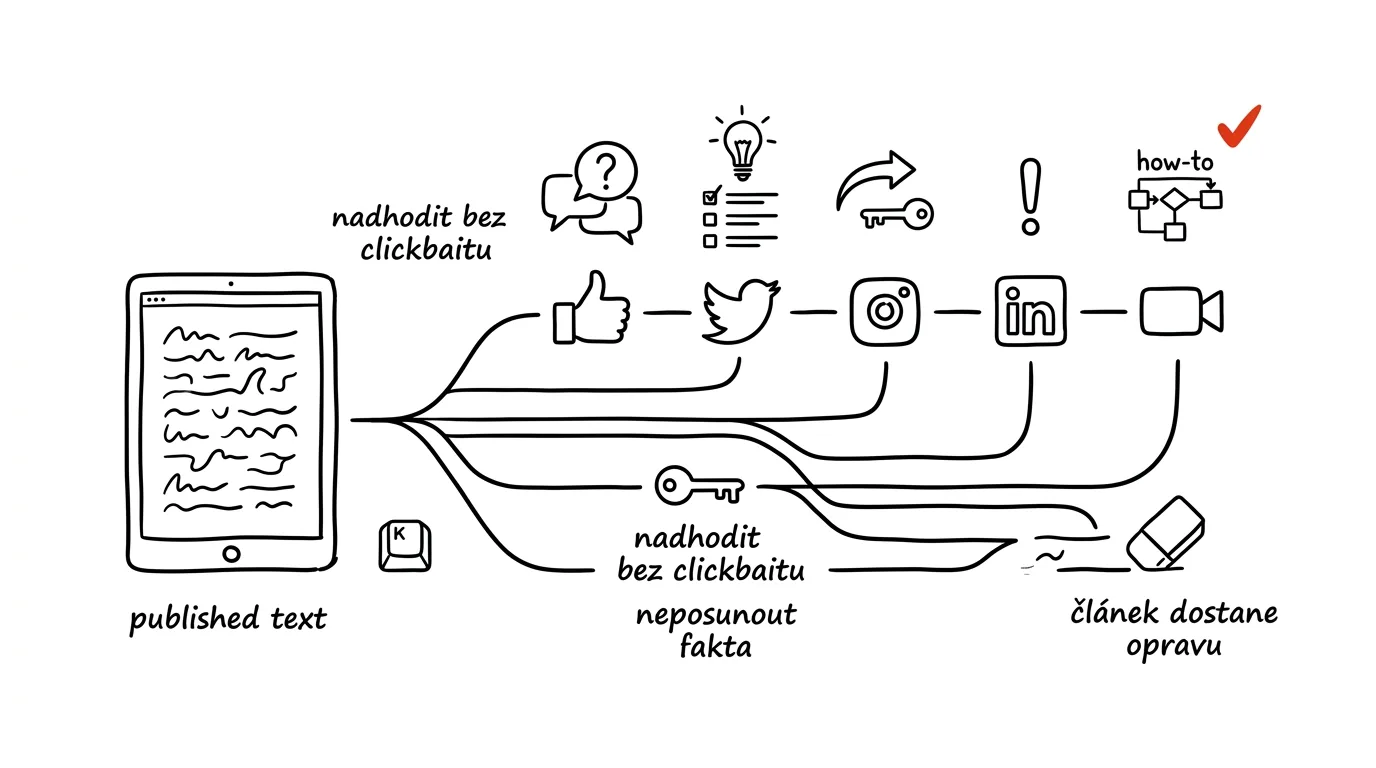
Networks don't just differ in character count — mainly they differ in why people read them there. Roughly:
- X and Bluesky. One sentence, one number or one name. The hook is specificity, not suspense. The attribution has to fit.
- Facebook. Two to four sentences. Room for “why this matters to you” — context that doesn't fit on a shorter network.
- LinkedIn. A professional angle: what the finding means for the industry, for authorities, for people in the field. The first line decides, because the rest sits behind “see more.”
- Instagram and stories. The image carries the message. The caption gets one claim, and a link mostly doesn't work there, so the hook has to stand up without a click-through.
- Newsletter. Three to five sentences; the reader has patience and already trusts you. This is where something goes that doesn't fit anywhere else: why you wrote it.
So the brief shouldn't say “make posts for social media” — it should give limits and a role for each network separately:
Here are 8 cores from a published article and a link to it.
Produce a set of posts. Each one stands on ONE core — note
its number. No post is a summary of the article.

- X / Bluesky: 2 posts, each under 260 characters including
  spaces, one specific number or name, attribution in the text
- Facebook: 2 posts, 3-4 sentences, the second sentence says
  who this affects
- LinkedIn: 1 post, 100-150 words, first line under 12 words,
  angle "what this means for the industry," no emoji, no
  hashtags
- Instagram: 1 caption under 300 characters, understandable
  without a click-through, plus a suggestion for the image
- Newsletter: 1 paragraph of 4 sentences, last sentence says
  what readers will find in the article beyond this

In every post: no claim that isn't in the article; hedges
and attribution carry over; numbers verbatim.
Don't use the intro or the headline verbatim.
Below each post, note which core it's based on.
How to tease without clickbait
The line isn't whether a post is enticing — it should be. It's whether it promises something the article doesn't deliver. Two tests settle that in a few seconds:
The delivery test. Read the post and write down what you now expect from it. Then open the article. If that expectation isn't there, or is weaker, the post is clickbait, even if every word in it is true.
The withholding test. Clickbait typically works by hiding the subject or the outcome (“This company got millions. Guess from whom.”). A newsy hook does the opposite: it states the most interesting part right away, and the reader clicks to find out how it happened.
Four patterns to avoid: a rhetorical question instead of a statement, “you won't believe” and its relatives, a superlative that isn't in the article (“unprecedented”), and a number pulled out of the context that explains it. This check can also be run on posts you didn't write:
Go through these posts and the attached article. For each
post, return:

1. what the post promises (as one sentence, as a reader would
   phrase it)
2. does the article deliver on it? YES / PARTIALLY / NO — and
   why
3. does the post withhold a subject, outcome, or amount to
   create curiosity?
4. does it contain a judgment or superlative that isn't in the
   article?
5. has an attribution or hedge from the article gone missing
   from the post?

Don't rewrite anything, just list findings with a quote.
Step 3: checking for drift against the article
A post is a publication under the newsroom's name. It's held to the same standard as the article, except more people read it and most of them never open the article at all. That's why this last step is worth doing even for a batch that looks flawless:
Compare each post with the article. I only care about the
facts.

Table: post | claim in the post | how the article states it | drift

Label the drift: MATCH / WEAKENED / STRENGTHENED / MISSING
ATTRIBUTION / MISSING HEDGE / NOT IN ARTICLE.

Check specifically:
- every number, character by character
- time references (does the article say "on Monday" and the
  post say "today"?)
- the distinction between being charged, indicted, and
  convicted
- whether "according to the document" quietly became a claim
  by the newsroom

Don't fix anything.
Always read the STRENGTHENED and NOT IN ARTICLE rows. The most common silent drift isn't an invented fact but a lost word: on the way down to 260 characters, “the company reportedly drew funds, according to the audit” becomes “the company drew funds,” and the newsroom suddenly claims something only the audit claimed.
When the article gets a correction
This is the part most often forgotten. The article gets corrected or amended, there's a footnote on the site — and posts on five networks keep asserting the original version. The habit worth building into a newsroom's routine: fix or delete every post touching the corrected fact, and for a significant correction, write a separate post about it. A new post that silently fixes the old one is not a correction.
The article received a correction. Original wording: [...]
Corrected wording: [...]

Here are the posts that went out with the article.
For each one, determine:
1. does the correction affect it? YES / NO
2. if yes: FIX (and propose new wording within the same
   character limit) or DELETE (and say why)

Finally, propose a standalone post about the correction:
what was wrong, what's correct now, no apologetic language
and no explaining why the error happened.
A second wave, when something moves
A published article doesn't end on publication day. When an authority responds, a court rules, or simply an anniversary comes around, an old article can be pulled back out — but only with a new reason, not by simply reposting it.
There's news on this article: [describe what happened and
attach the source].

Propose 3 posts that link back to the article. Each one must
open with the news, not the article — the article is context,
not the point. State the date of the original finding in the
post, so it's clear this isn't a new finding.

Limits: 260 characters, 3 sentences, 100 words (for three
different networks).
Nothing that isn't in the article or in the attached news.
A typical scenario
Reporter Jana publishes an article on Friday about regional subsidies. Instead of copying the intro, she runs the core-extraction prompt and gets eight; three of them stand on their own because they contain a number and a name. She has a set of posts produced, runs the clickbait check — it flags one post that promises an answer to a question the article leaves open, and Jana cuts it. The drift check finds two things: one post is missing the word “not yet final,” and another rounds off an amount. She fixes both. The whole set is done in twelve minutes. On Tuesday the region issues a statement; Jana runs the second-wave prompt and the article goes back out with a new reason.
What you get out of it
The most unpleasant part of the day after filing a story disappears — coming up with five different sentences when you're already worn out. The real saving is roughly forty minutes per article, but the main payoff is elsewhere: the drift check is a record that hand-written posts never produce, and it catches exactly the small thing that later gets a thousand-share post deleted over. A person still decides — the model proposes variants, the newsroom publishes.
Following on from working with tone across versions is changing a text's tone, for exact character limits fitting text to an exact character count, and for an image to go with the post, SVG diagrams.
Pro tip
Have a list of likely reader questions generated alongside the set of posts — the model predicts them surprisingly accurately from what the article leaves open. You'll answer half of them by pointing to a paragraph, and the rest tell you what was missing from the article. It's the cheapest feedback you'll get on a piece, and it arrives before readers give you any.
Want to go deeper? The handbook has a whole chapter on it — AI and automation.
Similar tips
Hlídač státu as a journalism tool
Contracts, subsidies, party donations, and the K-index right inside a conversation. Where a lead comes from and where data ends and an accusation begins.
In-depth guide · 58 min
A conference as a system: one program that generates everything
A complete guide with 23 prompts: the event program as structured data — generating the website, name badges, signage, posts, and MC notes. When a speaker cancels the day before, you fix one file, not eight outputs at 3 a.m.
In-depth guide · 57 min
A single source of truth for your marketing campaign: Canva, Buffer, Meta Ads, and Brevo via MCP
A complete guide with 25 prompts: a campaign document in git as the single source of truth, artwork from a brand template in Canva, scheduling through Buffer, ads through the Meta Ads MCP, and a newsletter in Brevo — six weeks of campaign where changing the tagline means one fix, not five rewrites.
Was this helpful?
Liked this tip?
I send one like it every week by email. Two minutes to read, hours saved.
The Top 30 tips e-book, free — it lands in your inbox right away.
Then 1 tip a week · no spam · unsubscribe in one click
Prefer a system to single tips? The free email course — seven days, seven emails, one skill a day.