Handbook · Freelancing · 16 min read
Financial peace of mind on your own: cash flow, a buffer, and taxes
Last reviewed:
Working for yourself doesn't fail because of low profit — it fails because the account is empty on the wrong day. How to separate profit from cash, how big a buffer to keep, why taxes are a question of the calendar, and how to ask for more.
In this article
- Profit and cash are two different numbers
- A buffer is measured in months, not money
- Separate accounts, and a system that survives five o'clock on a Friday
- Taxes and contributions as the rhythm of the year
- Unpaid invoices: prevention is cheaper than collection
- Investing in yourself is an operating cost, not a reward
- When to raise your price, and how to say it
- Key takeaways
The year was good. There was plenty of work, the rate finally went up, and when you total up what you billed over the year, it's the best number since you started working for yourself. And yet one Tuesday in February arrives when there's nothing on the account for rent — because the biggest client pays in sixty days, a second one bounced an invoice back for a missing order number, and at a third, “the accountant is on vacation.” Nothing went wrong. The work is done, the invoices are issued, the money exists. It just isn't here.
This gap tends to be the most unpleasant discovery of the first years working for yourself. As an employee, your pay arrived on a fixed day, and the only question was how to make it stretch. Working independently pulls earning and receiving apart: you do the work in January, invoice in February, the money arrives in the spring, and you pay tax on it on an entirely different rhythm — and in the meantime you have to live off something. Your books, the whole time, are saying business is good, and they're right. They're just talking about a different variable than the one your rent is asking about.
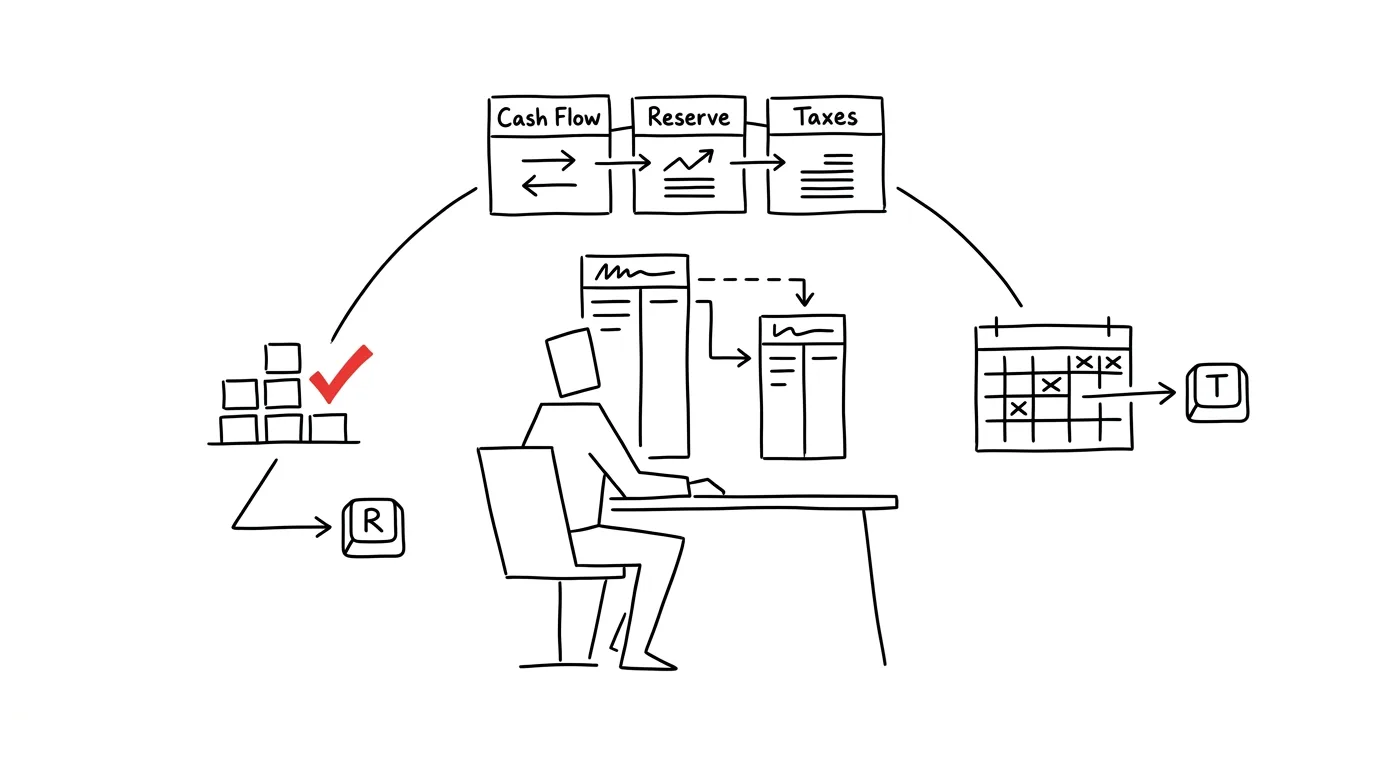
Working on your own doesn't fail because of low profit — it fails because on one specific day, there's no money in the account. The difference between profit and cash is the core of this chapter, and everything else follows from it: why a buffer is measured in months of operating cost, not money; why one account isn't enough; why taxes are a question of the calendar, not of nerve. This builds on the chapter Time as inventory, where the rate got calculated, and on Client operations, where the terms got negotiated. You won't find any rates, amounts, or specific dates here — those change, differ by setup and field, and belong with a tax advisor or accountant, not in an article.
Profit and cash are two different numbers
Profit is the difference between what you earned over a period and what it cost you. Cash is your account balance this morning. The two are only loosely related, and several sources of delay sit between them, and they add up.
The first source is your own invoicing: the work happens continuously, but the invoice only goes out at the end of a phase or a month, and if the admin gets postponed, easily two weeks later than that. The second is payment terms — short with small clients, considerably longer with big companies and the public sector, and in some fields a long payment term is a standard that's barely negotiable. The third is the approval loop on the client's side: an invoice has to pass through the person who confirms the work was actually done, then through accounting, then wait for a payment run, which happens once or twice a month. And the fourth is small formal errors — a missing order number, a different address — that send the invoice back to the start of the queue. Not because anyone doesn't want to pay, but because the system on the other end has no way to let it through.
Add it up, and there are commonly two to three months between doing the work and having the money in your account — even when everything is going fine. Anyone who doesn't account for that gap plans spending around the work they're currently doing instead of the money that's actually arriving — and because the work is visible and the money isn't yet, almost everyone does this.
It's worth saying the practical consequence out loud: the most dangerous moment usually isn't a crisis — it's growth. When the volume of work rises fast, costs go up first — more tools, more subcontracting, more time worked — while the revenue from it lands two to three months later. That means you can run into cash trouble at the exact moment things are, objectively, going best. And it's all the more surprising because subjectively everything feels great.
A forecast, not a report
The defense is simple, and nobody does it, because it looks like bookkeeping — and that's supposed to be somebody else's job. It isn't bookkeeping. It's a cash forecast: a three-month-ahead view where one column shows what's coming in and when, and the other shows what's going out and when. It fits in a single spreadsheet and takes a few minutes a week to update.
Inflows include issued invoices with the date the money will actually land — not the due date, but a realistic estimate based on how that particular client usually pays. Outflows include rent, loan payments, subscriptions, contributions, planned tax payments, living costs, and what you pay yourself. The most valuable number that comes out of it isn't the total, but the low point: the day in the next three months when the account will be at its lowest. Anyone who knows it ahead of time has several weeks to do something about it — send an invoice earlier, negotiate a deposit, push back a big purchase, chase a late payer. Anyone who doesn't know it finds out on the day it happens.
Building a forecast like this for the first time is usually an afternoon's work, because you have to figure out where the money is actually going. The fastest route runs through your own bank statement; the tip A personal budget in one evening: your bank statement and AI walks through the steps. If you want to go further and treat your own numbers as data — seasonality of income, the average time to payment for each client, how much of the total one client accounts for — the approach in the tip Analyzing data with AI is a good fit. Both apply the rule that applies everywhere: AI proposes, a human approves. And a bank statement is a sensitive document — it belongs strictly in a paid account with contractually protected data handling, ideally after stripping out account numbers and counterparties' names.
A buffer is measured in months, not money
The question “how much should I have saved” has no universal answer in currency, and any such answer would be useless, because costs are different for everyone. The usable unit is different: how many months of normal operating costs you could cover if the money stopped coming in today. Everyone calculates that number for themselves, and it has the advantage of changing along with your life.
A buffer actually has two layers that often get mixed together, and that's a mistake. The first is an operating cushion: money that smooths over the delay in payments. It isn't savings — it's working capital, covering the gap between doing the work and getting paid for it. The second layer is a personal reserve: money for the situation where there's no work at all, where you get sick, where you need to walk away from a client who made up half your revenue. This layer doesn't get touched.
How big it should be depends on things only the person living in that situation can judge. How much of your income one client accounts for. How long your payment terms run and how long the quiet stretch of the year tends to be. Whether you're the only income in the household, or there's a second one alongside you. How quickly you could line up a new job — in some fields that's two weeks, in others half a year. And whether you have regular obligations that can't be postponed.
A buffer doesn't get built by deciding at the end of the year to put something aside — money sitting in an account always looks available. Only one thing works: set it aside continuously and automatically, the moment a payment lands, not from whatever's left over. Anyone who leaves the buffer as the leftover will never have one, because the leftover is a variable that spending determines.
And when there's no buffer and a shortfall is looming, there's one option people don't like to mention: cut costs before the money runs out. Done ahead of time, it's incomparably easier than doing it in a panic.
Separate accounts, and a system that survives five o'clock on a Friday
The most common operating mistake when working on your own is a single account everything flows through: invoice income, business purchases, rent, groceries, and money set aside for tax. With an account like that, you can never tell how much of the balance is actually yours. A big balance looks like success — and then a tax bill shows up and it feels like an injustice.
The solution is mundane, and its effect is disproportionately large: separate the money by whose it is. At least three places. An operating account, where payments from clients arrive and business costs get paid from. A set-aside account for tax and contributions, into which a fixed share of every payment received moves immediately, and from which nothing else gets paid. And a personal account, into which you send yourself a regular amount as pay. How big that set-aside share should be depends on your tax setup, and someone who understands it should help you set it — but the mechanism itself applies to everyone.
The effect of this change is psychological more than financial. The tax money was never yours — it only passed through your account for a while — and when it sits somewhere else, paying it is a transfer, not a blow. Paying yourself a fixed amount also smooths out the seasonality covered in the chapter Time as inventory: a strong month doesn't turn into a big purchase and a weak one into panic, because the household gets the same amount every time and the swings stay contained in the business.
The other half of the system is rhythm. Paperwork has the property that, without a fixed slot, it seeps across the whole week and eats up more time than it would take done in one focused sitting. Invoicing, paperwork for your accountant, checking incoming payments, reminders, the cash forecast, expense records — all of these are line items in one standing block, as described in the tip The Friday admin block: invoicing, reports, email. The key is that the block happens even in a week where “there's nothing to deal with.” That's exactly when you check whether that's actually true.
The last component is the least popular and pays off the most: a money professional. An accountant or tax advisor isn't just a service that fills out a form — they've seen dozens of similar operations and will flag things that wouldn't occur to you. This is not a place where it pays to learn from your own mistakes, because mistakes here come with a delay and interest attached. A language model can explain terms and prepare questions for a meeting; decisions, and responsibility for them, belong to a person with the right qualifications.
Taxes and contributions as the rhythm of the year
Most of the stress around taxes doesn't come from their size, but from the fact that they arrive as a surprise. Yet this is the one part of the business you can know in detail ahead of time: the obligations repeat every year in the same order, and the only things that change are the specific figures and exact dates. Anyone who transfers that rhythm into a calendar once stops living in a mode where a disaster happens every spring.
The shape of the year is roughly this: regular, usually monthly, contributions that run continuously and are the most predictable line item in the business. A year-end close and tax filing in the first part of the year, along with reports for health insurance and social security. The annual reconciliation produces either a balance due or a refund, and at the same time recalculates the level of the regular advance payments for the next period — and it's this second step that tends to be the nasty surprise, because after a good year the regular payment goes up, and nobody planned for it. On top of that, advance tax payments can come due during the year, and value-added-tax payers have their own rhythm depending on the filing period they've chosen.
- OngoingContributions and record-keepingRegular payments and filing documents as you go. The cheapest part of the year if done continuously, the most expensive if left to catch up on.
- Turn of the yearPaperwork and stock-takingClosing out invoicing, filling in missing documents, checking unpaid invoices, and handing materials to your accountant.
- First part of the yearFiling and reportsAnnual tax reconciliation plus reports for health insurance and social security. Deadlines vary depending on how you file and who prepares the return.
- After reconciliationBalance due and new advance-payment levelTwo payments, not one: settling last year, plus a raised regular advance payment for the next one. This is the part that surprises the most people.
- Mid-yearA halfway checkCompare actual income to what you assumed, and verify the set-aside share still holds.
- End of yearDecisions you can't undoTiming purchases and payments, changing your setup for next year. This gets discussed with your advisor in November, not in March.
Two things to note about this timeline. First, specific dates and rates change and differ based on each person's situation — verify them with an accountant or tax advisor, not from what someone remembers from last year. Second, items from this timeline belong in the calendar as an action, ahead of time, not as a date. Not “filing deadline,” but “prepare paperwork,” three weeks in advance. A date by itself can't be done — an action can.
And one note about the set-aside share: it's better to set aside a bit more than you'll need than a bit less. Overpaying is a pleasant surprise, and in the worst case it just sat in a different account. Underpaying is a problem that gets dealt with at the worst possible moment — usually in the spring, right after the seasonal quiet stretch, when cash is at its lowest.
Unpaid invoices: prevention is cheaper than collection
Sooner or later, an invoice shows up that stays unpaid. It isn't an exception or a personal failure — it's an operating risk that comes with working for yourself. The difference between people for whom it eats up a week of their life and people for whom it costs half an hour is whether they have a procedure figured out in advance.
Most prevention happens before the work even starts, and it's covered in the chapter Client operations: a written agreement on scope and price, a deposit as a filter, installments tied to milestones, one decision-maker on the client's side. A few small things come with it. Send the invoice right after finishing a phase — every day of delay on your side adds to the wait on theirs. Put everything the other side needs to pay it on the invoice. And keep an eye on whether the payment actually arrived, which is exactly the part that doesn't happen without a standing block.
When an invoice doesn't arrive past its due date, a staged approach works. First, a short, factual reminder: often the invoice really did just get stuck somewhere, and one message shakes it loose. Then a phone call to a specific person, ideally the one who commissioned the work, not a general accounting inbox — asking what needs to happen for the payment to go through. Then a written reminder with a deadline and a mention of the next step. And only after that, legal action, which is worth it mainly for larger amounts and should be decided by someone who understands it.
Two things to add. Stopping work is legitimate — if the contract allows you to pause work on non-payment, it's sensible to do so before the debt grows, and above all, to write that into the agreement beforehand, not in the middle of a conflict. And stay factual in your communication: a reminder isn't a personal message, and the calmer it is, the more likely it is to make it through the system on the other side, where it'll be read by someone who isn't at fault for any of it anyway.
Finally, a risk connected to unpaid invoices and prior to them: dependence on a single client. When one client accounts for most of your revenue, that isn't success, it's concentrated risk — their delay is your crisis, and their departure is the end of your business. Spreading income across more sources is slow work, covered in the chapter Getting work without burning out on sales, and its value shows up exactly once — but fully.
Investing in yourself is an operating cost, not a reward
Employees get their training, tools, and a new laptop paid for, and nobody considers it generous — it's maintenance of their working capacity, and the employer gets back more than they put in. On your own, that employer is nobody but you. And yet training and equipment almost always end up in the “whatever's left over” category — the category of things that never actually happen.
The reason is understandable: a course or a better tool doesn't come with an invoice, and its payoff is indirect and delayed. But it's true that the skill you sell is your only piece of production equipment. Equipment nobody invests in loses value slowly and invisibly — you only notice once you're landing less interesting jobs on worse terms. It doesn't happen all at once, and that's exactly why it never gets addressed in time.
The practical solution has nothing to do with willpower. Investing in yourself belongs in the rate calculation as a line item, as the chapter Time as inventory described — whatever doesn't make it into the rate never happens. It also belongs in the calendar as time, not only in the budget as money: a course bought and never taken is a pure loss, and there are more of those than anyone expects. There's one sensible rule of thumb: a small, regular amount of money and a small, regular amount of time work better than one big burst investment you spend a year saving up for.
The same category includes things nobody thinks of as an investment, even though they are. Equipment that doesn't slow you down or hurt. Time spent on your own systems and templates, which pays off with every subsequent project. And health, which is the most underrated operating risk of working on your own, because there's nobody else to cover the cost of getting sick; the chapter Working in tune with your body covers the connections.
When to raise your price, and how to say it
Raising prices is the topic where economics and nerve get confused the most. Yet the question “should I raise my price” has fairly concrete answers, and most of them can be spotted before your patience runs out.
There are several signals, and they're fairly clear. You're fully booked and have to turn work away — that's the strongest one, because raising prices only really works from a position of strength. Your work is noticeably better or faster than it was a year ago. Your costs have risen, including the ones that aren't visible. Your annual rate recalculation came out different from your current price. You're taking on jobs with the feeling they don't pay off. And finally, the quietest signal: you haven't changed your price in so long you don't remember when. Prices that never change are actually falling — just slowly, and without it being visible.
How you communicate it rests on four things. In advance — with enough notice for the client to adjust their budget; a change effective next month is an unpleasant surprise, a change effective in three months is routine information. In writing and briefly, in one short message with no apologetic preamble. Without justifying it with your own situation — your costs and inflation aren't the client's problem, and citing them opens up negotiation on something that shouldn't be negotiable. And with a clear date the new price takes effect from, including that projects already in progress finish under the original terms.
One short sentence is enough: “Starting in January, I'm adjusting my rate. The project in progress will finish under the original terms — I wanted to tell you ahead of time so you can plan for it.” No apology, no waiting for permission. Anyone worried about the reaction can rehearse the conversation first — that's what the tip Rehearsing a hard conversation: AI plays the other side is for.
What's left is to expect that some clients will leave. That isn't a communication failure, it's price doing its job — and the ones who leave are usually the ones who were buying mostly on the number and cost the most energy. It's sensible to calculate ahead of time how many such departures you can absorb, so the decision doesn't get made in the heat of the moment when the first one happens. With long-standing clients, an increase tends to be more sensitive; it helps to do it in smaller, regular steps instead of one dramatic-looking jump every five years that's really just catching up on lost ground.
Key takeaways
- Profit and cash are two different numbers. There are commonly two to three months between doing the work and having the money in your account, and the riskiest period isn't a crisis — it's fast growth.
- The most valuable number is the low point of your forecast. A simple three-month view of inflows and outflows, updated once a week, turns a future problem into a task you have several weeks to handle.
- A buffer is counted in months of operating cost, not currency, and it has two layers: an operating cushion and a personal reserve. Set it aside the moment money arrives, not from whatever's left over.
- Separate the money by whose it is. An operating account, an account for taxes and contributions, and a personal account with a regular payment to yourself. The tax money was never yours.
- Taxes are a question of the calendar, not of nerve. The year's rhythm repeats, and what belongs in the calendar is an action taken ahead of time, not a deadline. Specific figures and dates change — they belong with your accountant or tax advisor.
- An unpaid invoice is an operating risk, not an insult. Prevention happens in the agreement and in fast invoicing; the response escalates in stages and stays factual.
- Investing in yourself is an operating cost. Your skill is the only piece of production equipment you have: it belongs in the rate as a line item and in the calendar as time.
- Raise your price when you're fully booked, not when your patience runs out. With notice, in writing, briefly, with a clear date, and without justifying it with your own costs.
Want to keep the momentum?
One tip from the handbook by email each week — in an order that makes sense.
The Top 30 tips e-book, free — it lands in your inbox right away.
Then 1 tip a week · no spam · unsubscribe in one click
Prefer a system to single tips? The free email course — seven days, seven emails, one skill a day.