Handbook · Freelancing · 15 min read
Time as inventory: capacity, rate, and seasonality
Last reviewed:
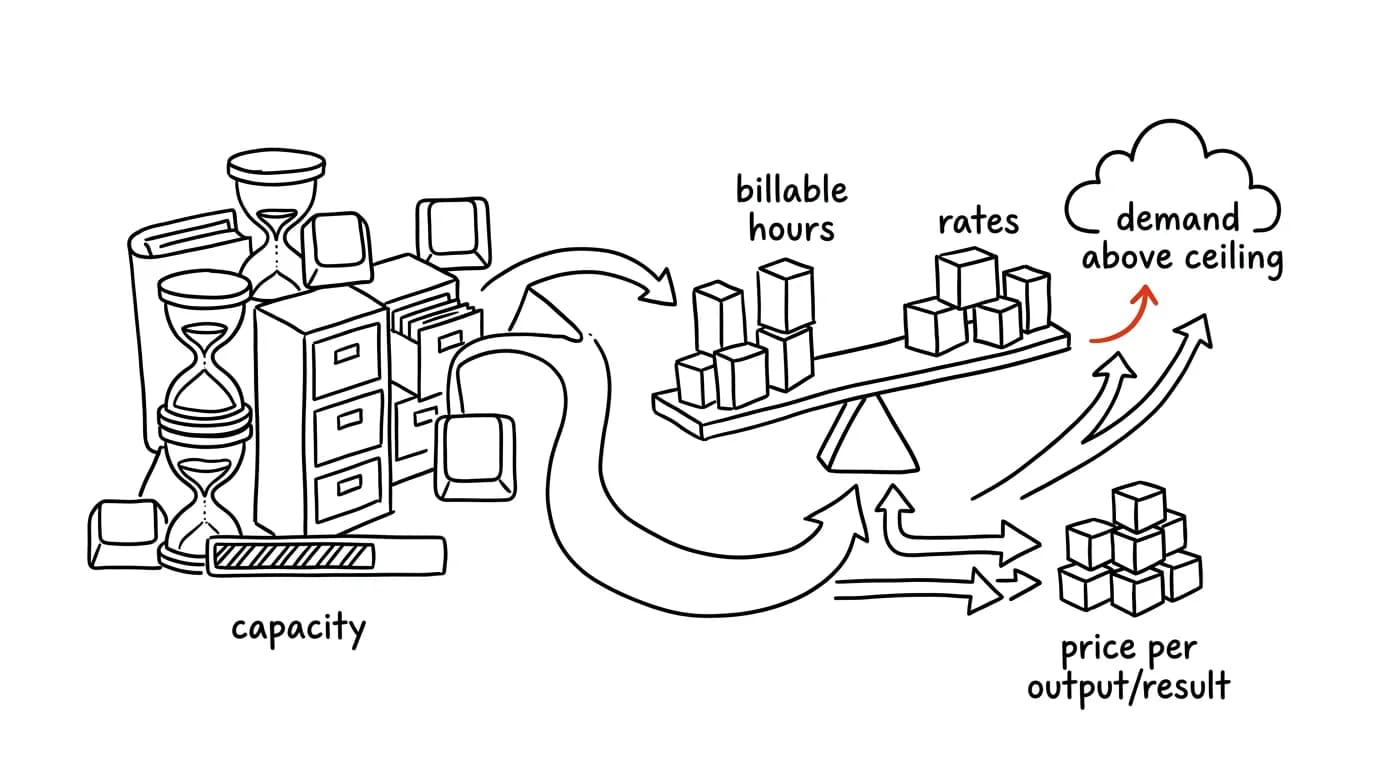
On your own, you don't sell work — you sell capacity, and billable hours are only a fraction of the week. How that math produces a rate, when a flat project price makes sense, and what to do when demand outstrips your ceiling.
In this article
- You're not selling work, you're selling capacity
- How many hours a week are actually for sale
- Your rate is the output of a calculation, not a feeling
- An hourly rate, or a price for the outcome
- The year has a shape: seasonality and rhythm
- The capacity ceiling, and what to do with demand above it
- Burnout from both directions
- Key takeaways
Almost everyone who moves from a job to working for themselves calculates their rate the same way at first. They take their old gross salary, divide it by the number of working hours in a month, add something on top “for the uncertainty” — and have a number to take to market. A year later they're staring at a bank statement, unable to understand why, for the same number of hours worked, there's noticeably less money left than before.
The mistake isn't in the number. It's in what never made it into the calculation. The old salary didn't have to account for who pays for vacation, sick leave, public holidays, a computer, an accountant, training, the time spent finding the next job, and the months when there's simply no work. An employee pays for all of that too — by not getting the full value they create. Working for yourself, you pay for it as well. You just see it now.
When you work for yourself, you don't sell finished work — you sell capacity: the ability to be available at a given time for a given type of job. And capacity is a strange kind of inventory. It can't be stored. An unused Wednesday can't be sold at a discount in November — it just vanishes. Almost everything else in this chapter follows from that single fact: why the rate is calculated differently than it looks; why there are fewer billable hours than the ones you actually work; why the year has a shape; and why an overloaded calendar can burn you out just as effectively as an empty one. This chapter is about the method, not the numbers. You'll have to fill in the actual figures yourself, because they're different for everyone — but the way you get to them is the same for all.
You're not selling work, you're selling capacity
The difference between selling work and selling capacity looks like semantics until you translate it into money. Someone who sells work thinks like this: I worked six hours, I'll bill six hours, and we're square. Someone who sells capacity thinks differently: to deliver those six hours, I had to be ready, available and capable for the whole week — and all of that has a cost, even though it never shows up as a line item on the invoice.
The closest analogy is industries that work with this idea openly. A hotel doesn't sell beds, it sells nights; an airline doesn't sell seats, it sells departures. An unsold room on Tuesday can't be sold twice on Saturday. That's why prices move with season and occupancy, and why nobody in hospitality prices a room as “cost of the linens plus a reasonable margin.” The price has to cover the empty nights too, or the hotel doesn't pay for itself.
That leads to the first uncomfortable conclusion. The price of an hour you did sell has to cover the hours you couldn't. Not out of greed, but because otherwise the year doesn't add up. Anyone who charges only enough to cover that one specific hour is funding their downtime out of their own savings — and that model holds up for exactly as long as the savings do.
The second conclusion concerns comparing yourself to employees. A freelance hourly rate and an employee's hourly wage aren't comparable numbers, even though they share the same units. In one case, the price includes almost everything that belongs to the job; in the other, almost nothing. Anyone who doesn't account for that difference will always feel expensive with their own rate — and will discount it at exactly the moments they should be holding firm.
How many hours a week are actually for sale
The idea of a forty-hour work week in which you bill forty hours is a fiction when you work for yourself. And it isn't a fiction in the sense that you occasionally fall short — it's structurally a fiction, because a substantial part of the work you have to do simply can't be billed to anyone.
Unbillable work falls into a handful of recurring categories. Sales and acquisition: chasing leads, calls with potential clients, writing proposals that sometimes land and sometimes don't, negotiating scope. Administration: invoicing, payment reminders, paperwork for your accountant, contracts, taxes, record-keeping. Learning and staying sharp: new tool versions, following the field, courses, reading. Running your own business: setting up and maintaining tools, backups, your website, portfolio, email. Downtime and fragments: waiting for materials from a client, gaps between projects, time lost switching between them. Unpaid communication: emails, status updates, short “just a quick thing” calls that never make it onto any timesheet.
That chart isn't a norm or a recommendation — it's an illustration of a shape that recurs across independent work. What matters is that the billable share is somewhere between a bit under half and a bit over half of total time, and that the rest doesn't disappear just because you don't log it. It only disappears from the rate calculation — which is exactly how people working for themselves systematically undercharge.
You won't find this out by guessing. Everyone's estimates of their own time skew toward the story they tell about themselves, and working independently means there's no external check either. The only reliable way is one honestly logged month — not to judge yourself, but to find out the ratio. The tip Track a week: where your time actually goes walks through the practical steps. Rough categories are enough: project A, project B, sales, admin, learning, other. After a month you have a number you can plan around, instead of a feeling you can't.
There's one more thing measurement usually reveals: a large chunk of unbillable time isn't actually necessary. It's fragmentation. Admin done in five-minute pieces throughout the week eats up more time than the same admin done in one block — and, worse, it breaks up the blocks where you could be doing paid work. That's exactly why it makes sense to run one fixed weekly admin block, as the tip The Friday admin block: invoicing, reports, email describes. You can't make unbillable work go away, but you can bag it into one place so it doesn't contaminate the whole week.
Your rate is the output of a calculation, not a feeling
An hourly rate isn't pay for an hour. It's a ratio: how much money you need to bring in over a year, divided by the number of hours you'll actually sell that year. Both numbers can be calculated, and both are routinely calculated wrong.
- 1Annual cost of livingHow much net income you need for the year — rent, food, family, loan payments. Pull it from your statements, not your head.
- 2Cost of running the businessEquipment, software, accountant, insurance, travel, training, phone, workspace. An annual total, not a monthly guess.
- 3Taxes and contributionsDepends on your setup and field. Goes into the calculation upfront, not as an unpleasant surprise in the spring.
- 4Buffer and self-investmentFinancial cushion, new equipment, courses, retirement. Whatever doesn't make it into the rate never happens.
- 5Sellable hours per year52 weeks minus vacation, holidays, illness, and a buffer — and out of what's left, only the billable share you actually measured.
- 6The ratioThe first number divided by the second. What comes out is a floor below which the work doesn't pay — not a target price.
The most common mistake happens in the first step: people plug in what they think they need instead of what they actually spend. The gap is usually surprising, and going through your own statements reliably exposes it — the tip A personal budget in one evening: your bank statement and AI walks through the process, prompts included. Without this step, the whole calculation is built on a hunch.
The second common mistake is in the fifth step: people plug in something like “50 weeks times 40 hours” for sellable hours. That's a number nobody ever actually works. The year does have 52 weeks, but you need to subtract vacation, public holidays, sick days — your own and your kids' — and some buffer for things that happen and can't be planned for. Of what's left, only the billable share you measured in the earlier step is sellable. The number that comes out is usually roughly half the first guess. That isn't a calculation error — it's the reality the first guess was papering over.
What comes out is a floor, not a price. The calculation tells you where work stops paying off; the market tells you what you can actually get for it. When the two numbers don't meet — the calculated floor is higher than what the market will pay — that isn't a reason to nudge the rate down and finance the gap out of your own free time. It's a signal that something else needs to change: the type of work you take, your client segment, your specialization, or how you bill. A rate that doesn't add up is information, not a character flaw.
And one last thing people forget: the rate doesn't update itself. Costs rise, experience grows, market prices shift — and the number on the quote stays the same for years, because nobody wants to touch it. Recalculating once a year, on the same date as your tax return, is the cheapest available protection against slowly getting poorer.
An hourly rate, or a price for the outcome
An hourly rate and a fixed price for a deliverable aren't two philosophies you pick between based on temperament. They're two different ways of allocating risk — and the choice should follow from who is better placed to absorb the uncertainty in a given situation.
An hourly rate shifts the risk to the client. When the brief keeps changing mid-project, when nobody knows exactly how big the job will end up being, when it's ongoing work with no sharp end point, or consulting where the value happens in the conversation — an hourly rate is honest and simple. But it has two unpleasant properties. It punishes experience: the faster you get, the less you earn for the same result, which is economically absurd. And it points the client's attention at the wrong thing — they start watching the hours instead of the output.
A fixed price for the outcome shifts the risk to you. It makes sense where the deliverable is clearly bounded, where you've done something similar enough times to know how much effort it takes, and where the value to the client has little to do with how long it takes you. It rewards efficiency: templates, routine and experience translate directly into a better return per hour. The condition is being able to estimate the effort — and, above all, being able to describe precisely what's included in the price, because a fixed price without a defined scope is just an hourly rate where you forgot to count the hours.
The third option is a retainer for reserved capacity: the client buys a set amount of your availability over a given period, up front. It's the most predictable model for both sides — you know what to plan around, the client knows there will be time for them. A retainer has one risk, but it's a serious one: if nothing spells out how much capacity is included in the price and what happens once it's exceeded, the retainer turns into unlimited availability for a fixed fee. This is exactly where having prepared documents to build on pays off most; the tip Templates for proposals, contracts and invoices shows how to put them together properly once.
The practical rule of thumb fits in one sentence: the more reliably you can estimate the effort, the more a fixed price pays off; the vaguer the brief, the more an hourly rate pays off. And the same thing applies to both, as to any work agreement — it has to be written down what “done” means, how many rounds of revisions are included, and what happens if the brief changes along the way. Without that, the difference between hourly and fixed pricing washes out anyway, because the scope ends up getting negotiated only once the work is finished and you're in the weaker position.
The year has a shape: seasonality and rhythm
Anyone who plans around an average month is planning around a month that never happens. Almost every field has seasonality, and almost everyone discovers it for the first time only when it catches them off guard.
The shapes differ by field, but the logic is the same: demand follows the client's rhythm, not yours. Accounting and everything around it peaks around closing periods and tax filings. Education and training pick up in September and January. Anything tied to retail sees a rush before Christmas and a dead spell in January. Corporate work often gets commissioned at the start of the budget year and rushed to catch up before its end. August and the second half of December tend to go quiet almost everywhere, because the clients who approve and pay are on vacation.
Two practical consequences follow. First: you can't derive an annual budget from a good month. If you set your standard of living based on the best month of the season, you'll be financing every off-season month out of savings or debt. It's smarter to work from a rolling twelve-month view and smooth out the monthly swings yourself — in effect, paying yourself a stable amount out of an account that fills up unevenly.
Second: a quiet stretch isn't emptiness, it's a different kind of work. The things there's no time for during the season can be scheduled right here — portfolio maintenance, recalculating your rate, cleaning up your tools, learning, preparing templates, systematic outreach for the next season. Anyone who does this deliberately experiences the off-season as a working period with different content. Anyone who doesn't experiences it as a string of days where nothing happens and anxiety climbs.
Seasonality has one more layer that people working for themselves usually discover only after years: your own energy has it too. The year isn't a straight line for you either — there are stretches where work flows on its own, and stretches where everything is heavy going. Anyone who maps both and schedules demanding projects for the strong periods and maintenance for the weak ones gains more than from any productivity technique.
The capacity ceiling, and what to do with demand above it
Your capacity ceiling is the number of billable hours you can deliver sustainably — not the number of hours you can physically survive. The gap between those two numbers is the space where most bad decisions on your own get made.
The most dangerous response to demand above the ceiling is the most common one: take everything on and somehow manage. It works for a few weeks, then deadlines start slipping, quality drops, communication breaks down, and in the end what you're left with isn't more money but a damaged reputation with the people who referred you. Overcommitted work isn't a success — it's an unfunded promise.
There are four honest solutions, and each has a cost.
- A queue. Offer a later date. The simplest and often the best option, especially with clients who value the relationship. The risk is obvious: some of the demand goes elsewhere. A queue only works if the dates get kept — otherwise all it produces is delayed disappointment.
- Price. Raise it. Price is actually the fastest demand regulator you have available, and a full calendar is the one moment when you can raise your rate from a position of strength. Anyone who never raised their price when they were swamped with work will never raise it at all.
- Rejection and selection. When you can't get to everything, you start deciding what's worth doing. That's uncomfortable only until you realize you're always choosing — either consciously, or by whoever wrote to you first. Turning something down with a referral to a colleague is, incidentally, the cheapest investment you can make in your own network.
- Subcontracting or partnering. The seemingly most elegant solution, and in reality the biggest change. At that point you stop selling your own capacity and start managing someone else's — you take on responsibility for quality you don't fully control, and shift part of your time from doing the work to coordinating it. That can be a good move, but it's a different business, not a scaled-up version of the one you had. The chapter Leadership and delegation is useful for delegating and handing off context, even though it's written for companies — the principles of handing off work apply to a two-person collaboration too.
The fifth solution is indirect: increase the return on each hour. Templates, automating repetitive steps, better tools, less context-switching, protected blocks of focused work as described in the Pomodoro and time blocking chapter. You can gain a surprising amount this way — but it's worth knowing that all you're doing is moving the ceiling. It doesn't disappear, it just shifts a bit further out.
Burnout from both directions
Burnout from overload gets talked about a lot and is fairly well described: too much work, no boundaries, no end to the working day. On your own it has an additional specific shape — nobody tells you you've had enough, and every extra job looks like insurance against a lean month that might be coming.
There's less talk about the other side, which is just as common when you work for yourself: burnout from underused capacity. An empty week looks like rest, but it doesn't function like rest. There's no structure, no feedback, no sense of purpose — instead there's a constant, low-grade anxiety that you should be doing something. The result is the worst possible combination: you don't rest, because you feel guilty, and you don't work, because there's nothing to work on. After a few weeks like that, the same exhaustion sets in as after overload — it's just harder to explain to people around you who see an open calendar.
The defense against both is, paradoxically, the same: a fixed structure that doesn't depend on how busy you are. A start and end to the working day that hold even when there's little work. A defined agenda for slow days, prepared in advance so you don't have to invent one in a moment of weakness. A separate space and a clear transition between work and personal life — the chapter Home office covers that in detail. And the acknowledged fact that looking for work is work: it belongs inside working hours, not Sunday evening.
It also helps to watch your own warning signs before they harden into a state. The chapter The psychology of productivity describes how to recognize burnout early; on your own, one specific signal gets added to the general ones — the moment you start taking on jobs you already know you don't want, just to keep your calendar full. That's almost always fear, not a business decision.
One last note for the whole chapter: capacity isn't measured only in hours. Two hundred hours of routine work and two hundred hours of work that demands constant decisions and dealing with people are two completely different numbers, even though they bill the same. Anyone who plans purely by the hour will sooner or later hit a ceiling that never showed up on any spreadsheet. How to actually secure enough demand to have something to choose from is the subject of the next chapter in this series — on getting work without burning out on sales.
Key takeaways
- You're not selling hours, you're selling capacity. Capacity can't be stored, so the price of a sold hour has to cover the hours you couldn't sell too.
- Billable hours are a fraction of the week. Sales, admin, learning, operations and downtime don't disappear because you don't log them — they only disappear from the rate calculation. Measure one honest month; a guess isn't enough here.
- The rate is a ratio, not a feeling: annual need, including costs, taxes and a buffer, divided by hours you can actually sell. The result is a floor; the market sets the ceiling, and the gap between them is information, not personal failure.
- Hourly and fixed pricing split the risk differently. A vague brief and ongoing work suit an hourly rate; a bounded, well-estimated deliverable suits a fixed price. Either way, “done” has to be written down.
- The year has a shape. Plan in a twelve-month window, schedule the off-season as a different kind of work, and recalculate your rate once a year.
- There are four honest solutions once you hit the capacity ceiling: a queue, a price increase, saying no, or subcontracting. The fifth, “I'll somehow manage,” is an unfunded promise paid for in reputation.
- An empty calendar can burn you out just as badly. A fixed daily structure, a prepared agenda for slow periods, and job-hunting scheduled inside working hours protect against both forms of burnout.
Want to keep the momentum?
One tip from the handbook by email each week — in an order that makes sense.
The Top 30 tips e-book, free — it lands in your inbox right away.
Then 1 tip a week · no spam · unsubscribe in one click
Prefer a system to single tips? The free email course — seven days, seven emails, one skill a day.