Handbook · Situations · 12 min read
Team productivity: the art of collective performance
Last reviewed:
Synchronous vs. asynchronous communication, meetings that actually go somewhere, and tools as the team's nervous system.
In this article
Think of a team as a living organism. Just as the human body needs perfectly synchronized systems to function, a working group requires a delicate balance between individual creativity and shared effort. Productivity stopped being about how many hours someone spends in the office or how many tasks they check off a long time ago — it's the art of creating an environment where the energy, ideas, and abilities of individuals multiply rather than merely add up.
Modern teams face unprecedented challenges. Geographic boundaries have essentially ceased to exist, technology has transformed the way we communicate, and every team member brings a different perspective and a different working rhythm. It's no accident that the most successful organizations today invest enormous resources into understanding the dynamics of collaboration.
The key is realizing that communication isn't just an exchange of information but the building of mutual understanding. When a team communicates truly effectively, it overcomes obstacles that would seem insurmountable to an individual. It's like an orchestra where every instrument plays its part and together they create a harmony richer than the sum of the individual performances.
Synchronous vs. asynchronous: partners, not rivals
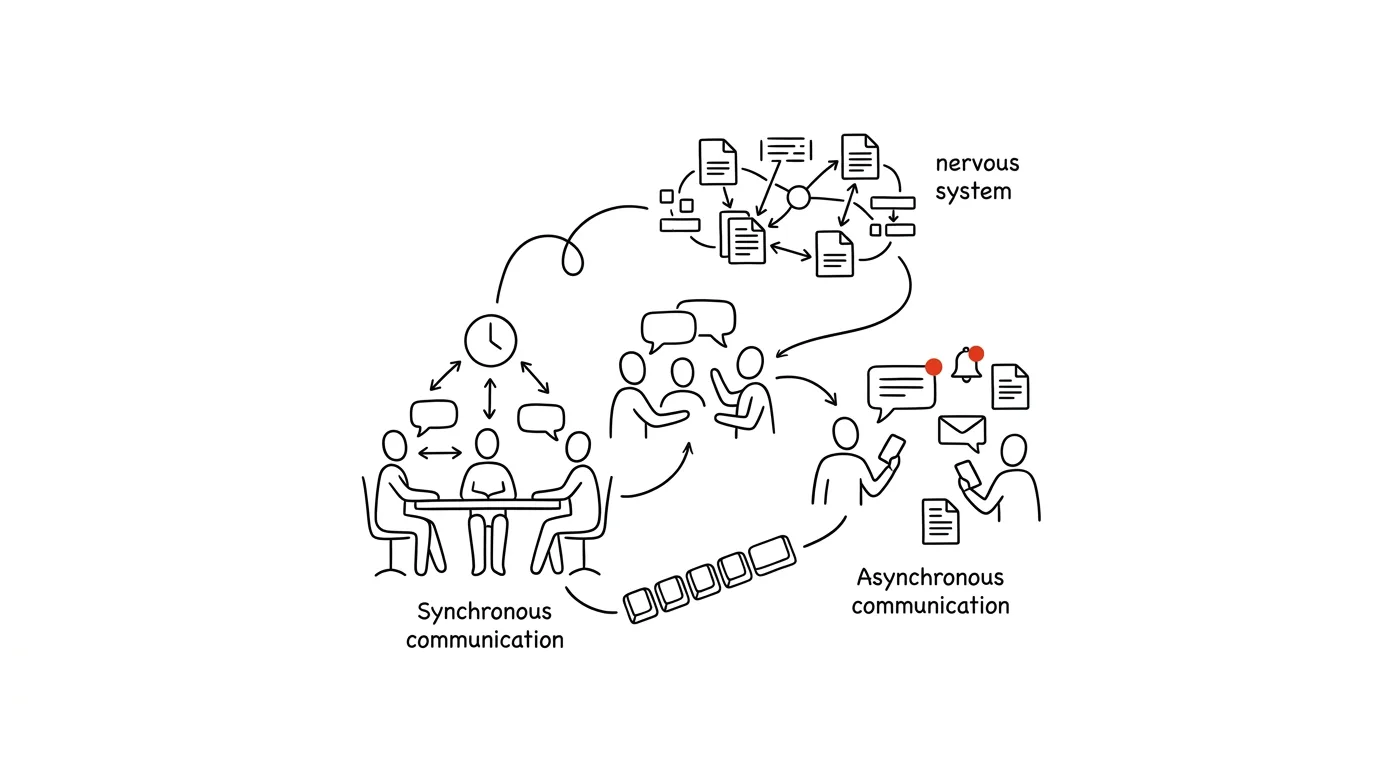
Synchronous and asynchronous communication aren't rivals. They're two different tools for two different jobs — and most team problems come from reaching for the wrong one.
Synchronous communication — direct calls, video conferences, real-time chat — allows for a rapid exchange of ideas, relationship building, and solving complex problems. When a team needs to agree quickly, or when an urgent situation has to be resolved, live communication is irreplaceable.
It works best for complex problems, brainstorming, urgent situations, building team spirit, resolving conflicts, and strategic decisions. Tools: video calls (Zoom, Google Meet, Microsoft Teams — pick one main tool for the whole team, not three depending on the mood) and instant messaging (Slack, Teams, Discord).
Its risks are real, though: it interrupts focused work, it's draining (especially for introverts), coordinating across time zones is hard, and there's always the risk of a call that never needed to happen.
Asynchronous communication — detailed messages, shared documents, project platforms, recorded video messages — offers depth and room for considered responses. It lets people work during their most productive hours and respects different working styles and time zones.
Favor it for detailed messages, more complex briefs, international teams, projects that require deep focus, and handing over detailed information. Tools: project platforms (Asana, Trello, Notion, ClickUp), documentation tools (Google Docs, Confluence, Dropbox Paper), and recording tools (Loom and other screen recorders — a two-minute video often replaces a half-hour call).
Kvadrant „Důležité, neurgentní“ je místo, kde vzniká skutečný pokrok — plánujte si pro něj čas dřív, než ho urgence sežerou.
Strategies for effective communication
Splitting things into synchronous and asynchronous isn't enough on its own. Without rules, every tool turns into a source of interruption.
Setting boundaries. Clear communication hours, notifications off outside working hours, honest use of Do Not Disturb. The boundaries have to apply to the whole team, otherwise nobody will dare to honor them.
Technical setup. Group channels instead of direct messages (so information stays findable for everyone else), categorizing messages by importance, filters and labels. A direct message is the most expensive form of communication in a team — it locks the information inside two heads.
Communication etiquette. Respecting other people's time, clear and concise messages, materials prepared in advance, timely replies. The sentence “the materials are in the doc, please read them before the meeting” saves twenty minutes in a ten-person meeting.
From experience: the best test of whether something should be a meeting is simple — try writing it out first. If while writing you realize the matter is clear, you've just saved a meeting. If three open questions come up, you have your agenda.
Meetings that actually go somewhere
Meetings are the most frequently criticized black hole in productivity. But a well-run gathering can be a catalyst for change. The point isn't to fill an hour with conversation but to create room for strategic thinking, sharing ideas, and building team spirit. Every meeting should have a clear goal, a prepared structure, and concrete outputs.
- 1BeforeA clear goal, agenda and materials sent in advance, a schedule, defined roles. No agenda = no meeting.
- 2OpeningStart on time, brief introductions, restate the goal.
- 3DuringTime-boxed segments, everyone actively involved, key points captured, recaps along the way.
- 4ClosingClear outputs: who, what, by when. And a thank you.
- 5AfterNotes sent within 24 hours, follow-up on the tasks, feedback.
The invitation is part of the preparation, not a formality. It should include the exact time, the length of the meeting, the joining link, the agenda, and what participants should prepare. An invitation without an agenda is a request for an hour of someone else's life without giving a reason.
Three healthy types of meeting:
- Stand-up — short, daily or weekly, 15 minutes maximum, in the format “what happened / what's next / what's blocking me.” You stand so nobody sits around for long.
- Strategic — quarterly or annual planning, longer and more complex, requires real preparation, and doesn't belong at the end of a working day.
- Problem-solving — tackling one specific challenge, a narrow focus, and only the people who genuinely have something to contribute.
Everything else, try asynchronously first.
Tools: the team's nervous system
Collaboration tools these days resemble a nervous system more than mere software. Platforms like Slack, Notion, or Asana don't just define how you work — they create the team's culture. They enable transparency, knowledge sharing, and continuous improvement.
- Project management: Asana, Trello, ClickUp, Jira
- Documentation and knowledge: Notion, Confluence, Google Workspace
- Communication: Slack, Microsoft Teams, Discord
- Design and visual collaboration: Figma, Miro, Mural
Selection criteria: compatibility with your existing systems, the user interface (a tool nobody wants to open is a dead tool), integration options, cost, and security. On security, be specific: where the data lives, who has access after someone leaves the team, and what happens if you cancel the tool. The same goes double for tools with built-in AI — check whether the content of your documents and conversations is used to train models, and what your company policy says about it.
But be careful — technology alone doesn't work miracles. It's the way of thinking and working that makes a team genuinely effective. Ten tools with no agreement about which is used for what is worse than two used consistently.
Optimizing the team workflow
Workflow optimization isn't a one-off event but a continuous process of learning and adaptation. Successful teams are like flexible organisms — constantly evolving and adjusting to a changing environment.
Principles of optimization:
- Standardized processes — clear procedures, shared methods, consistent tools. Boring, but it works: the less you have to decide about form, the more energy is left for substance.
- Continuous improvement — regular retrospectives, feedback, experimentation.
- Individual development — support for learning, training, mentoring. A team only grows as fast as its people do.
Practical steps: map the current workflow, identify the bottlenecks, propose improvements, implement them, and measure the impact. Then start over.
A dynamic team ecosystem
The human dimension matters most. No system and no technology replaces mutual respect, open communication, and a shared vision. A productive team isn't a collection of individual performances — it's a community where everyone understands their role in a wider context and is motivated not only by personal success but by the success of the whole.
A living team needs four things: clear communication, mutual respect, flexibility, and constant learning. The key lies in finding balance — between structure and creativity, between synchronous and asynchronous communication, between individual needs and team goals.
In an era of constant change, team productivity is more than a management term. It's the ability to face challenges collectively, overcome obstacles, and create something together that goes beyond what any individual could manage. It takes patience, empathy, strategic thinking, and a willingness to learn. And above all: seeing the team as a living organism — changeable, fragile, but with enormous potential.
Related tips
1:1s with a standing document
A shared document both sides keep adding to between meetings. The meeting has structure, and the history is easy to find.
Office hours: availability with boundaries
Two hours a day when anyone can come to you with anything — and the rest of the day belongs to your own work. The team adjusts within a week.
No agenda, no meeting
One simple rule that erases half your meetings: whoever calls the meeting sends an agenda and expected outcome in advance.
Slack: Ctrl+K jumps to any channel or teammate
Ctrl+K
The quick switcher finds a channel, a message, or a person in a few keystrokes. Slack's single most important shortcut.
Want to keep the momentum?
One tip from the handbook by email each week — in an order that makes sense.
The Top 30 tips e-book, free — it lands in your inbox right away.
Then 1 tip a week · no spam · unsubscribe in one click
Prefer a system to single tips? The free email course — seven days, seven emails, one skill a day.