Tips & tricks · AI · Everywhere · ~better one-on-ones in 5 min of prep · 18 min read · in-depth guide, doing it ~2 h
One-on-one with AI: prep, delivery, continuity
Last reviewed:
In this article
- A typical scenario
- Phase 1: A notebook per person
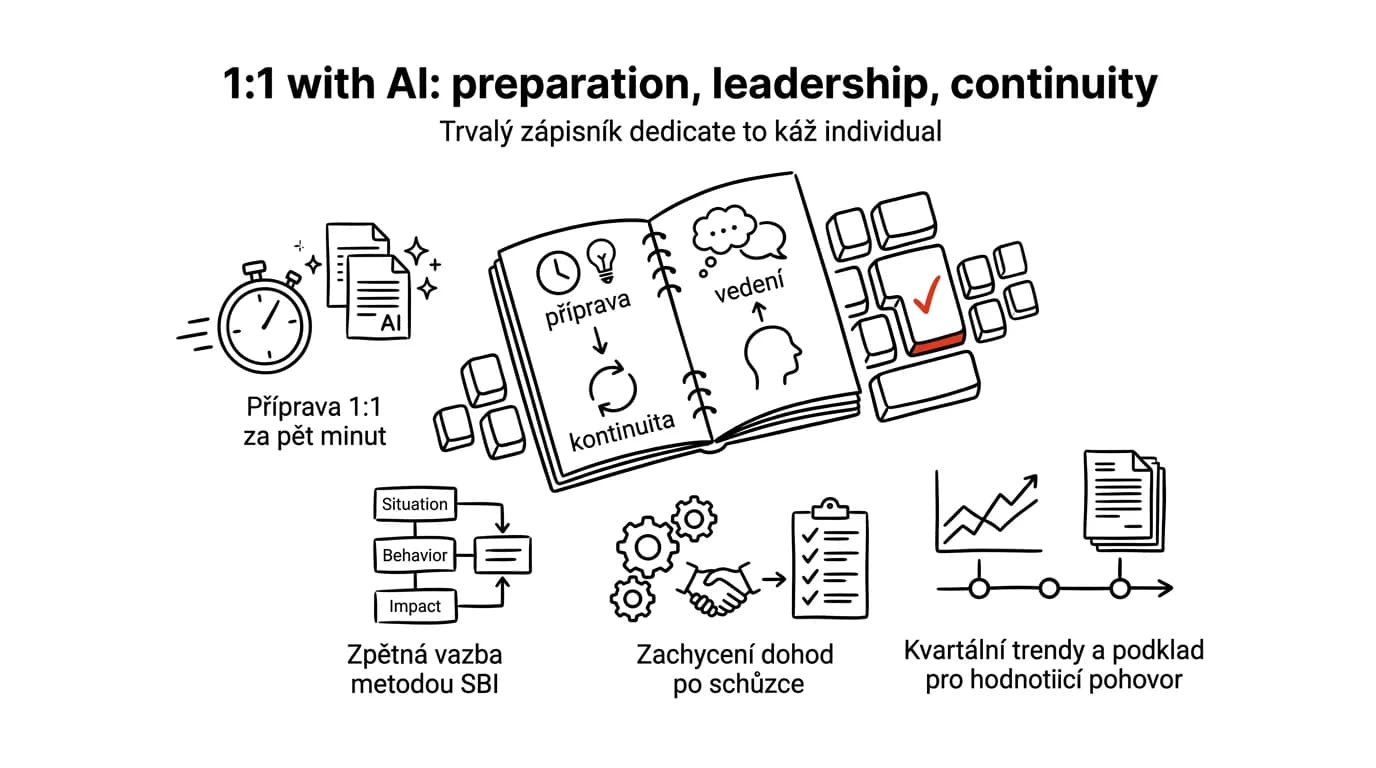
- Phase 2: Five-minute one-on-one prep
- Phase 3: Feedback you can actually say out loud
- Phase 4: After the meeting — agreements that don't vanish
- Phase 5: The quarterly view — trends, not impressions
- Phase 6: A performance review built from a full year's history
- Common mistakes
- The best tools
- What you get out of it
- Pro tip
Most managers don't have a problem holding one-on-ones. Their problem is that every one starts from zero. You open your calendar, see “1:1 Martin” in ten minutes, skim Slack and email, remember two things from day-to-day operations — and spend half an hour on task statuses you could have just read in the task list. The topic the person wanted to raise since last time never comes up again. The feedback you meant to give three weeks ago fizzled out. And a year later, writing up the performance review, you're working from impressions of the last month.
One thing is missing: memory that survives between meetings. Not a better calendar or another task tool, but a place where it's written down, for each person, what they were dealing with, what got agreed, and where they're headed long-term — and that you can ask questions of. This is exactly what AI is good at: reading your own notes, finding the connections in them, and assembling a five-minute prep from them before the meeting. It doesn't manage people for you. It does the scrolling back for you.
This guide follows the order you'd actually roll it out in: first a notebook per person, then prep, then how to phrase feedback, then capturing agreements, a quarterly view, and finally the performance review. Before you start, accept one rule that governs the whole piece: notes about people are sensitive data. They belong only in a company account with contractual data protection, never in a free chat tool on a personal profile, and they should be written the way you could bear having read aloud — in front of that person. The second rule is just as hard: evaluating a person is a manager's decision. AI may prepare the material and back it up with examples. It won't write the rating, the raise, or the sentence “didn't meet expectations” for you.
A typical scenario
Petra manages a team of seven and has a one-on-one with each of them every two weeks. She used to prep the evening before, and it took her ten to fifteen minutes per person: clicking through Slack, going through email, trying to remember. Even so, the meeting would still open with “so what's new,” and the first ten minutes went to ticket status. When it came time in January to write the annual review, she sat over a blank document, mostly recalling November and December.
Now she has one text file per person in a Project — a card with role, goals, and agreements, and below it a chronological log of every meeting. She adds notes to the file on an ongoing basis, sometimes just three sentences typed on her phone after a hallway conversation. Before a meeting she writes one prompt and, two minutes later, has on screen: what was agreed last time and how it turned out, whose task it was (often hers), three recurring themes, and one question she hasn't asked in the last three meetings. She has feedback translated from an irritated “he handed it in late again” into a sentence about the situation, the behavior, and the impact — one she can say without wincing.
The change isn't that the one-on-ones got shorter. They still run half an hour — but the first ten minutes no longer belong to recapping. And the January review got written from twenty-six logged meetings instead of a vague impression.
Phase 1: A notebook per person
One file per person, not one for the whole team
The foundation is boring and decides everything else: one standing document per person, updated continuously. Not a shared team spreadsheet, not notes scattered across meeting minutes. One file, chronological, newest at the top or the bottom — it just has to stay consistent.
Pick the format based on where you actually work. A plain text or markdown file in a folder AI can see is the most robust: it opens anywhere, never breaks, and is searchable. Notion or a Google Doc work too, just expect to paste the content into the chat by hand or via a connector. Note the difference from a shared one-on-one document: that one is joint, and both sides write in it. A manager's notebook is yours alone, and holds things that don't belong in the shared document — your doubts, half-formed thoughts about someone's development, notes toward a review. The ideal is to keep both and never mix them.
A person card at the top of the file holds context that changes about once every six months:
Help me set up a notebook for someone on my team.
Role: [position]. Time on the team: [duration]. Experience
level: [junior/mid/senior].
What they're working on: [projects]. What they enjoy: [what
you know].
Where they want to end up: [long-term goal, if you know it].

Suggest a structure for a card at the top of the file: what
sections it should have so they still make sense to me a year
from now, and what belongs in each one.
Assume a chronological log from every one-on-one will go
below the card.

For each section, note in one sentence how often it gets
updated (every meeting / quarterly / once a year).
Don't make anything up about this person — where you're
missing information, write QUESTION: [what I should ask myself].
You'll get back a skeleton with six to eight sections — typically role and responsibilities, long-term goals, agreed-on development, what works well for them, open topics, feedback history. Go through the questions at the end honestly: most managers find they can't fill in the “where they want to end up” line for half their team. That's a finding, not a flaw in the prompt.
What to write down and what not to
Write down what you wouldn't remember in three months but that would be useful: agreements (who, what, by when — including your own), context (what's going on with them, what's slowing them down), long-term themes (wants to lead people, wants to go deeper technically, is working through a balance with family), specific behavioral examples — good and problematic alike, with a date and situation. The last point is the one that makes the whole system pay off: a documented example from March is incomparably stronger at a review in December than a feeling.
Don't write down three things. Assumptions about their private life (what you think is going on for them at home). Health information and anything from protected categories, unless it's an HR record kept under your company's formal process — a manager's notes file is not the right place. And evaluative labels with nothing behind them: “he's unreliable” doesn't belong anywhere, “pushed the deadline back three times in a row without warning, on 4/3, 4/18, and 5/2” does. The difference isn't strictness — it's that the first sentence can't be defended and the second one can.
A test that works: would I write it this way if this person read it tomorrow? At most companies, the right of access to personal data is a real thing, not a theoretical one. Sober phrasing isn't caution for its own sake — it's the only form that holds up.
A Project as standing context
So AI doesn't need the rules handed to it every single time, set up a dedicated Project with standing context for managing people. The rules go into the instructions, and your notebook's structure — plus your company's evaluation framework, if it has one — goes into the knowledge.
Write me project instructions for a project where I work
with notebooks on my team members (one-on-one prep, feedback,
material for reviews). My team: [number] people, field [field],
company [size].

The instructions must include at least this:
- work exclusively with what's in my notes, don't make
  anything up
- where the notes aren't enough for a conclusion, write
  MISSING MATERIAL instead of guessing
- distinguish a documented fact (date, situation) from my
  own impression, and always state which one it is
- phrase things soberly, no labels on a person's character
- never suggest a rating, a raise, or any HR action
- when I ask about a review, return material and questions,
  not a verdict

Write it as finished instruction text, not as a
recommendation. At the end, add 3 sentences you think I
should fill in to match my company's specifics.
You'll get back instructions to drop into the project, and you won't need to touch them again. Check the second-to-last rule especially — it's the only safeguard against the model, unprompted, writing “I recommend rating B” while prepping a review. Material is its job; the verdict is yours.
Phase 2: Five-minute one-on-one prep
The prompt that replaces scrolling back
Prep needs to answer three questions: what did we promise each other, which of it still holds, and what has to get discussed today. The whole trick is that the answer is already in the notes — nobody just wants to go dig it out.
Prep a one-on-one with [name] for me, the meeting is [when]
and we have [30] minutes.
Attaching their notebook — the card and notes from the last
few meetings.

[paste file contents]

Give me structured prep:
1. Open agreements from last time: what, who (including mine),
   status per the last entry. For each, note whether the notes
   show it's done, or whether there's been no mention of it
   since.
2. What to follow up on: 3 topics that keep recurring in the
   notes and never got resolved into a decision.
3. What hasn't come up in a while: topics from the card
   (development, goals) we haven't talked about in at least
   2 meetings.
4. Three questions to open the meeting with — specific to
   their situation, not a generic “how are you.”
5. One thing I should acknowledge based on the notes.

Work only from the text I attached. Where you're not sure,
say so.
You'll get back prep you can read in two minutes. Point 1's “mine” section is usually the most valuable part — the most common silent flaw in one-on-ones is a manager who never checks up on their own promises. And point 3 is a safeguard against the meeting turning into a status update: if “development” lights up three meetings in a row, that's a signal, not a statistic.
Opening questions that aren't generic
The difference between “how are you” and a good question is specificity. A question that names a project, a person, or a situation from the notes opens the conversation two levels deeper.
From these notes on [name], suggest 8 questions for a
one-on-one.

[paste the last 3 entries]

Split them into:
- 2 questions about current work that ask about obstacles,
  not status
- 2 questions about what, per the notes, has been bothering
  them for a while
- 2 questions about development and where they want to go
- 2 questions about me: what they need from me, and what I'm
  doing wrong

For each, note in one sentence why to ask it that way, and
what to avoid so it doesn't sound like a check-up.
No yes/no questions.
You'll get back a set to pick three from. The last pair is the uncomfortable one, and also the most useful — the question “what am I doing that makes your work harder” only has a chance of landing if you ask it repeatedly and then actually change something based on the answer.
The first one-on-one with a new person
For a new hire there's no history yet, so the prep looks different: it's about gathering the context that will feed the notebook for the next year. It pairs well with onboarding via a Project — the new hire asks the documentation questions, and in the one-on-one you ask about whatever the documentation doesn't know.
Tomorrow I have my first one-on-one with a new team member.
Role: [position]. Start date: [when]. Prior experience: [what
you know].
Team: [number of people, what they do]. My leadership style:
[description].

Prepare a structure for a 45-minute first meeting:
- what I should say about myself and how we'll work together
  (5 sentences)
- 8 questions to learn how they want to be led: what
  motivates them, how they want to receive feedback, what
  wore them down in past jobs
- what from the answers I should write into their notebook,
  and why
- 3 things I should NOT do in this first meeting

Ask like a human, not like an HR questionnaire.
You'll get back a script that turns into the person card after the meeting. Write down the answer to “how do you want to receive feedback” word for word — six months from now, when you're phrasing something uncomfortable, it'll be the most useful note in the whole file.
Phase 3: Feedback you can actually say out loud
SBI: situation, behavior, impact
Feedback fails on phrasing more often than on substance. “You're unreliable” is an attack on someone's character, one they'll defend against, and it can't even be fixed — character doesn't change by Friday. SBI is a simple framework that turns an attack into information: situation (exactly when and where), behavior (what I saw and heard, without interpretation), impact (what it caused — for me, the team, the client).
In practice, the difference is this: instead of “you interrupt people in meetings,” you say “at Tuesday's meeting you finished Jana's sentence for her three times (situation, behavior) — she stopped talking and her proposal never got heard (impact).” The first version can be dismissed; the second can't. AI is good at this conversion because it doesn't share your frustration: it can pull out what's observation and what's already interpretation from an angry note.
I want to give feedback. Here's my raw note, written in the
moment when it was bothering me:

[paste note]

Convert it into the SBI structure:
- Situation: exactly when and where (ask me if it's missing)
- Behavior: only what was seen and heard, no interpretation
  of intent
- Impact: what it caused, concretely and verifiably

Then, separately, list for me:
1. What in my note is observation and what's already my
   interpretation
2. Which phrases judge the person instead of the situation
3. One question I should ask at the end to check I understood
   this correctly

Don't try to soften it into vagueness. I want to say it
clearly, in a way I won't be embarrassed about later.
You'll get back usable wording, and — more importantly — a list of places where you assumed intent (“he's doing it on purpose,” “he doesn't care”). That final question at the end is part of the method, not politeness — without it you're handing down a verdict, not giving feedback.
Praise works the same way
Most praise fails for the same reason most criticism does: it's generic. “Good job” doesn't move anyone forward, because there's no way to tell what to repeat. SBI works here too, and it's the cheapest leadership tool there is.
I want to recognize someone on my team. Here's what happened:

[describe the situation, messy is fine]

Phrase the recognition using SBI: a specific situation,
specific behavior, specific impact on the team or the client.

Give me three versions:
a) one-on-one, just the two of us
b) public, in the team channel, 3 sentences
c) for a review, as a documented example with a date

Avoid superlatives and phrases like “great job.” I want it to
be clear exactly what they should do again.
Version c) is the one people forget about: praise written into the notebook with a date becomes a documented example a year later. Praise said out loud and never written down is nothing a year later.
Rehearsing the hard things to say
When feedback affects someone's pay, role, or continued employment, phrasing alone isn't enough — you'll get a reaction you didn't expect. That's what rehearsing with AI playing the other side is for, covered in detail in the tip rehearsing a hard conversation. For a one-on-one, a shorter version is enough:
Play the role of someone on my team in a one-on-one. Context:
[position, how long at the company, how they react to
criticism based on my notes — paste the relevant passages].

I'm about to tell them this: [wording of the feedback].

Play them realistically: defensive at first, with substantive
counterarguments, then try shifting responsibility onto
circumstances or onto me.
Reply briefly, one line at a time, and wait for my response.
Don't cave immediately, but don't be a caricature either.

When I say END, drop out of character and write:
- where I drifted from a specific behavior into judging the
  person
- where I got pulled into defending myself
- the one sentence I should have said and didn't
You'll get back five to ten rounds of dialogue, then a breakdown. The finding is almost always the same: the manager backs off into generalities after the first defensive reaction, and the meeting ends without an agreement. Better to discover that in rehearsal than for real.
Phase 4: After the meeting — agreements that don't vanish
The ten minutes that create continuity
Writing up notes after a one-on-one is the single step the whole system stands or falls on. Without it, even the best prep is a one-time thing. The good news: it doesn't have to be polished. Dictate three paragraphs on your way out of the meeting and let AI clean them up.
Here are my raw notes from a one-on-one with [name], dictated
right after the meeting:

[paste notes]

Turn this into a notebook entry in this format:
- Date and length of the meeting
- What we talked about (3-5 bullet points, factual)
- Agreements: who | what | by when — mine and theirs listed
  separately
- What's still open for next time
- Signals I should keep an eye on (only what's actually in
  the notes)

Rules:
- don't add anything I didn't say; where a note is unclear,
  write VERIFY: [what]
- no judgment of the person, just a description of the
  situation and the agreements
- write soberly, assume they might read this too
You'll get back an entry to copy into the file. Hold to the last rule even when the notes are only for you — “he was off again” and “reacted irritably to two questions, but came back to the topic on his own after five minutes” differ in that you can actually work with the second one.
Your own promises, and tracking them
A manager usually promises something in a one-on-one: I'll find out, I'll talk to so-and-so, I'll get the budget, I'll let you know by Friday. These promises carry the highest cost when broken — from the other person's point of view, they're proof the one-on-one goes nowhere. Pull them out separately and put them in a task list, not in your head. The follow-up watchdog handles this systematically; at minimum, use this prompt:
Go through one-on-one notes for the whole team over the last
[6] weeks.

[paste notes]

List, in a table, EVERYTHING I promised:
to whom | what exactly | when I promised it | agreed deadline |
did a later entry mention it's done?

Sort by how long it's been hanging.
At the end, list 3 promises where the notes suggest the other
person is waiting on them and I haven't circled back since.

Don't guess anything — if the notes don't make the status
clear, write UNCLEAR.
The result tends to be uncomfortable, and that's the point. When the same promise hangs across three consecutive entries, it isn't forgetfulness — it's a decision you never actually made out loud. Either do it, or say so out loud and cross it off.
A routine that reminds you
When your mail and calendar are wired up via a connector, prep can run automatically on a schedule — scheduled routines can check your calendar each morning and prepare the material for you ahead of time. The rule stays the same as everywhere else: a routine prepares the material, a human runs the meeting and makes the decisions. Never let it send anything to people on your team on your behalf.
Phase 5: The quarterly view — trends, not impressions
What keeps recurring for a person
A single meeting shows you a mood. Six meetings in a row show you a pattern — and a pattern is what development gets built on. Nobody does this by hand, because nobody's going to reread a quarter's worth of notes. The model handles it in a minute.
Here's [name]'s notebook for the last quarter — the card and
[6] entries.

[paste content]

Analyze the trajectory:
1. Topics that recur in 3 or more entries — for each, note
   which dates it appeared on and whether it moved forward or
   stayed put.
2. What demonstrably improved: a concrete example from the
   notes (before X, now Y), not an impression.
3. What keeps coming back even after we agreed it would
   change.
4. Topics that disappeared — and whether that's because they
   got resolved, or because we just stopped talking about
   them.
5. What we didn't talk about at all this quarter, even though
   it's on the card as one of their long-term goals.

For each point, cite the date of the entry it's based on.
Where the material isn't enough for a conclusion, write
MISSING MATERIAL.
Don't judge the person, describe what's in the notes.
You'll get back an overview that doubles as the agenda for the next meeting. Point 4 is worth paying attention to — a lot of topics don't disappear because they got resolved, they disappear from fatigue, and that's information about you, not about them.
A view across the whole team
The second useful cut runs across the whole team and answers a question managers don't like asking themselves: who am I actually giving attention to, and who am I just handing operational tasks? It typically turns out you've spent six months talking to your most self-sufficient team member about nothing but tickets.
I'm attaching one-on-one notes for all [7] people on my team
for [quarter].

[paste notes, with each person's name]

Compare them across the team and give me:
1. Who's dominated by operational matters (task status) and
   who I actually get to development and direction with —
   based on the ratio of bullet points in the notes.
2. Who I didn't have a single career or goals conversation
   with this quarter.
3. Topics that come up independently for multiple people —
   that's usually a signal about the team or about me, not
   about the individual.
4. Whose entries are the shortest and sparsest — where I have
   the least material.

I'm not trying to evaluate people, I'm checking my own
attention. Phrase this descriptively, no conclusions about
individual ability.
Point 3 tends to be surprisingly valuable: when three people independently complain about the same thing, it isn't their issue, it's a systemic flaw in the process that the manager needs to fix. Point 4, meanwhile, flags who you'll struggle to write a review for a year from now, because you have nothing on them.
Phase 6: A performance review built from a full year's history
Material from facts, not from the last month
The annual review has one built-in flaw: memory. A manager remembers the last quarter and one standout event; everything else dissolves. The notebook cancels out that flaw — and with it, most of the time spent writing the review.
I'm preparing an annual performance review with [name].
Attaching their notebook for the whole year: the card, [24]
one-on-one entries, and feedback notes.

[paste content]

Put together MATERIAL for me, not an evaluation. I want:
1. A chronology of documented achievements: what, when, what
   impact it had — with a date reference for each.
2. Documented problem situations the same way, descriptively,
   with no labels.
3. Goals agreed on at the start of the year, and what the
   entries say about them.
4. How recurring themes evolved (quarter by quarter).
5. What's missing from the material for me to be able to
   discuss [area].
6. A separately marked list: what's in the notes as a
   documented fact, and what's just my impression with
   nothing behind it.

Don't suggest a rating, a raise, or any HR decision.
You'll get back four to six pages of material, and you write the actual evaluation yourself — which is exactly the division of labor that makes sense. Point 6 is the single most important thing in this whole guide. The “this is just my impression” list is what separates a review that holds up from one that falls apart at the first objection.
Once more, plainly: the verdict is yours. AI doesn't know your company's criteria in all their unwritten detail, doesn't sit in on calibration meetings, and doesn't bear the consequences. If the model suggests a rating anyway, ignore it — and add the ban to your project instructions.
Preparing for the conversation itself
The material is half the job. The other half is the conversation itself, where questions about pay, promotion, and things you never said all year will come up.
I have material ready for a performance review with [name]
[paste the material or a summary of it].

Prepare me for the conversation:
- 10 questions and objections I can expect from them, ranked
  by likelihood; specifically flag the ones aimed at pay,
  promotion, and fairness of the review
- for each, a skeleton of an honest answer in three points
- 3 questions my material doesn't have a good answer for, and
  how to admit that fairly
- 5 sentences to open the conversation with, so it doesn't
  start like a trial

Don't tell me what to promise them. Decisions about pay and
promotion are mine and the company's to make, not yours.
The third bullet is the valuable one: every review has spots where the manager doesn't know, and admitting “I don't have enough material on this, I'll keep an eye on it next quarter” beats an improvised answer the other person will remember word for word.
After the review: goals for the next period
Goals come out of the review, and they have the highest mortality rate of any agreement in a company. Write them into the person's card and reference them every fifth meeting or so — or have yourself reminded quarterly of where they stand.
These agreements and goals came out of the performance review
with [name]:

[paste]

1. Reword each goal so that a quarter from now, it's clear
   whether it happened — what exactly would have to be
   visible.
2. For each one, write what I need to do to make it possible
   (access, time, budget, opportunity), not just what they
   need to do.
3. Suggest when to revisit each one: a specific month and a
   question to ask in a one-on-one.
4. Flag goals that depend on things outside their control —
   those can't be evaluated as their performance.

Give me point 4 even if it feels uncomfortable.
Point 2 is the test that determines which goals survive: a development goal with no commitment from the manager is just a wish. Point 4 protects both sides from a year from now evaluating bad luck as performance.
Common mistakes
- Letting AI write the evaluation. The model doesn't know your company's unwritten criteria, calibration process, or the context of other people involved. Material, yes. Documented examples, yes. A verdict, no — the evaluation is a manager's decision, and a human owns it.
- Writing sentences into the notebook you wouldn't say out loud. Notes about people are sensitive data, and phrasing like “he's lazy” can neither be defended nor fixed. Describe behavior and situation with a date, not character.
- Uploading notes about people into a free chat tool on a personal account. They belong only in a company account with contractual data protection. And you often don't even need names or sensitive details: an anonymized version is enough for working on phrasing.
- Turning the one-on-one into a status update. When the prep returns just a list of tasks, the meeting will be about tasks. That's why the prep specifically asks about topics that haven't come up in a while.
- Writing down only their commitments, not yours. A manager's broken promises are the fastest way to make someone stop taking one-on-ones seriously — that's why they get their own line in every entry.
- Taking the output of an analysis as fact. The model only works with what you wrote down. When entries are missing for three months, “improved” means “I have no record of it,” not a finding.
The best tools
- An AI Project with standing context — set up the rules and the notebook structure once; every prep after that runs on two sentences instead of a half-page prompt.
- Text files in a folder (markdown) — one file per person, searchable, portable, and durable; you can work over the folder in desktop mode without copy-pasting into a chat.
- Notion or a Google Doc — when your team is used to writing in a shared space; mainly useful for the shared one-on-one document you keep alongside your own notebook.
- Dictating on your phone — three sentences right after the meeting on your way out; let the model clean up the raw dictation, and that's what actually gets the entry written.
- Scheduled routines with a calendar connector — prepares material for today's one-on-ones each morning; the routine prepares the material, you run the meeting.
- A task list for your own promises — anything you promised in a one-on-one belongs out of your head and into a list with a deadline.
What you get out of it
- Time: prep drops from ten or fifteen minutes per person to five; for a seven-person team, that's an hour of recovered time every other week. The annual review takes an hour to write instead of half a day, because the material builds up continuously.
- Better leadership: topics don't get lost between meetings, feedback arrives within days instead of months, and it's phrased so it's actually usable. Development topics get room, because the prep itself flags when they haven't come up in two months.
- Peace of mind: you don't have to remember what anyone was dealing with three months ago, or dig through Slack before a meeting. Going into a performance review, you're sitting over a documented history, not a blank document.
- Fairness: an evaluation built on dated examples holds up both to the person and to HR — and the separate “this is just my impression” list shows you in time where you're judging without evidence.
Pro tip
Keep a section in the notebook called “things to tell them when there's time.” Most important feedback never gets said, not because the manager didn't want to, but because the moment it occurs to them isn't the right one — and two days later it's forgotten. A sentence written into the file shows up in prep for the next meeting, and the question “is there anything in here that's been waiting for the right moment for over a month?” usually has an uncomfortable answer.
And the final rule that overrides everything else: the notebook is a memory tool, not evidence. The moment you start writing notes to one day use them against someone, you've stopped managing people and started building a case file — and it shows up in your phrasing before you notice it yourself.
Want to go deeper? The handbook has a whole chapter on it — AI and automation.
Similar tips
Focus modes: every activity gets its own rules
Set up a Work mode that lets through only colleagues and family — synced to your iPhone and Apple Watch too.
Frozen app? Force quit without restarting
Cmd+Option+Esc
Cmd+Option+Esc is macOS's version of Ctrl+Alt+Delete. Quit a frozen app in three seconds.
Handoff: pick up unfinished work from iPhone on your Mac with one click
Finish an email you started on the tram, on your Mac, exactly where you left off. Handoff passes work in progress between your devices automatically.
Common questions
Can I let AI write a person's performance review?
No. The model doesn't know the unwritten company criteria, doesn't sit in calibration meetings, and bears no consequences. It may prepare the material and back it with dated examples, but it won't write the rating, the raise, or the sentence “didn't meet expectations” — evaluation is the manager's decision. If the model proposes a rating anyway, ignore it and add the prohibition to your project instructions.
What may I write in a notebook about people, and what not?
Record agreements, context, long-term themes, and specific examples of behavior with dates. Don't record guesses about someone's private life, health information, or judgmental labels without evidence — “he's unreliable” belongs nowhere, “pushed the deadline three times in a row without warning” does. The test: would I write it this way if the person read it tomorrow?
Where should notes about people be stored to keep this safe?
Only in a company account with contractual data protection, never a free chat on a personal profile. Names and sensitive details often aren't needed anyway — an anonymized version is enough for working on the phrasing of feedback.
How do I keep a 1:1 from turning into a status meeting?
The prep prompt specifically asks for themes that keep recurring without reaching a decision, and for card topics (growth, goals) not discussed for at least two meetings. When “growth” lights up three meetings in a row, that's a signal, not a statistic — and the opening questions ask about obstacles, not status.
What is the SBI method and why use it?
Situation, behavior, impact: when and where exactly, what I saw and heard without interpreting intent, and what it caused. It turns an attack on character (“you're unreliable”) into information that can be acted on — and AI is good at the conversion because it doesn't share your anger and separates observation from interpretation in a heated note.
Why record my own promises, not just theirs?
A manager's unkept promises are the fastest way for someone to stop taking one-on-ones seriously. That's why they get their own line in every log, and it pays to regularly list what you promised, to whom, and whether it happened — when the same promise hangs in three consecutive logs, either do it or say so out loud and delete it.
Was this helpful?
Liked this tip?
I send one like it every week by email. Two minutes to read, hours saved.
The Top 30 tips e-book, free — it lands in your inbox right away.
Then 1 tip a week · no spam · unsubscribe in one click
Prefer a system to single tips? The free email course — seven days, seven emails, one skill a day.