Tips & tricks · AI · Everywhere · ~a week per filled position · 19 min read · in-depth guide, doing it ~2 h
Hiring with AI: from job description to structured interview
Last reviewed:
In this article
- A typical scenario
- Phase 1: a job description from the team's reality
- Phase 2: an ad that speaks to the candidate
- Phase 3: sorting applications, and its hard limit
- Phase 4: the structured interview
- Phase 5: notes and comparing candidates
- Phase 6: rejection, offer, and start date
- Phase 7: what's left after the hire
- Common mistakes
- The best tools
- What you get out of it
- Pro tip
For most managers, hiring is work on top of work. The job description gets copied from the last posting, eighty applications come in, interviews get run off the cuff, and the decision comes down to a gut feeling from the last half hour. The result is a process that eats months, and its quality lives or dies by how well you happened to read the person across the table that day. AI can take most of that mechanics off your hands — and it's also the area with the hardest line of anything covered on this site.
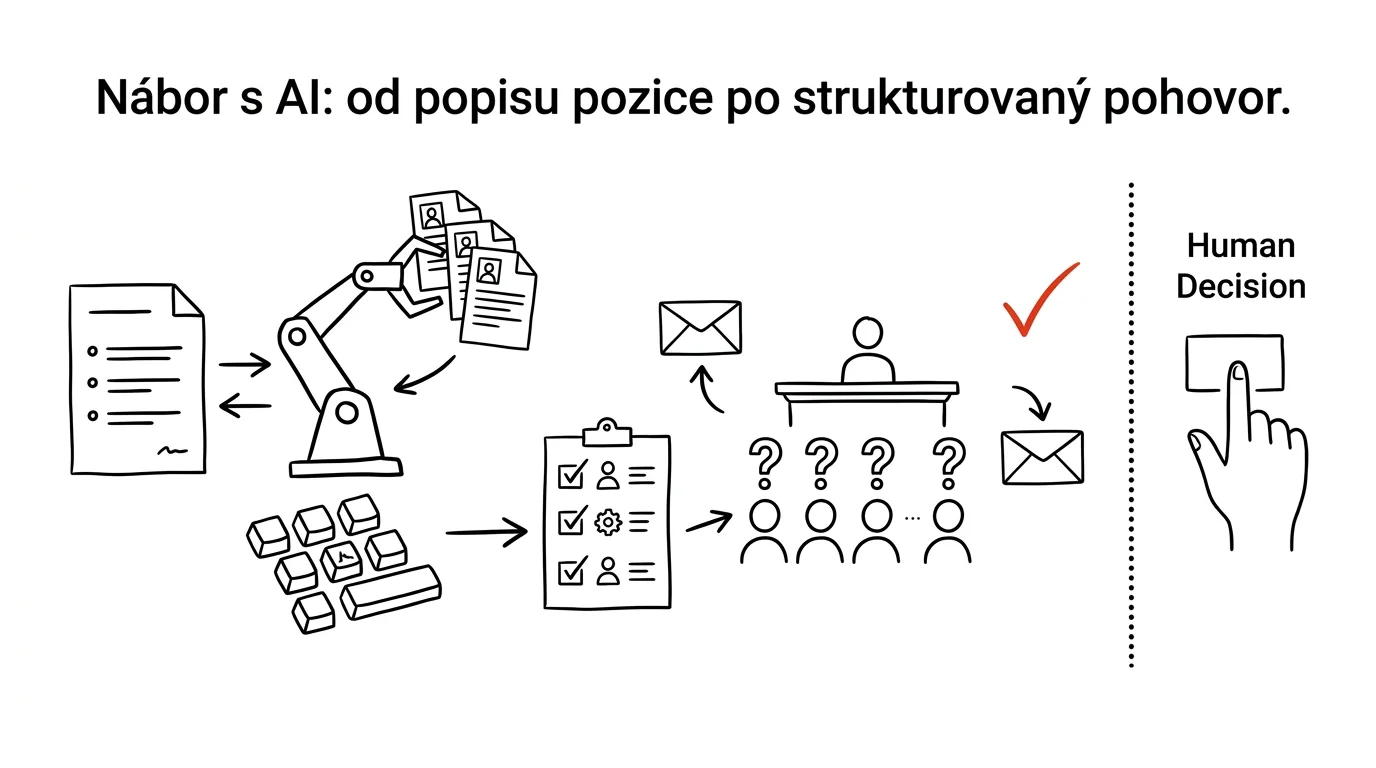
The line is this: AI may sort material against your criteria and prepare questions. It never decides on a candidate. It must never rank applicants by fit, must never say “this one, not that one,” and must never be asked “who should I hire.” This isn't caution for its own sake: automated candidate scoring reliably reproduces whatever bias was baked into the material it learned from, and a decision you can't explain except as “that's what the tool said” is indefensible, legally and humanly both. The EU's AI Act, on top of that, classifies AI used in recruitment and candidate selection as high-risk — with obligations like human oversight, transparency toward candidates, and documentable process. The exact deadlines and scope of those obligations have shifted over time, so check the current wording with your own legal counsel; the underlying principle doesn't change, though, and it's simple: a named human makes the decision and must be able to justify it without pointing at the tool.
This guide walks you through the whole hiring process: from a job description built on what the team actually does, through the ad and the scorecard, to a structured interview, comparing candidates, and a rejection that doesn't leave people talking badly about you. Every phase comes with prompts you can copy — just fill in the brackets. And running through all of it is one principle that comes back twice in concrete form: AI proposes, a human approves.
A typical scenario
Marek runs a ten-person team in operations and needs to fill one position. His previous round was a lesson in what not to do: the job description was stitched together from two old postings, seventy applications came in, Marek read them in bed at night, invited eight people in, and ran a different conversation with each one. Three weeks later, he had a feeling two of them were good, but couldn't say why — and when HR asked him to justify the choice, he wrote a sentence about the candidate being “the best fit for the team.” The offer went to someone who left after five months because the job turned out to be different from how Marek had described it.
The second round he ran differently. He started with a list of things the team wasn't keeping up with and turned that into the job description — instead of nine requirements he had four, because the rest could be learned on the job. He wrote the criteria and the rating scale before the first résumé arrived. He had applications converted into a uniform structure against those criteria: what's in the material, what's missing, what to ask about. He decided who to invite himself, and in ten cases he went against what looked best on paper.
Interviews had the same skeleton and the same six questions for everyone, plus three questions tailored to the specific experience on that person's résumé. He dictated notes into his phone right after each candidate left and had them tidied into the criteria structure. The decision meeting wasn't about impressions — it was about evidence against each criterion. The whole round took a week less than last time, and, most importantly, the justification for the hire fit on half a page and was true. Everyone got a rejection within three days, and two of them reached out again a year later.
Phase 1: a job description from the team's reality
The most common hiring mistake happens before the first applicant shows up. The job description gets written as a wish list — you collect what would be nice to have from everyone, and out comes a role for a person who doesn't exist. “Looking for a colleague with team-leadership experience, SQL skills, business acumen, C1-level English, and an appetite for learning new things.” That's not a set of requirements — it's five different people.
Start with what isn't getting done
An honest job description comes from day-to-day reality, not an org chart. Spend twenty minutes writing down what specifically isn't getting done on the team, or is getting done badly, because of a lack of capacity — and who's doing it instead right now. The role falls out of that list on its own.
I need to put together a job description for a new position on my
team. I don't want a wishlist — I want a role built on what the
team actually does.

Team: [how many people, what it does, who it reports to]
What currently isn't getting done, or is getting done badly, due to
lack of capacity: [list 8-12 specific tasks, and for each, who's
doing it now and how much time it takes]
What the new hire should take over in the first three months: [list]
What they'll do once they're up to speed: [list]
How we'll know it worked, a year in: [list]

Put together a job description that includes:
1. The job as 5-7 tasks in order of time spent, with an estimate
   of what percent of the week each takes.
2. Decisions this person makes on their own, and which ones they
   escalate.
3. Who they work with and how often.
4. Three outcomes that define success a year in — measurable, not
   “will be a great team member.”

Don't add anything I haven't given you in the brief. Where you're
missing information, write the question you should ask me instead.
You'll get a job description that shows what an ordinary week looks like — exactly the information candidates are looking for and can't find anywhere. Don't skip the questions at the end; they usually point at whatever you hadn't thought through yourself, typically the handoff points with other teams.
Cutting the wishlist down: must-have, nice-to-have, will-learn-here
Once the job description exists, comes the most useful ten minutes of the whole hiring process: sorting requirements into three buckets. Must-have is what someone can't function without in the first three months and can't pick up quickly. Nice-to-have shortens ramp-up time but isn't a condition. Will learn here belongs in the ad as an offer, not a requirement. Most job ads put six to ten items in the first bucket; a realistic number is three to four.
Here's the list of requirements we collected for the [title]
position, from the team and from leadership:

[paste all the requirements exactly as they came in]

Job duties and responsibilities: [paste the job description from
the previous step]

Sort the requirements into three groups, with a one-sentence
justification for each placement:
A) MUST-HAVE — can't do the job in the first three months without
   it, and it can't be picked up through onboarding
B) NICE-TO-HAVE — shortens ramp-up, but you can start without it
C) WILL LEARN HERE — belongs in the ad as an offer, not a
   requirement

Then tell me:
1. How many people on the market you think satisfy all of group A
   at once — and whether I accidentally combined two different
   roles into one.
2. Which requirements in group A are actually requirements for a
   trait rather than a skill, and how to reword them into something
   that can be demonstrated with an example in an interview.
3. Which requirements needlessly narrow the applicant pool without
   improving the outcome (for example, years of experience instead
   of a demonstrated ability, or a specific tool instead of a task
   type).
Point 1 tends to be uncomfortable, and that's exactly why it's there: most “unfillable” positions are actually two roles glued together. Point 3 tackles hiring's quiet killer — the “minimum 5 years of experience” requirement that screens out half the qualified people without improving quality at all.
Scorecard: criteria before the first résumé
Criteria written up after you've read the applications aren't criteria — they're a rationalization of what you happened to like. A scorecard is a simple table: four to six criteria, and for each one, what a weak, adequate, and strong level looks like, plus how you'll verify it in the interview. Print it out and fill it in the same way for every candidate.
Build me an evaluation scorecard for the [title] position.

Job description: [paste]
Group A and B requirements: [paste]

For each criterion (I want 4-6, no more), give me:
- a name and one sentence on exactly what it measures,
- a description of three levels — WEAK / ADEQUATE / STRONG — each
  described by what the candidate says or shows, not by
  adjectives,
- how it gets verified: an interview question, a practical
  exercise, a reference check,
- the weight of the criterion relative to the role, and why.

Criteria must be observable. None of them can be “culture fit,”
“team player,” or anything judged on impression — if I genuinely
need a trait like that, reword it into a specific behavior in a
specific situation that can be shown with a real example.

At the end, add a warning about which criteria are easy to score
in a biased way, and what to do about it.
You'll get a scorecard you can start using right away. The sentence about “culture fit” is in the prompt on purpose — it's the most common cover for deciding by likability, and it's also where discrimination sneaks into hiring without anyone intending it.
Phase 2: an ad that speaks to the candidate
Most job ads are written from the inside out: what the company is, what it wants, what it offers. The candidate, meanwhile, is looking for the answer to three different questions — what will I be doing on a Tuesday afternoon, with whom, and why should I want exactly this. An ad that answers those gets fewer applications, and more of the right ones.
Write a job ad for the [title] position at [industry, company
size, city].

Job description: [paste]
Must-have: [paste group A]
Will learn here: [paste group C]
What an ordinary week looks like: [paste]
Team: [paste — how many people, what they do, who leads]
What's hard or unpleasant about the job: [be honest]

Rules:
- open with what this person will be doing, not who we are,
- describe the work through concrete tasks and an ordinary week,
- requirements, max 5 bullets, phrased as an ability to demonstrate
  something, not years of experience,
- include the unpleasant part too — what isn't nice about the job;
  a candidate it scares off would have left within a year anyway,
- describe how the hiring process works: how many rounds, what
  each one covers, and by when we'll get back to people,
- no phrases like “dynamic team,” “friendly environment,”
  “interesting projects,”
- max [400] words, [informal / formal] address.
You'll get an ad that sounds like it was written by a person. Don't skip the paragraph on how the process works — it's the cheapest way to raise your completed-application rate, because silence and uncertainty are what people hate most. And don't let the “what's hard about it” part get smoothed away; it functions as pre-screening.
Checking for exclusionary wording
Discrimination in a job ad is usually unintentional and still legally risky. “Young, dynamic team,” “great for recent grads,” “looking for a female colleague for the front desk,” a native-language requirement where a working level would do — all of these narrow the applicant pool along lines that have nothing to do with job performance.
Review this job ad the way someone responsible for equal
treatment in hiring would. Don't rewrite it, just list your
findings.

Ad: [paste]

1. Wording that directly or indirectly references age, gender,
   marital status, health, nationality, religion, or any other
   personal trait — quote the specific sentence and say what's
   wrong with it.
2. Requirements that don't relate to job performance and needlessly
   narrow the pool (years of experience, a specific school, native
   language where a working level would do, a driver's license for
   a job with no travel).
3. Hidden signals in the tone — phrasing that hints at who the
   company “pictures” in the role.
4. For each finding, suggest neutral wording that keeps what I
   actually needed.

At the end, note what's missing from the ad so a candidate knows
how to apply and what to expect.
Go through the findings yourself — the model occasionally flags a neutral phrase and misses one that carries meaning specific to your industry. Legal judgment on borderline cases belongs to whoever's responsible for that at your company. Incidentally, the flip side of this coin — how a candidate tailors their résumé to the ad — is covered in the tip on a résumé tailored to the job listing; knowing what the other side is doing is useful when you're reading applications.
Phase 3: sorting applications, and its hard limit
This is where the guide gets the most cautious, and for good reason. Eighty résumés is exactly the kind of task that tempts you to let AI “just sort them somehow.” Don't.
What AI may and may not do
May: convert scattered material into a uniform structure, list what's in a résumé against a given criterion and what's missing, flag inconsistencies in a timeline, prepare follow-up questions, and summarize a cover letter. All of these are tasks where the model works with text right in front of it, and you can check the result yourself.
Must not: assign a candidate an overall score, rank applicants by fit, recommend who to invite, or infer traits from the material (“comes across as a team player”). And it must never be asked “who should I hire.”
The difference isn't cosmetic. Ranking by fit is a decision about people, even if you formally sign off on it afterward — in practice, you'll rarely deviate from a ranking a tool hands you. On top of that, two things are worth stating plainly, without alarmism. First, a model infers things from material that aren't stated directly, and in doing so reproduces patterns from the data it was trained on — with names, schools, gaps in a résumé, or length of experience, that can mean unequal treatment nobody intended. Second, the EU's AI Act classifies recruitment and candidate-selection systems as high-risk and attaches obligations like human oversight, informing candidates, and documentable process. A general-purpose chat tool you paste thirty résumés into is not a system that meets those requirements — and using it to decide on candidates is a bad idea on both counts, the legal one and the practical one.
The practical takeaway is simple: AI prepares the material, you record the decision, and you need to be able to justify it by pointing at the criteria, not the tool's output.
A structured extract against your criteria
Here's a résumé and cover letter from one applicant for the
[title] position, and my evaluation criteria.

Criteria: [paste the scorecard from phase 1]
Applicant's material: [paste the résumé and cover letter text]

Produce a structured extract — DO NOT SCORE OR RECOMMEND:
1. For each criterion, list exactly what's documented in the
   material: what experience, where, for how long, in what role.
   Quote the location in the material.
2. For each criterion, note what's NOT in the material — what I'd
   need to ask about to be able to judge it.
3. Career timeline and any spots where it's unclear or has a gap
   (just describe it, don't speculate about the reason).
4. Three follow-up questions that come directly out of this
   specific material, not generic questions.

Don't assign a score, don't rank, don't write a recommendation, and
don't infer traits or motivation. Stick to what's in the text.
You'll get the same structure for every applicant, which you can compare in a few minutes instead of two hours of reading. The ban on speculation in point 3 matters: a gap in a résumé usually has a reason that a question can uncover, not a guess. If the model starts evaluating anyway, repeat the instruction not to — and, above all, don't use the evaluation it gave you.
Anonymization and data protection
Before you paste any of this material anywhere, check two things. Where the data is going: a résumé is a bundle of personal data, often including date of birth, address, and a photo, and it belongs only in a paid account with contractual data protection, not a free chat tool. What the model actually needs to see: for an extract against your criteria, the professional section is enough. You can strip out name, contact info, date of birth, and photo before pasting, and work with a label like “applicant 7” instead — besides protecting data, it also shrinks the room for bias.
Phase 4: the structured interview
An unstructured interview is one of the worst-predicting selection tools in common use — and also one of the most popular, because it's easy. A structured interview means three things: the same questions for every candidate in the same order, scoring against criteria written in advance, and notes taken immediately. None of that is hard — it just has to be prepared ahead of time.
A question skeleton for everyone
Prepare a set of structured-interview questions for the [title]
position. The interview runs [60] minutes, with [two] interviewers.

Criteria and their levels: [paste the scorecard]
Job description: [paste]

I want:
1. For each criterion, one main question about a specific past
   experience (not a hypothetical) plus two follow-ups that get at
   what the candidate did themselves, not their team.
2. For each question, describe what a WEAK, ADEQUATE, and STRONG
   answer sounds like — specifically, how they differ.
3. One practical exercise for [15] minutes that I'll give every
   candidate the same way, plus how to score it.
4. A time-blocked interview schedule, including time for the
   candidate's questions (at least 10 minutes) and a description
   of next steps.

Questions must be the same for every candidate and must not ask
about age, family, health, plans to have children, religion, or
anything unrelated to job performance.
You'll get a complete interview script. The answer-level descriptions in point 2 are the reason to do this at all — without them, every interviewer defines a “strong answer” their own way, and scoring drifts apart.
Questions tailored to a specific résumé
Add two or three questions tailored to the specific candidate on top of the shared skeleton. This is where AI is strong: it can pull, from a specific project on a résumé, what to ask so you can tell what this person actually did.
Here's the professional section of a candidate's résumé and the
position's criteria.

Material: [paste]
Criteria: [paste]

Prepare 3 questions tailored directly to their experience. For
each one:
- why I'm asking it (which criterion it targets),
- what I want to hear in a good answer,
- how I'll tell they're describing the team's work instead of
  their own,
- one follow-up question that gets at a specific decision they made
  themselves, and its consequences.

Only ask about things that are actually in the material. Don't
invent anything or assume anything about their motivation or
personality.
You'll get questions that surprise the candidate in a good way — asking about their specific project is also the best available signal that you actually read the material.
How to ask, so it's worth something
Three habits that turn an interview into a source of evidence instead of a collection of impressions. Ask about the past, not hypotheticals. “What would you do if…” measures the ability to tell a story; “describe a time this happened” measures experience. Follow up on their role. When a candidate talks in “we,” ask what they specifically did and what decision they made. Let silence sit. The best part of an answer usually comes after a three-second pause that most interviewers can't stand and end up filling.
One more thing: an interview runs both ways. Ten minutes for the candidate's questions isn't a courtesy — it's information; what they ask tells you how they think about the job. If you need to rehearse handling a harder conversation yourself, the method is in rehearsing a hard conversation.
Phase 5: notes and comparing candidates
Memory of interviews is short, and it skews toward whoever was last and most likable. The only defense is notes written within fifteen minutes of the candidate leaving, while you still remember the exact phrasing.
From notes to structure
The fastest route is to dictate — on the walk from the door back to your desk, record a three-minute spoken summary and have it tidied into a structure. General coverage of automatic meeting notes is in meetings that write themselves up; for an interview, this prompt is all you need.
Here's my transcribed notes from the interview with candidate
[label] for the [title] position, and my evaluation criteria.

Criteria and levels: [paste the scorecard]
Notes and dictation transcript: [paste]

Put this into a structure:
1. For each criterion, list what the candidate said — in their own
   words where possible, not my interpretation.
2. For each criterion, flag whether I have enough material to
   score it, or what's missing (and what specifically).
3. List separately: facts they stated, my impressions, and my
   assumptions. Three separate lists.
4. What's still unresolved and needs following up on, either in the
   next round or with references.

Don't evaluate the candidate, don't assign levels or a score —
I fill in the levels myself. Don't add anything that isn't in the
notes.
Point 3 is the core of it. Separating “said they led the migration” from “came across as confident” and from “probably good at leading people” is work the human brain doesn't do on its own — and it's exactly the point where an interview turns into an impression. You fill in the scorecard levels yourself, by hand, even when it's inconvenient.
Comparing against criteria, not against each other
Once the scorecards are filled in, comparison comes next. The same line applies here too: the model prepares a clear table of evidence; you write the verdict.
Here are the filled-in scorecards for [4] candidates for the
[title] position. I filled in the criteria levels myself.

[paste the scorecards]

Prepare material for the decision meeting:
1. A table: criteria in rows, candidates in columns, each cell
   holding only the documented evidence in a few words (not my
   evaluation).
2. Which criteria show the biggest differences between candidates,
   and which are practically a tie.
3. Where I have too little material on any of them to decide, and
   what to add (another round, references, a practical exercise).
4. Questions the decision group should ask itself to check it isn't
   deciding on impression — for example, where a score rests only
   on how well someone presented.

Don't rank the candidates, don't recommend a winner, and don't
compute an overall score. We make the decision, and I write the
justification.
You'll get material you can actually debate on the merits. Point 4 is uncomfortable and is usually what saves the hire — it typically reveals that the strongest impression came from whoever spoke best, which only correlates with job performance for some roles.
The decision and its justification
Write the justification for your choice on half a page: which criterion tipped it, what evidence backed it, and why the other candidates didn't make it. It's written by the person who made the decision, and no one else. It's a record for HR, protection in case of a complaint, and above all a check on yourself — a justification that can't be written without the word “fit” usually means an impression made the call.
Phase 6: rejection, offer, and start date
A rejection email that's decent and specific
Rejection is the most underrated part of hiring, and it's the one thing about your company most applicants will end up talking about — because most of them don't get the job. Three rules: fast (within a few days, not a month), personal (name, position, one specific sentence about their material), and specific for anyone who made it to an interview (what specifically decided it, no generic phrases).
Give feedback that's factual and tied to the criteria, not the person. “We were looking for someone with independent migration-leadership experience, which you haven't had yet” is usable information. “You wouldn't have fit in with the team” isn't feedback — it's an insult with no content.
Write a rejection email to a candidate who interviewed with us for
the [title] position.

Stage they got to: [after the interview / after the second round]
What was strong on their side: [specifics]
What specifically tipped it in favor of another candidate:
[specifics, tied to a criterion, not to their personality]
Want to reach out to them in the future: [yes/no]
Tone: [formal], length under [180] words.

Rules:
- the first paragraph delivers the decision, no dragging it out,
- one specific, true sentence about what the team appreciated in
  their material or performance — it has to be true and based on
  what I give you,
- the reason phrased as a gap in required experience, not a
  personal shortcoming,
- offer the option to ask for more detailed feedback,
- no empty phrases like “we wish you every success in your future
  career” with no content, no “we'll keep your résumé on file”
  unless I actually have their consent for that,
- if I want to reach out in the future, say so specifically — for
  what role and why.

Don't invent anything I haven't given you in the brief.
Read the whole text before sending it. Sending is a human decision, and that's doubly true for a rejection: one imprecise sentence about the reasons can come back as a complaint. And really don't use the line about keeping their résumé on file automatically — holding onto material beyond the hiring process needs consent.
The offer and handing off to onboarding
Send the offer in writing and in full: position, start date, who they report to, and what the goal is for the first three months. From there it's onboarding — and what you wrote up in phase 1 (duties, decisions, year-one outcomes) is ready-made material for a first-weeks plan. How to turn that into onboarding that doesn't overwhelm a new hire is covered in onboarding a new hire through a Project.
Phase 7: what's left after the hire
Once the position is filled, you're left with a folder of dozens of résumés, notes, and interview records. That's personal data, and your responsibility for it doesn't end when the contract gets signed.
Candidate data
Four rules that apply regardless of company size. Process material only for the purpose people sent it for — this specific hiring round. Keep it only as long as you need it; once the process ends, delete unsuccessful applicants' material. Holding onto it longer, “for the database,” needs consent — asked for clearly, and revocable. Tell candidates how you handle their material and how long you keep it — ideally in a sentence right in the ad.
In practice, this mainly means one thing: write it down in advance and set yourself a reminder, because deletion is the step that gets forgotten in the relief of having filled the position.
Help me put together a plan for handling candidate material for the
[title] hiring round.

What we collect: [résumés, cover letters, interview notes,
scorecards, interviewer notes, tests]
Where it's stored: [email, shared drive, spreadsheet, system]
Who has access: [roles]
The hiring round ends around: [date]

Put together:
1. A table: type of material, where it's stored, who has access,
   what happens to it once the round ends, and exactly when.
2. A list of the places material typically gets forgotten (email
   attachments, shared folders, chat messages, printed interview
   notes) — go through them as a checklist.
3. Text for candidates, for the ad and the application
   confirmation: what we do with their material, how long we keep
   it, who to contact.
4. Draft consent wording, in case I want to hold onto material for
   future roles — clear, and revocable.

Distinguish what's an organizational measure from what a lawyer
should review. Don't write it as legal advice.
You'll get a practical plan and a checklist of the places material tends to get left behind. Have point 4 reviewed by whoever at your company is responsible for data protection — a model's draft is a starting point, not legal text.
Looking back at your own hiring round
One last thing that takes half an hour and pays off in the next round: six months in, go back and check how the decision held up. Which criterion predicted performance, and which turned out to be useless? Did you ask about something that ended up not mattering at all? Write it down against the job description — that way, the scorecard for the next round comes out of your own experience, not a template.
Common mistakes
- Letting AI decide who to invite or hire. The single worst mistake in the whole process. Automatic candidate ranking reproduces bias from the material it learned on, can't be explained, and in Europe falls under high-risk use with all the obligations that come with it. AI sorts material against criteria; a named human decides.
- A job description written as a wishlist. Nine requirements, five of them “must-have,” describes a person who doesn't exist. The position then sits unfilled for six months and nobody knows why.
- Criteria written after reading the applications. Those aren't criteria — they're a retroactive justification of what you liked. A scorecard needs to exist before the first résumé does.
- A different interview every time. Without the same questions and the same scale, candidates aren't comparable, and the decision comes down to who spoke better. A structured interview is the cheapest quality improvement in hiring, period.
- Deciding on “fit.” When a justification can't be written without that word, an impression made the call — and that's exactly where unequal treatment enters hiring without anyone meaning it to.
- Silence, and a phoned-in rejection. A candidate who hears nothing, or gets a template with no substance, remembers it and talks about it. A rejection within three days with one specific sentence costs a few minutes.
- Candidate material that sits around. Résumés in an inbox and notes in a shared folder are still personal data a year after the hire. Deletion belongs in the plan from day one, not on a list of good intentions.
The best tools
- Claude (claude.ai) — a job description from raw material, a scorecard, a question set, tidying up interview notes, and rejection emails; with Projects it keeps a single hiring round's context together.
- Voice dictation on your phone — a three-minute summary right after the candidate leaves, tidied into structure afterward; notes taken while it's fresh beat evening ones by a mile.
- A shared spreadsheet for scorecards — one place where every interviewer's ratings are in the same shape and you can see who filled in what.
- A calendar with interview slots — fixed blocks on the same day each week cut scheduling down from several days to one email.
- A paid account with contractual data protection — a condition for working with candidate material at all; personal data has no business in a free chat tool.
What you get out of it
- Time: prepping the position, sorting applications, and writing up notes drop by roughly a week of work per filled position. The biggest savings come from the structured application extract and dictated notes.
- Money: a better job description and an honest ad cut down on people who leave in their first six months — and a new hire leaving is the most expensive line item in the whole hiring process.
- Peace of mind: a decision backed by criteria and recorded evidence can be explained to the candidate, to HR, and to yourself. The feeling of having picked based on that afternoon's mood disappears.
- Quality: the same questions, the same scale, and notes taken while fresh mean candidates are genuinely comparable — and a year later you can go back and check which criterion actually predicted performance.
Pro tip
Once the process is running, try an exercise that will teach you more than three books on hiring: take the scorecard from your last filled position and have a calibration exercise prepared from it — two or three made-up sample answers to the same question, each at a different level, and have every interviewer independently assign a level to each one. The differences in scoring will show you, in half an hour, where your team has different ideas of what a “strong answer” looks like. Calibrating before the first interview does more for comparability between candidates than any improvement to the questions themselves.
And a rule to follow in hiring whenever you're unsure how far to let AI go: anything that could be written as “the tool picked” is wrong. The tool prepares material and saves you hours of mechanics. A human hires a human — and signs their name to it.
Want to go deeper? The handbook has a whole chapter on it — AI and automation.
Similar tips
Copy on your iPhone, paste on your Mac
Universal Clipboard works between Apple devices automatically — text, photos, and links travel over without emailing yourself.
Lock your Mac every time you step away
Ctrl+Cmd+Q
Ctrl+Cmd+Q locks the screen instantly. A two-second habit that protects your work and your data.
A written status instead of a status meeting
Three questions in a form on Friday: what went well, what's in progress, what's stuck. Suddenly the 45-minute status meeting is unnecessary.
Common questions
Why must AI never rank applicants by fit?
Ranking is a decision about people, even if you formally confirm it — in practice you'll only rarely depart from the order the tool presents. The model also reproduces bias from the data it learned from (names, schools, résumé gaps), and the EU's AI Act classifies recruitment systems as high-risk, with obligations like human oversight and a documentable process.
So what may AI do when sorting applications?
Convert disparate material into a uniform structure, list what a résumé contains for each criterion and what's missing, find inconsistencies in the timeline, prepare follow-up questions, and summarize the cover letter — tasks where it works with the text in front of it and the result can be verified. It must not assign scores, rank, recommend, or infer traits from the material.
Why write the evaluation criteria before the first résumé arrives?
Criteria written after reading the applications aren't criteria — they're a rationalization of what you liked. The scorecard — four to six observable criteria with described levels — is created up front and filled in identically for every candidate. Avoid “culture fit”: it's the most common cover for deciding by sympathy.
What is a structured interview and why is it worth it?
Three things: the same questions for everyone in the same order, evaluation against pre-written criteria, and notes taken immediately. The unstructured interview is one of the worst-predicting selection tools in common use — and the structured one is the cheapest quality improvement in hiring that exists. Ask about the past, not hypotheticals.
Can I paste résumés into a free chat?
No — a résumé is a collection of personal data and belongs only in a paid account with contractual data protection. For an extract against criteria, the professional part is enough anyway: you can remove the name, contact details, birth date, and photo and work with “candidate 7,” which incidentally also shrinks the room for bias.
What happens to candidates' materials after hiring ends?
Process them only for the purpose of that specific hiring round, and delete unsuccessful candidates' materials once it ends. Keeping them longer “in the database” requires revocable consent, and candidates should be told in the ad itself how you handle their materials. Set a reminder for the deletion — it's the step everyone forgets once the position is filled.
Was this helpful?
Liked this tip?
I send one like it every week by email. Two minutes to read, hours saved.
The Top 30 tips e-book, free — it lands in your inbox right away.
Then 1 tip a week · no spam · unsubscribe in one click
Prefer a system to single tips? The free email course — seven days, seven emails, one skill a day.